The Essential Learning Expectations
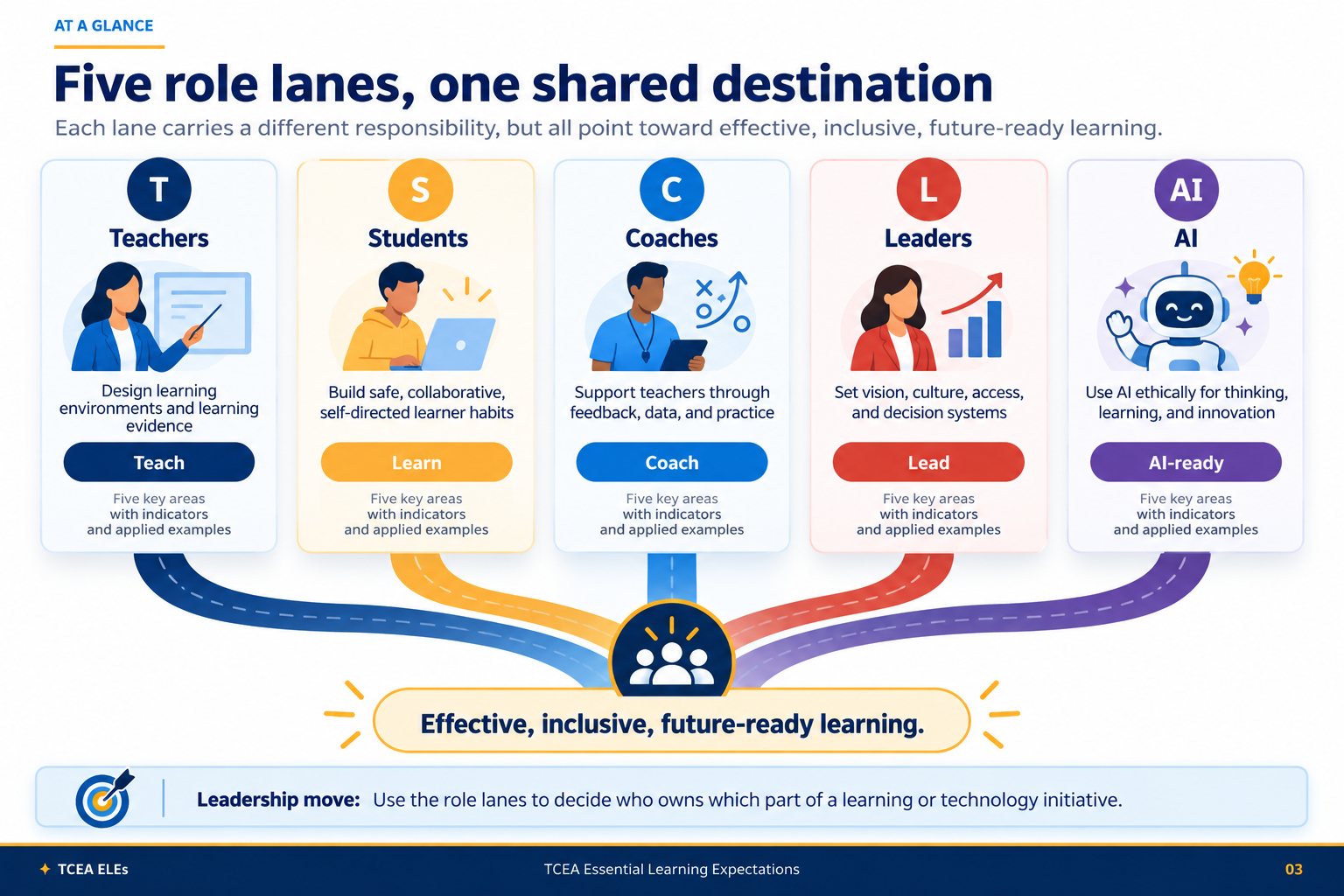
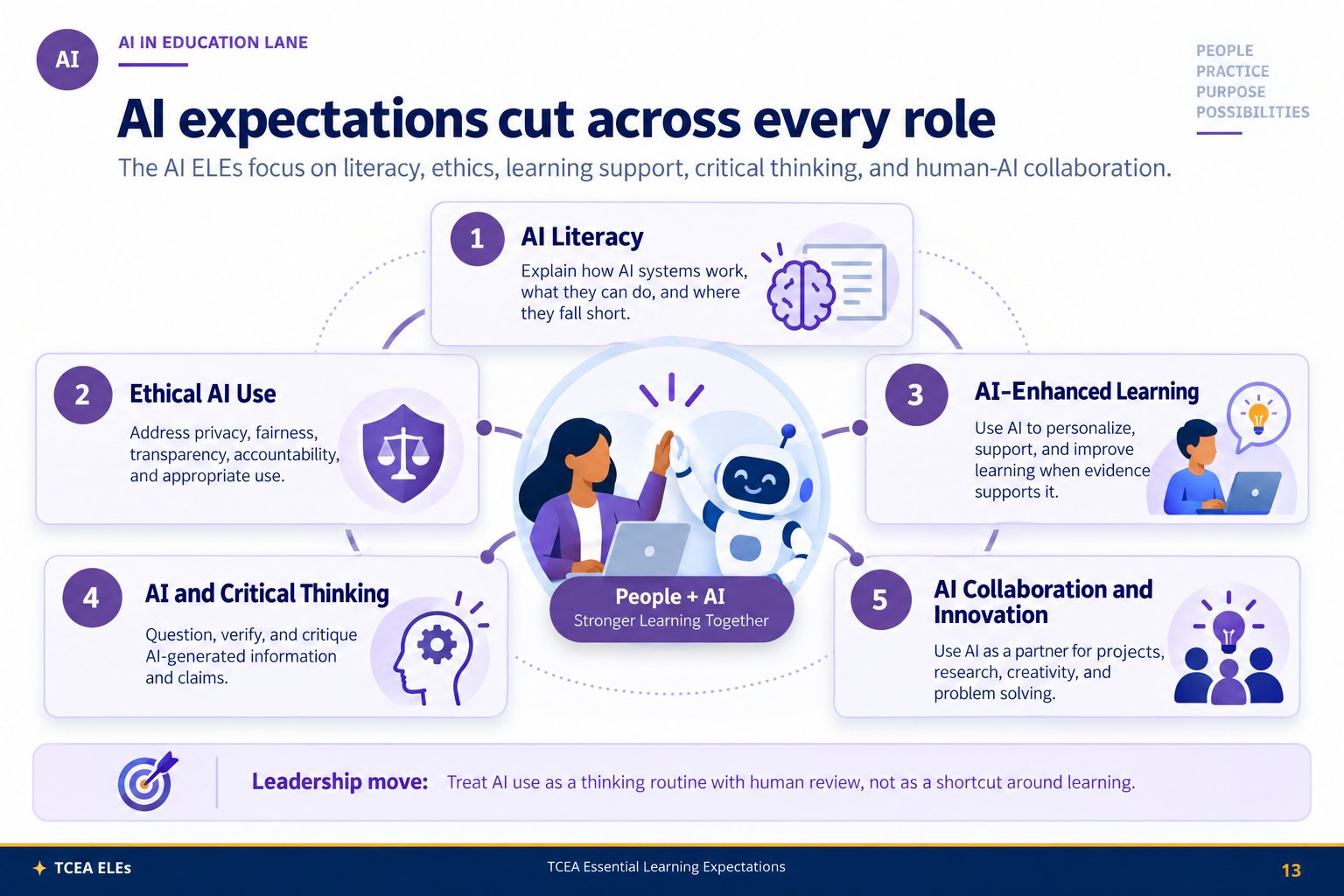
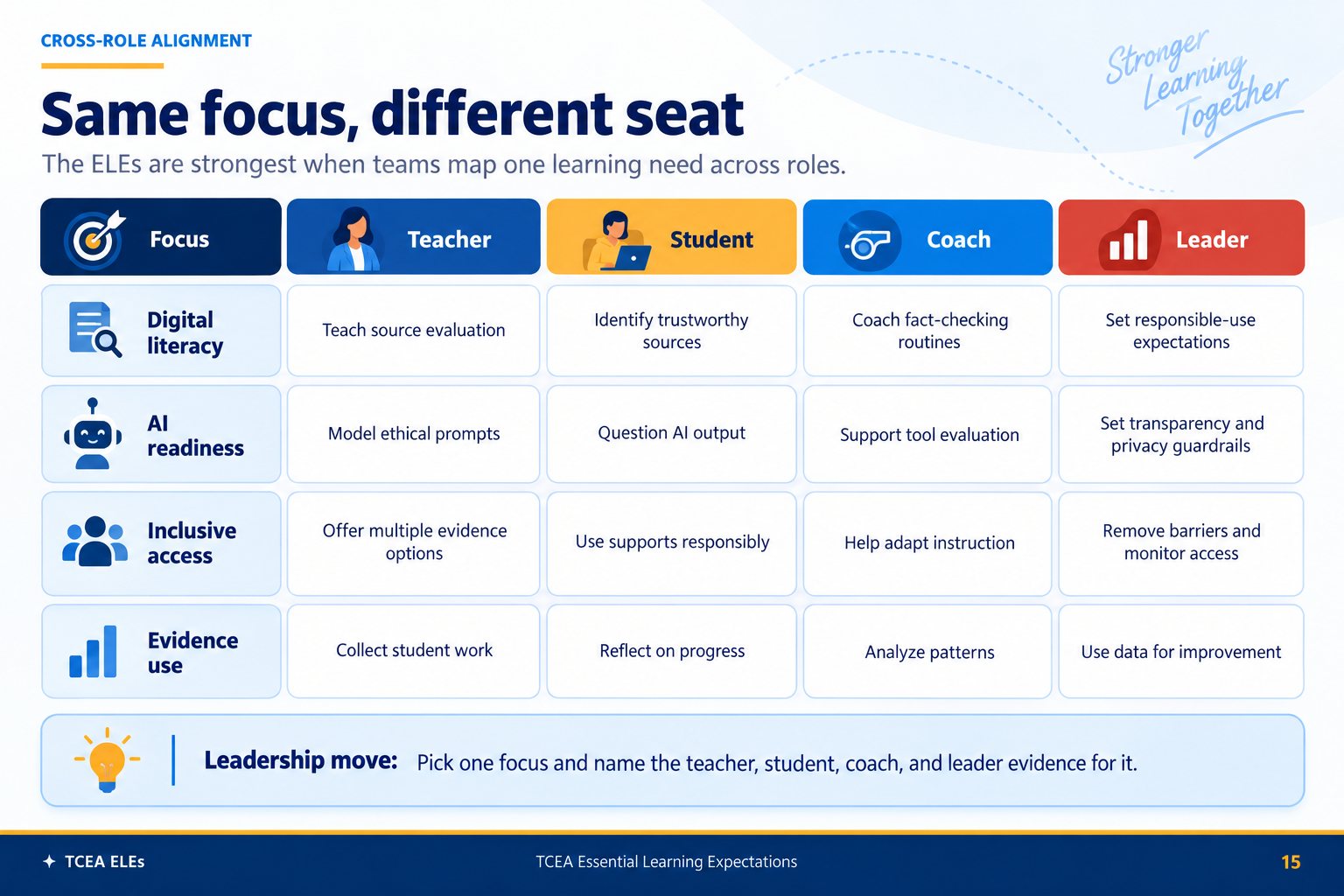
TCEA's ELEs give teachers, students, coaches, school leaders, and anyone working with AI a common language for better learning. Each role has five key areas with three indicators each, written as “I know,” “I can,” and “I am aware.” Below each indicator are the activities in this bank that build it.
See it at a glance
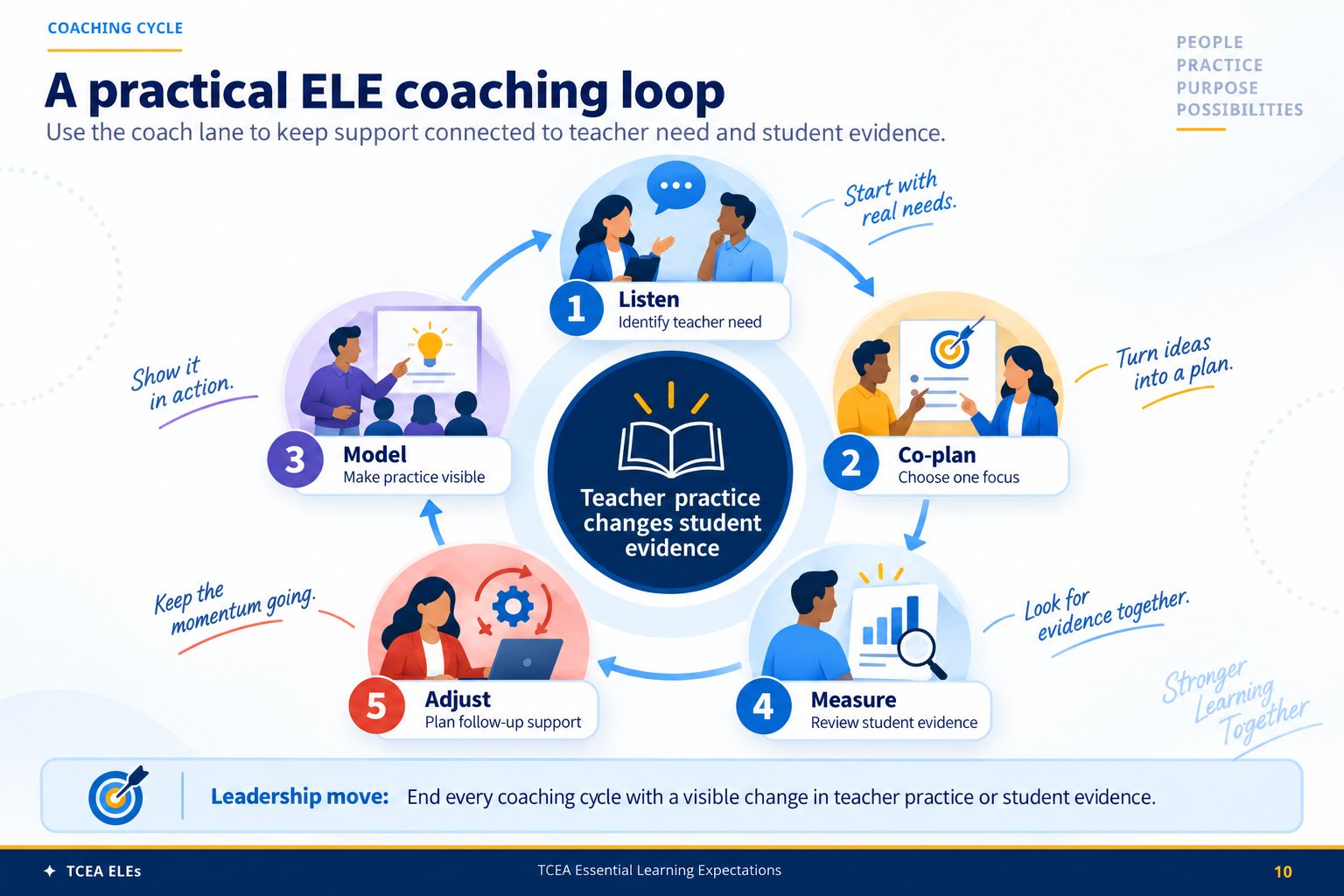
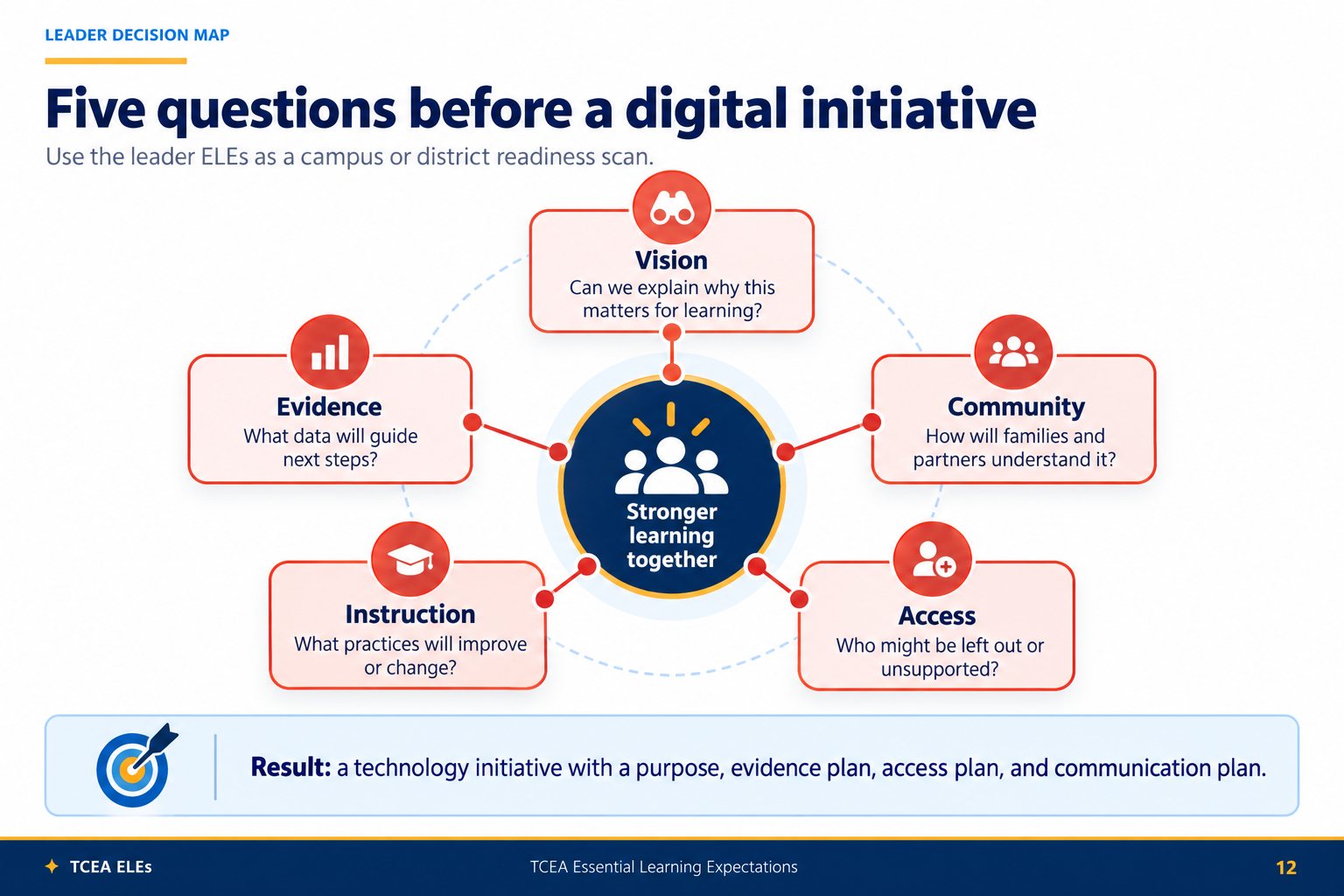
TCEA's infographics for the updated ELEs. Choose one to open it full size.
Teachers & Teacher Librarians
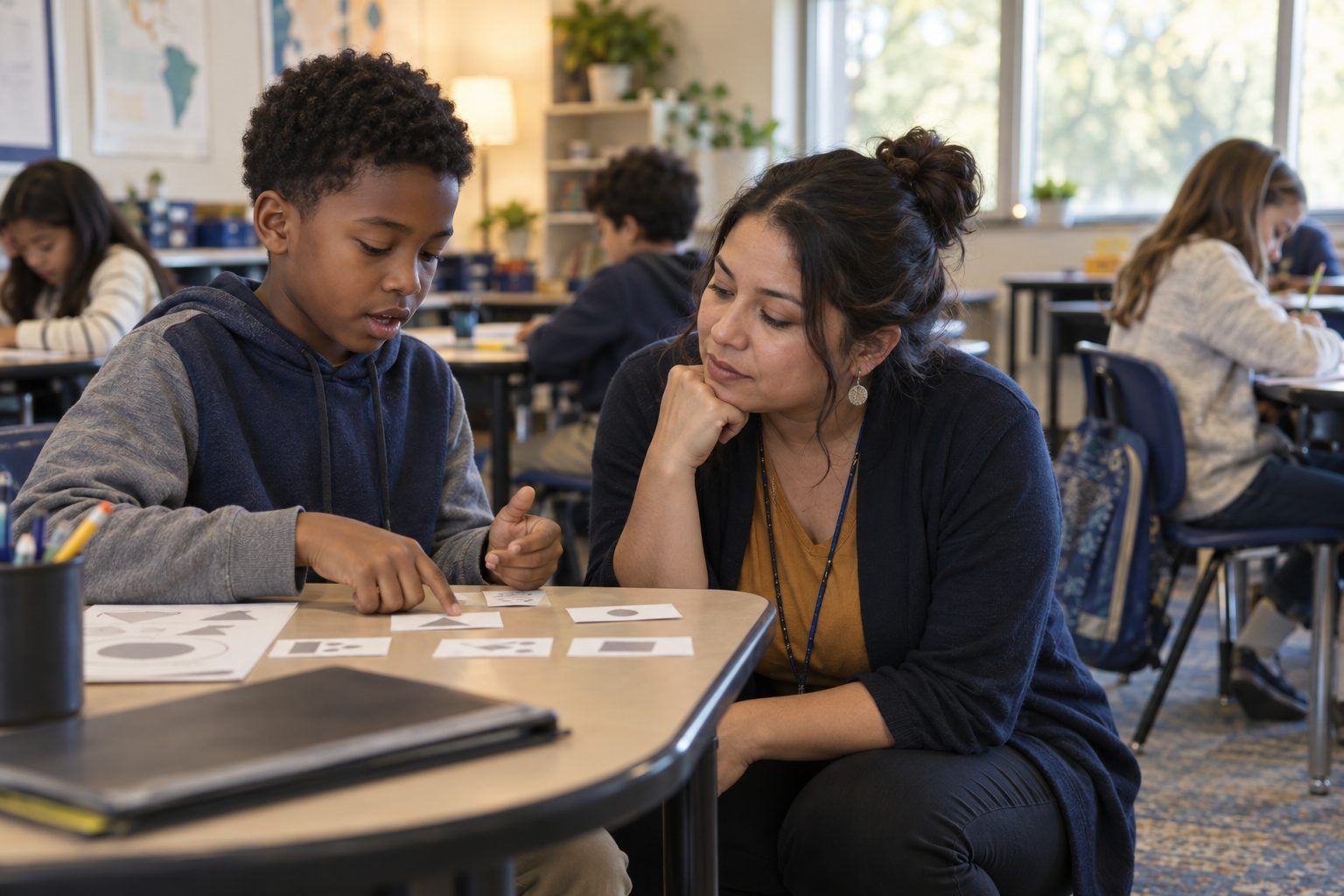
The Essential Learning Expectations for Teachers are designed to guide educators in developing the skills and knowledge necessary for effective, modern teaching. These expectations are grounded in research on best practices in education, including John Hattie's visible learning principles, which emphasize the importance of teacher clarity and feedback. They also incorporate findings from studies on technology integration, culturally responsive teaching, and the development of critical thinking skills. By focusing on areas such as tech integration, digital literacy, inclusive teaching, relationship building, and critical thinking, these ELEs aim to equip teachers with the tools they need to create engaging, effective, and inclusive learning environments that prepare students for their future.
“The most powerful single influence enhancing achievement is feedback.”
John Hattie
Guiding questions
- What strategies am I using to build positive relationships with my students?
- How am I fostering critical thinking skills in my lessons?
- How effectively am I integrating technology into my teaching practices?
- In what ways am I promoting digital literacy among my students?
- How am I creating an inclusive learning environment that respects diversity?
1.0Technology Integration
- T1.1
I know how to seamlessly integrate technology into my teaching practices.
Example from the ELEs
Students use digital mind-mapping tools to brainstorm and organize ideas for a research project on Texas history.
TEKS: Grade 7 Social Studies TEKS 7.21(A) - "differentiate between, locate, and use valid primary and secondary sources"
- T1.2
I can use AI tools to enhance student learning experiences.
Example from the ELEs
Students use an AI-powered language learning app to practice Spanish conversations, receiving real-time feedback on pronunciation and grammar.
TEKS: Grade 1-5 LOTE TEKS 1.A - "engage in oral and written exchanges of learned material to socialize and to provide and obtain information"
- T1.3
I am aware of emerging technologies and their potential applications in education.
Example from the ELEs
Students use virtual reality headsets to explore the solar system, enhancing their understanding of planetary motion and scale.
TEKS: Grade 6 Science TEKS 6.11(A) - "describe the physical properties, locations, and movements of the Sun, planets, moons, meteors, asteroids, and comets"
2.0Digital Literacy
- T2.1
I can teach students to critically evaluate online information.
Example from the ELEs
Students analyze news articles from various sources about a current event, identifying potential biases and fact-checking claims.
TEKS: Grade 8 English Language Arts TEKS 8.9(C) - "analyze the author's use of print and graphic features to achieve specific purposes"
- T2.2
I know how to guide students in safe and responsible internet use.
Example from the ELEs
Students create digital citizenship posters outlining best practices for online safety and responsible social media use.
TEKS: Grade 6 Technology Applications TEKS 6.2(A) - "demonstrate an understanding of technology concepts"
- T2.3
I am aware of strategies to help students identify and combat misinformation.
Example from the ELEs
Students participate in a "fake news" challenge, where they must identify misleading information in social media posts and explain how to verify facts.
TEKS: Grade 7 English Language Arts TEKS 7.9(F) - "analyze characteristics of multimodal and digital texts"
3.0Inclusive Teaching
- T3.1
I know how to create a welcoming classroom environment for all students.
Example from the ELEs
Teacher creates a multilingual word wall featuring key mathematical terms in the languages represented in the classroom.
TEKS: Grade 3 Mathematics TEKS 3.1(D) - "communicate mathematical ideas, reasoning, and their implications using multiple representations"
- T3.2
I can adapt my teaching methods to accommodate diverse learning needs.
Example from the ELEs
Teacher provides multiple options for demonstrating understanding of a science concept, including written reports, oral presentations, and visual models.
TEKS: Grade 5 Science TEKS 5.2(F) - "communicate valid conclusions in both written and verbal forms"
- T3.3
I am aware of cultural differences and how they impact learning.
Example from the ELEs
Students explore and share cultural perspectives on environmental conservation, relating global issues to local practices.
TEKS: Grade 4 Social Studies TEKS 4.9(A) - "describe ways people have adapted to and modified their environment in Texas"
4.0Relationship Building
- T4.1
I know how to foster positive relationships with my students.
Example from the ELEs
Teacher implements a daily check-in routine where students share their emotional state and any concerns, fostering a supportive classroom community.
TEKS: Grade K-12 Health TEKS 115.16(b)(10)(A) - "practice communication skills in building and maintaining healthy relationships"
- T4.2
I can create opportunities for student collaboration and peer learning.
Example from the ELEs
Students work in pairs to solve complex word problems, explaining their reasoning to each other and providing constructive feedback.
TEKS: Grade 6 Mathematics TEKS 6.1(E) - "create and use representations to organize, record, and communicate mathematical ideas"
- T4.3
I am aware of the importance of emotional support in academic success.
Example from the ELEs
Teacher implements a peer mentoring program where older students support younger ones in reading comprehension strategies.
TEKS: Grade 3 English Language Arts TEKS 3.6(I) - "monitor comprehension and make adjustments such as re-reading, using background knowledge, asking questions, and annotating when understanding breaks down"
5.0Critical Thinking
- T5.1
I know how to design lessons that promote higher-order thinking skills.
Example from the ELEs
Students design and conduct an experiment to test the effect of different variables on plant growth, analyzing results and drawing conclusions.
TEKS: Grade 7 Science TEKS 7.2(E) - "design and implement experimental investigations by making observations, asking well-defined questions, formulating testable hypotheses, and using appropriate equipment and technology"
- T5.2
I can use questioning techniques to stimulate deep learning.
Example from the ELEs
Teacher uses Socratic seminar technique to guide students in analyzing themes in a novel, encouraging them to support their interpretations with textual evidence.
TEKS: Grade 8 English Language Arts TEKS 8.5(H) - "synthesize information to create new understanding"
- T5.3
I am aware of strategies to develop students' problem-solving abilities.
Example from the ELEs
Students participate in a "Shark Tank" style project where they identify a community problem, develop an innovative solution, and present their ideas to a panel.
TEKS: Grade 5 Social Studies TEKS 5.24(B) - "generate and implement a plan for identifying a problem, gathering information, listing and considering options, considering advantages and disadvantages, choosing and implementing a solution, and assessing the effectiveness of the solution"
Students

The Essential Learning Expectations for Students are designed to prepare learners for success in an increasingly complex and interconnected world. These expectations are based on research in cognitive science, educational psychology, and comprehensive skills frameworks. They draw on studies highlighting the importance of digital literacy, self-regulated learning, and problem-solving skills in academic and future career success. The ELEs for students focus on developing technological competence, online safety awareness, collaborative skills, self-directed learning abilities, and creative problem-solving capabilities. By mastering these competencies, students will be better equipped to navigate the complexities of modern life and become lifelong learners.
“Visible Learning occurs when teachers see learning through the eyes of students and help them become their own teachers.”
John Hattie
Guiding questions
- Am I trying my best to learn on my own?
- Do I use what I learn to fix problems in real life?
- How well do I work with others when we learn together?
- Am I good at using different tools and computers to help me learn?
- Do I stay safe and make good choices when I use the internet?
1.0Tech Savvy
- S1.1
I know how to use technology to support my learning.
Example from the ELEs
Students create a digital portfolio showcasing their best work across multiple subjects, using various multimedia elements.
TEKS: Grade 8 Technology Applications TEKS 1.A - "create and present digital content using appropriate tools and techniques"
- S1.2
I can adapt to new digital tools and platforms.
Example from the ELEs
Students explore and use a new coding platform to create an interactive story, demonstrating adaptability to unfamiliar software.
TEKS: Grade 6 Technology Applications TEKS 4.D - "create interactive documents using modeling, simulation, or concept-mapping software"
- S1.3
I am aware of how AI can assist me in my studies.
Example from the ELEs
Students use AI-powered language translation tools to enhance their understanding of a Spanish text, discussing the benefits and limitations of the technology.
TEKS: Grade 7 LOTE TEKS 3.A - "use resources (that may include technology) in the language and cultures being studied to gain access to information"
2.0Online Safety
- S2.1
I know how to protect my personal information online.
Example from the ELEs
Students create a digital safety plan outlining strategies to protect their personal information on social media and other online platforms.
TEKS: Grade 7 Technology Applications TEKS 2.A - "demonstrate an understanding of technology concepts, including terminology for the use of operating systems, network systems, virtual systems, and learning systems appropriate for Grades 6-8 learning"
- S2.2
I can identify trustworthy sources of information on the internet.
Example from the ELEs
Students evaluate a set of websites on a historical topic, ranking them based on credibility and explaining their reasoning.
TEKS: Grade 8 Social Studies TEKS 29.B - "analyze information by sequencing, categorizing, identifying cause-and-effect relationships, comparing, contrasting, finding the main idea, summarizing, making generalizations and predictions, and drawing inferences and conclusions"
Ad or Info?Algorithm AutopsyAsk TwoCart Check: Shopping and Money Scams OnlineDeepfake Election DeskHallucination HuntIs This Health Advice Real?Photo DetectivePrimary Source vs. AI SummaryReal, Fake, or Generated?Real, Pretend, or Changed?Real, Remixed, or Made Up?Signal to Headline LabThe Feed GameWho Made This? - S2.3
I am aware of the potential risks of sharing content online.
Example from the ELEs
Students participate in a role-playing activity where they make decisions about sharing various types of content online and discuss potential consequences.
TEKS: Grade 6 Health TEKS 22.B - "explain the importance of taking responsibility for establishing and implementing health maintenance for individuals and family members of all ages"
Data Trail AuditDigital Footprint TrailKind ClicksMy Digital Safety PlanNews From the Future CirclePassword Power & Secret KeepersPhish Tank IRLPhoto DetectivePrivate or Share?Real, Fake, or Generated?Remix RightsSignal to Headline LabSmart Speakers, Smart ChoicesThe Feed GameWhat Your Map App Knows
3.0Collaborative Learner
- S3.1
I know how to work effectively in a team.
Example from the ELEs
Students collaborate on a group science project, using online tools to assign roles, set deadlines, and track progress.
TEKS: Grade 7 Science TEKS 3.D - "construct tables and graphs, using repeated trials and means, to organize data and identify patterns"
- S3.2
I can communicate my ideas clearly to others.
Example from the ELEs
Students create and deliver a persuasive speech on a current events topic, incorporating multimedia elements to enhance their message.
TEKS: Grade 8 English Language Arts TEKS 1.C - "give a presentation using informal, formal, and technical language effectively to meet the needs of audience, purpose, and occasion"
- S3.3
I am aware of the value of diverse perspectives in group work.
Example from the ELEs
Students participate in a cultural exchange project, collaborating with peers from different backgrounds to create a presentation on global citizenship.
TEKS: Grade 6 Social Studies TEKS 23.A - "explain and give examples of how different groups of people view cultures, places, and regions differently"
4.0Self-Directed Learner
- S4.1
I know how to take responsibility for my own learning.
Example from the ELEs
Students create and maintain a learning journal, reflecting on their progress and identifying areas for improvement across subjects.
TEKS: Grade 7 English Language Arts TEKS 6.A - "establish purpose for reading assigned and self-selected texts"
- S4.2
I can set achievable goals and monitor my progress.
Example from the ELEs
Students use a digital tool to set SMART goals for their math performance, regularly updating their progress and adjusting strategies as needed.
TEKS: Grade 8 Mathematics TEKS 1.A - "apply mathematics to problems arising in everyday life, society, and the workplace"
- S4.3
I am aware of my learning strengths and areas for improvement.
Example from the ELEs
Students complete a learning styles assessment and create a personalized study plan that leverages their strengths and addresses areas for growth.
TEKS: Grade 6 Health TEKS 16.A - "analyze critical-thinking skills for making health-promoting decisions"
5.0Creative Problem Solver
- S5.1
I know how to approach complex problems systematically.
Example from the ELEs
Students use the engineering design process to develop a solution for reducing plastic waste in their school cafeteria.
TEKS: Grade 7 Science TEKS 3.A - "analyze, evaluate, and critique scientific explanations by using empirical evidence, logical reasoning, and experimental and observational testing"
- S5.2
I can use creativity and logic to find innovative solutions.
Example from the ELEs
Students participate in a "Shark Tank" style competition, developing and pitching innovative products to address local community issues.
TEKS: Grade 8 Technology Applications TEKS 6.D - "evaluate technologies and assess their applicability to address personal and workplace needs"
- S5.3
I am aware of how to apply computational thinking in various subjects.
Example from the ELEs
Students use block-based programming to create a simulation of a historical event, demonstrating how computational thinking can be applied to social studies.
TEKS: Grade 6 Technology Applications TEKS 4.G - "use the basic concepts of color theory, including primary, secondary, warm, cool, and complementary colors, to solve design problems"
School Leaders & Administrators
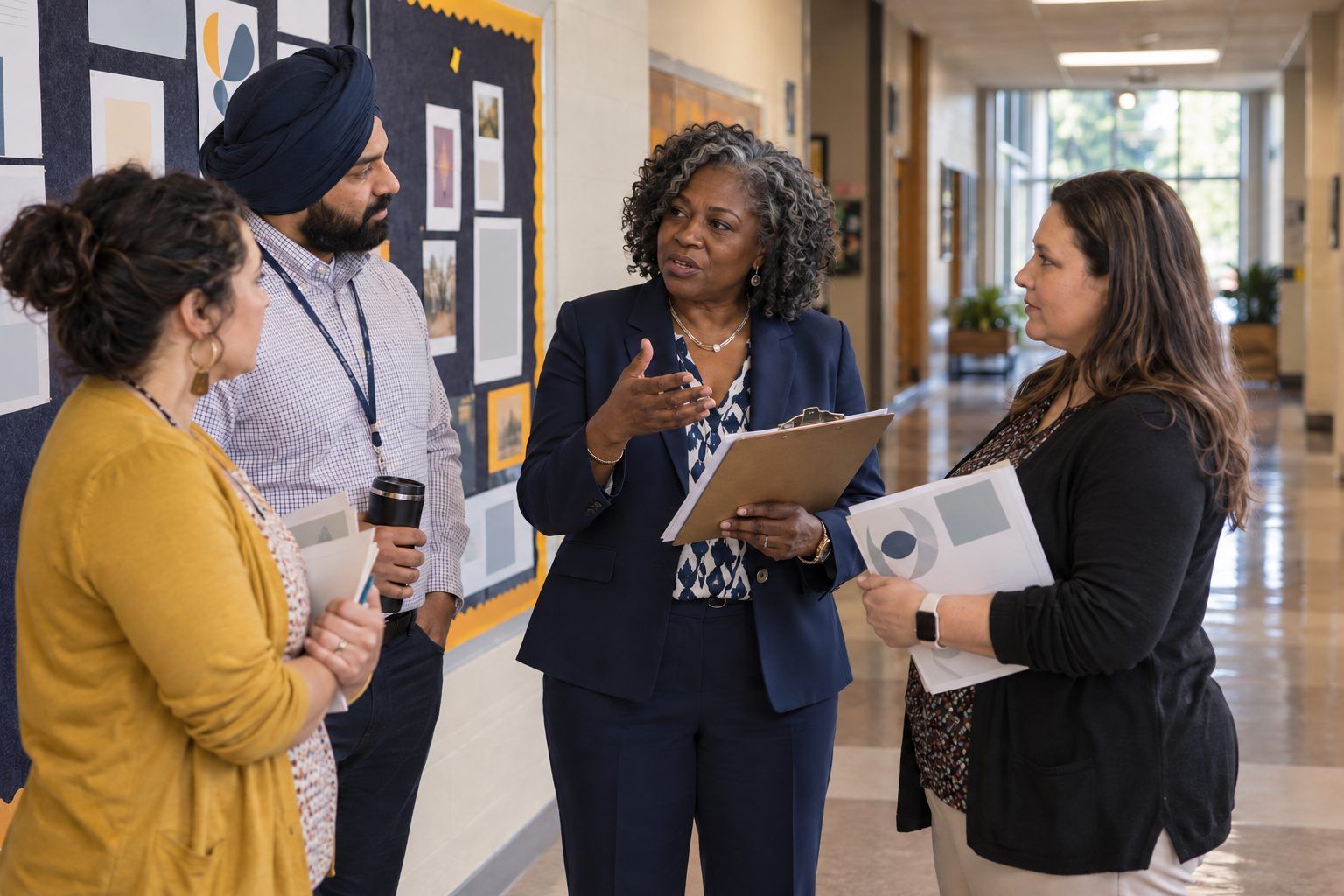
The Essential Learning Expectations for School Leaders and Administrators in Technology are designed to guide educational leaders in leveraging technology to create innovative, effective, and future-ready schools. These expectations are grounded in research on technology integration in education, digital leadership, and the impact of educational technology on student achievement. They incorporate findings from studies on data-driven decision making using technology, digital community engagement, and the role of emerging technologies in school improvement. By focusing on visionary technology leadership, technology-enhanced instruction, data-informed decision making with digital tools, fostering a digital learning culture, and technology-enabled community engagement, these ELEs aim to equip school leaders with the knowledge and skills needed to navigate the complex digital landscape of modern education and drive continuous technological improvement in their schools.
“The most important single factor influencing learning is what the learner already knows.”
David Ausubel
Guiding questions
- What steps am I taking to create an inclusive and positive digital learning culture?
- How effectively am I leveraging technology to engage with our school community and external stakeholders?
- How clearly have I articulated and communicated our school's vision for technology integration?
- In what ways am I supporting and evaluating effective use of educational technology across our school?
- How am I using digital tools and data analytics to drive school improvement efforts and decision-making?
1.0Visionary Technology Leadership
- L1.1
I know how to create and communicate a compelling vision for technology integration in the school.
Example from the ELEs
Administrator develops and presents a comprehensive technology integration plan to the school board, highlighting how it aligns with district goals and prepares students for future careers.
TEA Principal Standards: Standard 1 - Instructional Leadership: (A) ensure the vision, mission, goals, and values of the school are collaboratively developed, widely communicated, and aligned with state goals
- L1.2
I can develop strategic technology plans that align with educational trends and community needs.
Example from the ELEs
Administrator conducts a needs assessment involving teachers, students, and parents to inform a 3-year technology plan that addresses identified gaps and leverages community resources.
TEA Principal Standards: Standard 3 - Executive Leadership: (A) assess current needs of the campus, analyzing a wide set of evidence to determine the campus's priorities, and set measurable school goals, targets, and strategies that form the campus's strategic plan
- L1.3
I am aware of emerging educational technologies and their potential impact on teaching and learning.
Example from the ELEs
Administrator attends educational technology conferences and organizes staff professional development sessions on emerging technologies like AI and augmented reality in education.
TEA Principal Standards: Standard 5 - Strategic Operations: (A) outline and track clear goals, targets, and strategies aligned to a school vision that continuously improves teacher effectiveness and student outcomes
2.0Technology-Enhanced Instructional Leadership
- L2.1
I know how to support and evaluate effective technology integration practices.
Example from the ELEs
Administrator develops a technology integration rubric and conducts regular classroom observations to provide feedback on effective tech use in instruction.
TEA Principal Standards: Standard 1 - Instructional Leadership: (D) ensure implementation of appropriate curricula and assessments that are designed to meet the needs of all students
- L2.2
I can guide the implementation of digital curriculum and instructional technology initiatives.
Example from the ELEs
Administrator leads a committee to select and implement a new learning management system, providing training and support for staff throughout the process.
TEA Principal Standards: Standard 2 - Human Capital: (F) support and retain effective teachers by providing ongoing coaching and mentoring
- L2.3
I am aware of research-based approaches to technology-enhanced pedagogy and their applications.
Example from the ELEs
Administrator organizes a professional learning community focused on exploring and implementing research-based technology-enhanced teaching strategies.
TEA Principal Standards: Standard 1 - Instructional Leadership: (B) prioritize instruction and student achievement by understanding, sharing, and promoting a clear definition of high-quality instruction based on best practices
3.0Data-Informed Decision Making with Digital Tools
- L3.1
I know how to use digital data tools to drive school improvement efforts.
Example from the ELEs
Administrator implements a data dashboard system to track key performance indicators and uses insights to inform resource allocation and improvement strategies.
TEA Principal Standards: Standard 1 - Instructional Leadership: (H) monitor multiple forms of student data to inform instructional and intervention decisions
- L3.2
I can interpret complex digital data sets and communicate findings effectively using data visualization tools.
Example from the ELEs
Administrator creates and presents data visualizations to the school board and staff, illustrating trends in student achievement and areas for improvement.
TEA Principal Standards: Standard 3 - Executive Leadership: (B) prioritize, frame, and solve problems using effective problem-solving techniques and decision-making skills
- L3.3
I am aware of various digital assessment tools and their appropriate uses in education.
Example from the ELEs
Administrator leads a task force to evaluate and select appropriate digital formative assessment tools for different subject areas and grade levels.
TEA Principal Standards: Standard 5 - Strategic Operations: (D) implement systems to align resources with the needs of the school and effectively manage the school budget
4.0Fostering a Digital Learning Culture
- L4.1
I know how to create a positive and inclusive digital learning climate.
Example from the ELEs
Administrator implements a digital citizenship program and organizes events to celebrate responsible technology use and digital creativity.
TEA Principal Standards: Standard 3 - Executive Leadership: (C) communicate with all audiences and develop productive relationships
- L4.2
I can develop policies that support equitable access to technology and digital resources.
Example from the ELEs
Administrator works with the district to implement a 1:1 device program and ensures all students have internet access for remote learning.
TEA Principal Standards: Standard 4 - School Culture: (A) establish and implement a shared vision of high achievement for all students and use that vision as the foundation for key decisions and priorities for the school
- L4.3
I am aware of strategies to address digital divides and promote responsible technology use.
Example from the ELEs
Administrator partners with local businesses and organizations to provide technology resources and training for underserved families in the school community.
TEA Principal Standards: Standard 5 - Strategic Operations: (B) organize curriculum and instruction to align with the school's goals and state accountability system
5.0Technology-Enabled Community Engagement
- L5.1
I know how to build strong digital partnerships with families and community organizations.
Example from the ELEs
Administrator establishes an online platform for parent-teacher communication and collaboration with local businesses for internship opportunities.
TEA Principal Standards: Standard 4 - School Culture: (F) implement a system that promotes the sharing of critical information about students and staff to improve outcomes for students
- L5.2
I can effectively use digital communication tools to share school goals and achievements with stakeholders.
Example from the ELEs
Administrator creates a monthly digital newsletter and maintains an active social media presence to keep the community informed about school initiatives and successes.
TEA Principal Standards: Standard 3 - Executive Leadership: (C) communicate with all audiences and develop productive relationships
- L5.3
I am aware of strategies to leverage online community resources to support student learning.
Example from the ELEs
Administrator develops a virtual mentorship program connecting students with local professionals in various career fields.
TEA Principal Standards: Standard 5 - Strategic Operations: (C) facilitate the use of technology to support teaching and learning and efficient school operations
Instructional Coaches
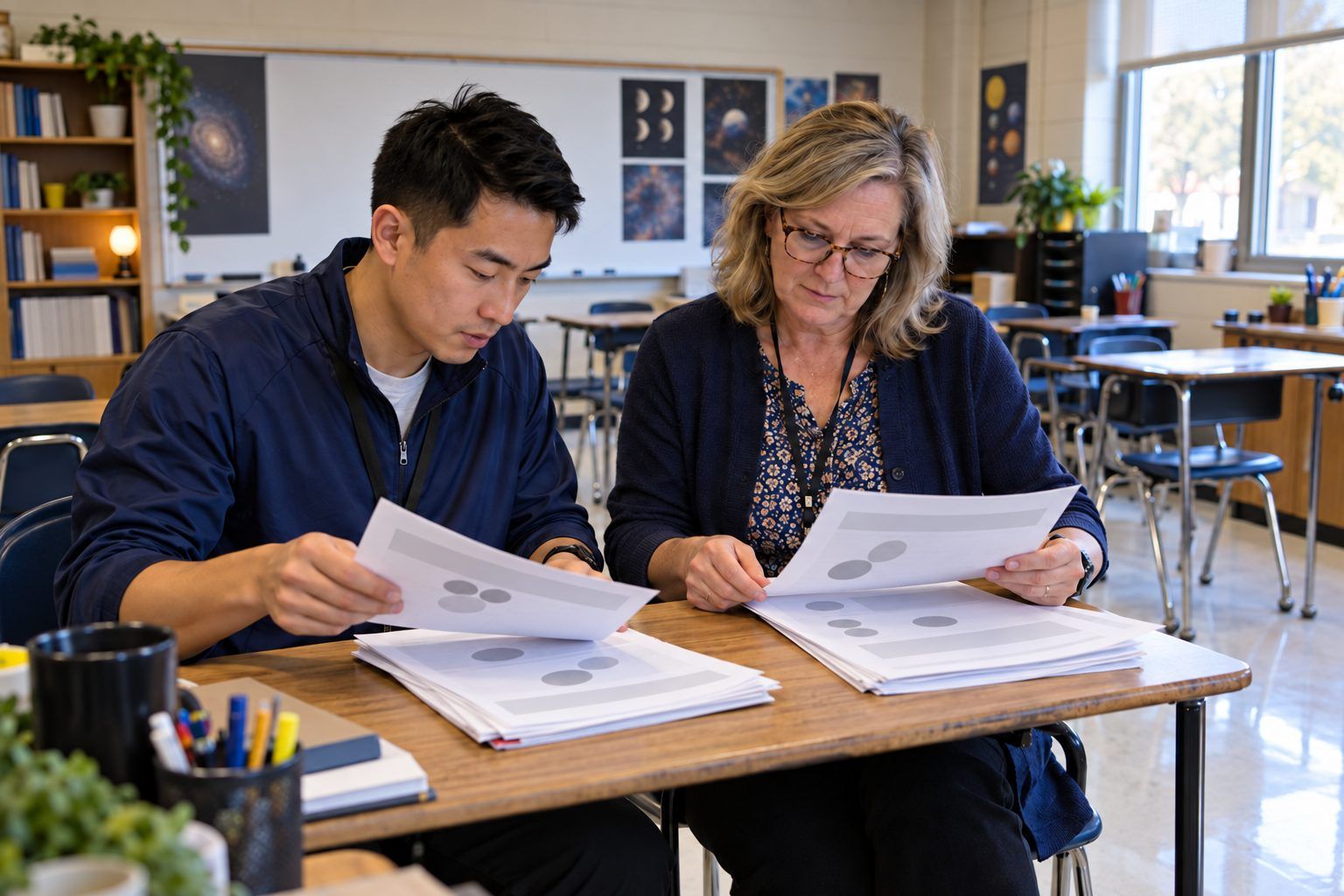
The Essential Learning Expectations for Instructional Coaches are crafted to enhance the effectiveness of educational support professionals in their critical role of improving teaching and learning. These expectations are rooted in research on adult learning theory, professional development best practices, and the impact of instructional coaching on teacher performance and student outcomes. Drawing from studies on effective coaching models and data-driven decision making in education, these ELEs focus on teacher support, technology integration, data-driven coaching, professional development, and collaborative leadership. By adhering to these expectations, instructional coaches can more effectively guide teachers in improving their practice and ultimately enhance student learning experiences.
“Every student deserves a great teacher, not by chance, but by design.”
John Hattie
Guiding questions
- How effectively am I supporting teachers in improving their instructional practices?
- How am I using data to inform and guide my coaching practices?
- How effective are my professional development initiatives in addressing teachers' needs?
- To what extent am I fostering a collaborative culture among the educators I work with?
- In what ways am I helping teachers meaningfully integrate technology into their teaching?
1.0Teacher Support
- C1.1
I know how to mentor teachers in effective instructional practices.
Example from the ELEs
Coach conducts a cycle of pre-observation, observation, and post-observation conferences with a new teacher, focusing on implementing differentiated instruction strategies.
TEA Principal Standards: Standard 1 - Instructional Leadership: (B) prioritize instruction and student achievement by developing and sharing a clear definition of high-quality instruction based on best practices
- C1.2
I can provide constructive feedback to improve teaching strategies.
Example from the ELEs
Coach uses video analysis to provide specific, actionable feedback on a teacher's questioning techniques and wait time during class discussions.
TEA Principal Standards: Standard 2 - Human Capital: (F) support and retain effective teachers by providing ongoing coaching and mentoring
- C1.3
I am aware of the latest educational research and best practices.
Example from the ELEs
Coach organizes a monthly journal club where teachers discuss recent research articles on effective teaching practices and brainstorm ways to apply findings in their classrooms.
TEA Principal Standards: Standard 1 - Instructional Leadership: (H) monitor multiple forms of student data to inform instructional and intervention decisions
2.0Technology Integration
- C2.1
I know how to guide teachers in meaningful technology integration.
Example from the ELEs
Coach co-plans and co-teaches a lesson with a math teacher, demonstrating how to effectively use interactive geometry software to enhance student understanding of complex concepts.
TEA Principal Standards: Standard 5 - Strategic Operations: (C) facilitate the use of technology to support teaching and learning and efficient school operations
- C2.2
I can evaluate the effectiveness of educational technology tools.
Example from the ELEs
Coach leads a team of teachers in conducting a systematic review of various learning management systems, using a rubric to assess their alignment with curriculum goals and ease of use.
TEA Principal Standards: Standard 3 - Executive Leadership: (B) prioritize, frame, and solve problems using effective problem-solving techniques and decision-making skills
- C2.3
I am aware of emerging technologies and their potential in education.
Example from the ELEs
Coach organizes a "Tech Showcase" where teachers can explore and evaluate new educational technologies, such as AI writing assistants and virtual reality applications.
TEA Principal Standards: Standard 5 - Strategic Operations: (A) outline and track clear goals, targets, and strategies aligned to a school vision that continuously improves teacher effectiveness and student outcomes
3.0Data-Driven Coaching
- C3.1
I know how to use data to inform instructional decisions.
Example from the ELEs
Coach facilitates a data team meeting where teachers analyze student performance on common assessments to identify trends and plan targeted interventions.
TEA Principal Standards: Standard 1 - Instructional Leadership: (H) monitor multiple forms of student data to inform instructional and intervention decisions
- C3.2
I can help teachers interpret and act on assessment results.
Example from the ELEs
Coach works one-on-one with a teacher to analyze formative assessment data and develop differentiated small group instruction plans based on student needs.
TEA Principal Standards: Standard 4 - School Culture: (F) implement a system that promotes the sharing of critical information about students and staff to improve outcomes for students
- C3.3
I am aware of various data collection and analysis tools.
Example from the ELEs
Coach leads a professional development session on using digital formative assessment tools and data visualization software to track student progress in real-time.
TEA Principal Standards: Standard 5 - Strategic Operations: (D) implement systems to align resources with the needs of the school and effectively manage the school budget
4.0Professional Development
- C4.1
I know how to design and deliver effective professional development sessions.
Example from the ELEs
Coach designs and facilitates a series of workshops on project-based learning, incorporating hands-on activities and peer collaboration to model effective instructional strategies.
TEA Principal Standards: Standard 2 - Human Capital: (D) ensure all staff have opportunities to participate in and grow through professional learning communities aligned with the school's improvement plan
- C4.2
I can identify and address teachers' individual learning needs.
Example from the ELEs
Coach conducts individual needs assessments with teachers and creates personalized professional growth plans tailored to each teacher's goals and areas for improvement.
TEA Principal Standards: Standard 2 - Human Capital: (E) implement effective, appropriate, and legal strategies for the recruitment, hiring, assignment, and retention of highly effective staff
- C4.3
I am aware of adult learning principles and how to apply them.
Example from the ELEs
Coach redesigns the school's new teacher orientation program to incorporate more active learning strategies, peer mentoring, and ongoing support throughout the year.
TEA Principal Standards: Standard 4 - School Culture: (A) establish and implement a shared vision of high achievement for all students and use that vision as the foundation for key decisions and priorities for the school
5.0Collaborative Leadership
- C5.1
I know how to foster a collaborative culture among educators.
Example from the ELEs
Coach establishes and facilitates cross-curricular professional learning communities focused on improving student literacy skills across all subject areas.
TEA Principal Standards: Standard 4 - School Culture: (C) create a positive, collaborative, and equitable culture that establishes and communicates high, consistent expectations for all stakeholders and addresses barriers to ensure achievement of campus initiatives
- C5.2
I can facilitate productive discussions and problem-solving sessions.
Example from the ELEs
Coach leads a root cause analysis session with a grade-level team to address persistent behavior issues, guiding teachers through a structured problem-solving process.
TEA Principal Standards: Standard 3 - Executive Leadership: (B) prioritize, frame, and solve problems using effective problem-solving techniques and decision-making skills
- C5.3
I am aware of strategies to build trust and promote teamwork.
Example from the ELEs
Coach organizes team-building activities and establishes norms for respectful communication and collaboration during department meetings and professional development sessions.
TEA Principal Standards: Standard 3 - Executive Leadership: (C) communicate with all audiences and develop productive relationships
AI in Education

The Essential Learning Expectations for AI in Education are designed to guide all stakeholders in the educational system - teachers, students, instructional coaches, and administrators - in the ethical and effective use of AI technologies. These expectations build upon existing educational research and best practices, while addressing the unique challenges and opportunities presented by AI in learning environments.
“The goal of AI is to create machines that can, in turn, create.”
Ray Kurzweil
Guiding questions
- How am I developing and applying AI literacy in educational contexts?
- In what ways am I addressing ethical considerations when using AI in learning and teaching?
- How am I leveraging AI to personalize and enhance learning experiences?
- What strategies am I employing to promote critical thinking skills when interacting with AI-generated information?
- How am I fostering collaboration between humans and AI systems in educational projects and research?
1.0AI Literacy
- AI1.1
I know how AI systems work and their capabilities in educational contexts.
Example from the ELEs
Students create a simple machine learning model to predict plant growth based on different environmental factors, discussing the model's strengths and limitations.
TEKS: Grade 8 Science TEKS 8.11(A) - "investigate how organisms and populations in an ecosystem depend on and may compete for biotic factors such as food and abiotic factors such as quantity of light, water, range of temperatures, or soil composition"
- AI1.2
I can explain AI concepts in simple terms to various stakeholders.
Example from the ELEs
Teachers develop and present a series of short videos explaining how AI is used in everyday technology, sharing these with students and parents.
TEKS: Grade 7 Technology Applications TEKS 1(C) - "explore complex systems or issues using models, simulations, and new technologies to make predictions, modify input, and review results"
- AI1.3
I am aware of the current limitations and potential biases in AI systems.
Example from the ELEs
Students analyze the results of AI-powered language translation software across different languages, discussing potential biases and their implications.
TEKS: Grade 8 English Language Arts TEKS 8.9(F) - "analyze how the author's use of language contributes to mood, voice, and tone"
AI Ethics Case CourtAlgorithm AutopsyBias DetectivesBias in the MachineExplain It to GrandmaHallucination HuntHype Check ShowcaseNews From the Future CircleNext Word, By HandPhoto DetectivePrimary Source vs. AI SummaryRead the Dashboard Before It Reads YouReal, Fake, or Generated?Real, Pretend, or Changed?Robot GuessesSignal to Headline LabSmart Speakers, Smart ChoicesThe Glass Box ChecklistThe Human Language ModelWhose Story Is Missing?
2.0Ethical AI Use
- AI2.1
I know how to apply ethical principles when using or developing AI for education.
Example from the ELEs
Administrators develop an AI ethics policy for the school district, outlining guidelines for data privacy, fairness, and transparency.
TEKS: Grade 6-8 Technology Applications TEKS 5(E) - "adhere to copyright law and the fair use guidelines for the use of digital information"
After the RumorAI Ethics Case CourtAI Study Buddy ContractBias DetectivesCredit Where It's DueDigital Footprint TrailDisclose ItFrom Values to Guidance: Drafting a Campus AI StatementHeadlines From Year ThreeInbox to Impact: Professional Digital CommunicationNever Paste ThisNorms for the AI EraPersonalization with GuardrailsPolicy MakersPresentation MakeoverPrivate or Share?Remix RightsThe AI Critic TankThe Glass Box ChecklistThe Prompt LadderTwo Drafts of FeedbackWait Time on the RecordWhat Do My Apps Know?Who Owns the Output? - AI2.2
I can identify potential ethical issues in AI applications and propose solutions.
Example from the ELEs
Students review scenarios of AI applications in various fields, identifying potential ethical concerns and proposing mitigation strategies.
TEKS: Grade 7 Social Studies TEKS 7.20(E) - "analyze the effects of scientific discoveries and technological innovations on the development of Texas in various industries"
AI Ethics Case CourtBias DetectivesBias in the MachineData Trail AuditDeepfake Election DeskDisclose ItNews From the Future CirclePassword Power & Secret KeepersPhish Tank IRLPolicy MakersRipple Out: A Futures Wheel for LearningThe Five-Question Rollout CheckWho Gets Left Out? Mapping the Digital DivideWho Owns the Output?Whose Story Is Missing? - AI2.3
I am aware of the importance of transparency and accountability in AI systems.
Example from the ELEs
Teachers create a checklist for evaluating the transparency and accountability of AI tools before implementing them in their classrooms.
TEKS: Grade 8 Technology Applications TEKS 6(D) - "evaluate technologies and assess their applicability to address personal and workplace needs"
AI Ethics Case CourtCo-Creation, Not SubstitutionCredit Where It's DueData Trail AuditDisclose ItFour-Lens App ReviewFrom Values to Guidance: Drafting a Campus AI StatementHuman + AI StudioNorms for the AI EraRemix RightsThe AI Critic TankThe Glass Box ChecklistTwo Drafts of FeedbackTwo Grade Levels? Vendor Claims vs. EvidenceWhat Do My Apps Know?Who Made This?
3.0AI-Enhanced Learning
- AI3.1
I know how to leverage AI tools to personalize and enhance learning experiences.
Example from the ELEs
Teachers use an AI-powered adaptive learning platform to create personalized reading comprehension exercises for students.
TEKS: Grade 6 English Language Arts TEKS 6.6(I) - "monitor comprehension and make adjustments such as re-reading, using background knowledge, asking questions, and annotating when understanding breaks down"
- AI3.2
I can evaluate the effectiveness of AI-enhanced learning interventions.
Example from the ELEs
Instructional coaches conduct a study comparing student outcomes between classes using AI-enhanced learning tools and those using traditional methods in mathematics instruction.
TEKS: Grade 7 Mathematics TEKS 7.1(A) - "apply mathematics to problems arising in everyday life, society, and the workplace"
- AI3.3
I am aware of how AI can support diverse learning needs and styles.
Example from the ELEs
Special education teachers explore AI-powered text-to-speech and speech-to-text tools to support students with dyslexia in their writing assignments.
TEKS: Grade 6-8 Technology Applications TEKS 3(D) - "acquire and use appropriate vocabulary for the field of technology and computer science"
4.0AI and Critical Thinking
- AI4.1
I know how to promote critical thinking skills in relation to AI-generated information.
Example from the ELEs
Students compare AI-generated summaries of historical events with primary source documents, analyzing differences in perspective and accuracy.
TEKS: Grade 8 Social Studies TEKS 8.29(B) - "analyze information by sequencing, categorizing, identifying cause-and-effect relationships, comparing, contrasting, finding the main idea, summarizing, making generalizations and predictions, and drawing inferences and conclusions"
Ad or Info?Ask TwoBias DetectivesCart Check: Shopping and Money Scams OnlineCo-Plan in 20Deepfake Election DeskDigital Notebook DetectivesHallucination HuntIs This Health Advice Real?Lateral Reading RelayLook-Fors That Look for LearningNext Word, By HandPersonalization with GuardrailsPhoto DetectivePrimary Source vs. AI SummaryReal, Fake, or Generated?Real, Pretend, or Changed?Seminar on a Machine's AnswerSignal to Headline LabSpreadsheet Sense-MakingStudent Voice Data DiveThe Human Language ModelThe Shallow Answers Coaching CycleVerify the Bot - AI4.2
I can teach others to question and verify AI outputs.
Example from the ELEs
Teachers lead a workshop for colleagues on fact-checking AI-generated content using multiple sources in the context of science education.
TEKS: Grade 7 Science TEKS 7.2(E) - "design and implement experimental investigations by making observations, asking well-defined questions, formulating testable hypotheses, and using appropriate equipment and technology"
- AI4.3
I am aware of strategies to develop AI-related problem-solving skills.
Example from the ELEs
Students participate in an AI challenge, developing algorithms to solve real-world problems in environmental science.
TEKS: Grade 8 Science TEKS 8.3(A) - "design and implement experimental investigations by making observations, asking well-defined questions, formulating testable hypotheses, and using appropriate equipment and technology"
5.0AI Collaboration and Innovation
- AI5.1
I know how to foster collaboration between humans and AI systems.
Example from the ELEs
Teachers and students collaborate to create an AI-powered virtual tutor for mathematics, enhancing personalized learning experiences.
TEKS: Grade 6 Mathematics TEKS 6.1(B) - "use a problem-solving model that incorporates analyzing given information, formulating a plan or strategy, determining a solution, justifying the solution, and evaluating the problem-solving process and the reasonableness of the solution"
- AI5.2
I can use AI as a tool for innovation in educational projects and research.
Example from the ELEs
Students use AI tools to analyze large datasets of Texas wildlife populations, uncovering new insights about local ecosystem changes.
TEKS: Grade 7 Science TEKS 7.8(C) - "model the effects of human activity on groundwater and surface water in a watershed"
- AI5.3
I am aware of the potential of AI to augment human creativity and problem-solving.
Example from the ELEs
Art and computer science teachers collaborate on a project where students use AI-generated prompts as inspiration for original short stories, exploring the intersection of technology and creative writing.
TEKS: Grade 8 English Language Arts TEKS 8.11(A) - "compose literary texts such as personal narratives, fiction, and poetry using genre characteristics and craft"
Framework text from the TCEA Essential Learning Expectations (ELEs), CC-BY-SA 2024, tinyurl.com/tceaeles1. Alignment examples and TEKS/TEA correlations are quoted from the ELE documents.