Professional learningfor Coaches, Teachers, Librarians
Co-Plan in 20
A timed, listening-first protocol a coach and teacher use to redesign one upcoming lesson so students verify an AI answer or evaluate a source, and turn in proof that they did.

All activities Professional learning
Coaches role-play a full listen, co-plan, model, measure, adjust cycle on one familiar problem: students finish the digital work but say very little.
A teacher tells you students are completing every digital activity but their answers are shallow, and some read as if a chatbot wrote them. This simulation walks coaches through a whole coaching cycle on that one case: listening before fixing, co-planning a lesson with fewer questions and more reasoning, modeling a move, and measuring the change in real student work. The cycle ends where the 2026 ELEs say coaching should: "What changed in teacher practice or student evidence?"
Hook
Read two answers from Handout B aloud: Week 1 Sample 2 ("Plants need sunlight to grow so the plant with more light grew more") and Week 3 Sample 2. Ask: "Both students finished the task. Which one gives you evidence of learning, and how do you know?" Take three responses. Say: "Completion was never the problem. Today we coach toward the second answer, one cycle at a time."
Facilitator noteListen for people who reach straight for a new tool or a new rubric. Name that pull gently: it is the urge we practice resisting in the Listen phase.
Explore
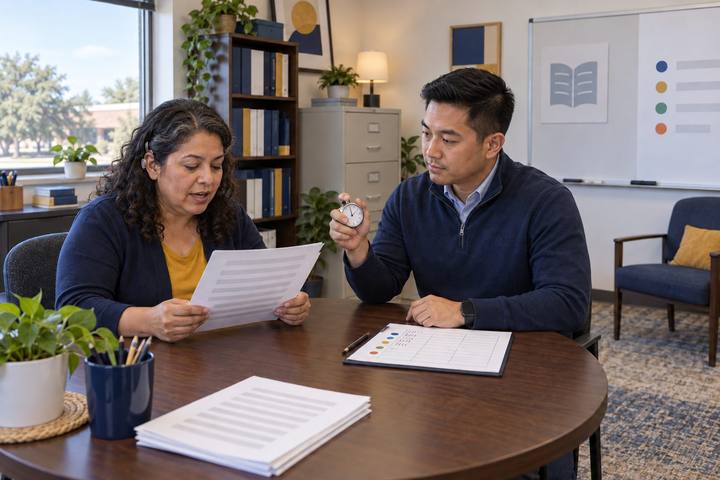
Triads deal the cards: one person takes a Teacher Persona card, one takes the Coach Move: Listen card, one takes the Observer card. The teacher opens with the line on the persona card. The coach may only use the listening stems for six minutes: no suggestions, no tools, no "have you tried." The observer tallies questions vs. suggestions and writes down the teacher's goal in the teacher's own words. Then the observer reports for two minutes and the triad posts one sticky note in the Listen column: "The teacher's real goal is…"
Facilitator noteThe persona cards hide a detail (for example, the teacher suspects students paste chatbot answers but hasn't said so). Good listening surfaces it. If a coach gives advice in the first two minutes, the observer should flag it with a raised hand.
Model
Using Week 1 Sample 4 from Handout B, think aloud as the coach co-planning with the teacher. Say what you notice ("The answer is fluent but never mentions our plant data"), then co-plan out loud: cut the 12-question digital activity to three questions, each requiring a claim, a piece of the class's own data, and a "because" sentence that links them. Add one AI check: students may ask an approved chatbot for an explanation only after they write their own, then must mark one thing the chatbot said that their data supports and one thing it did not. Record the plan on the chart under Co-plan and Model.
Facilitator notePoint out that the revised lesson keeps the device. It changes what the device is used to produce: a visible chain from data to claim.
Practice
Rotate roles. The new coach draws a Coach Move: Co-plan card and a Coach Move: Model card. Using Handout C, the triad co-plans a revision for their persona's lesson (not the science lesson you modeled). The coach then models one move for two minutes as if in front of students: a think-aloud, a sentence frame, or a verification check. The teacher decides what to keep. The observer checks that the plan names what student evidence will look different next week.
Facilitator noteIf a triad writes "students will be more engaged," ask: "What would you see on paper?" Engagement is not the evidence. Claims, reasons, and data references are.
Apply
Everyone reads the Week 3 samples on Handout B, which come from the same class after a revision like the one you modeled. Triads count, for each sample, whether it has a claim, class data, and reasoning that links them, then tally the Week 1 samples the same way. Rotate roles once more: the final coach draws Coach Move: Measure and Adjust and leads a four-minute conversation with the teacher on what changed and what to try next. Post one sticky under Measure and one under Adjust.
Facilitator noteWeek 3 is better, not perfect: Sample 5 still leans on the chatbot's wording, and Sample 3 has data but no reasoning. Strong triads adjust for those two students, not the whole class.
Debrief
Walk the five-column chart from left to right. Ask: "Where did we feel the most pull to skip ahead? What did the listening phase surface that the plan needed?" Then ask the coaching question directly: "What changed in teacher practice, and what changed in student evidence?" Have each triad answer both halves in one sentence each.
Facilitator noteMost rooms discover that the Listen phase is where the AI concern came out. That's worth naming: teachers often raise the problem they are comfortable naming first.
Transfer
Each coach writes the name of one teacher they will start a cycle with in the next two weeks on the back of Handout C, plus the first listening stem they'll use. Teachers in the room write one lesson where they'll trade question volume for reasoning.
Facilitator noteKeep it private. The commitment matters more than sharing it.
This activity is designed to run with no devices. The role-play cards, printed student samples, and the planner carry the whole cycle. The measurement step uses a hand tally on Handout B, which is exactly what a coach and teacher can do at a table with a stack of exit tickets.
In a virtual session, put triads in breakout rooms, share the role-play cards as a slide deck with one card per slide, and give each triad a shared copy of Handout C. Paste the student samples into a document triads can highlight in three colors (claim, data, reasoning). A shared board with the five cycle columns replaces the chart paper.
Does it need a screen? Unplugged is the better default here: the skill is a conversation, and screens pull attention away from the partner. A shared digital planner earns its place only when the real cycle continues over weeks and the coach and teacher need one record of what they tried and what student work showed.
What you should be able to see or collect if it worked.
Coaches co-plan a lesson that trades question volume for claims backed by class data and reasoning, then measure the change in student work.
Start a real cycle with the teacher you named: one listening conversation this week, a co-planned lesson next week, and a 15-minute look at the student work together afterward. Bring the before-and-after tally to your coaching team.