Professional learningfor Coaches, Leaders
Wait Time on the Record
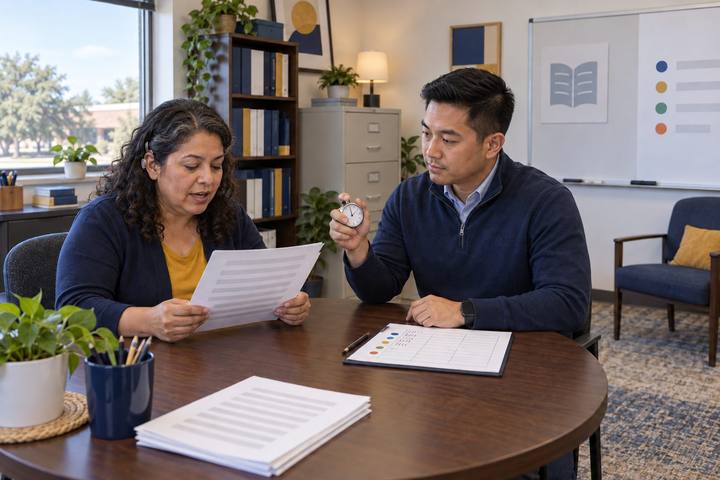
Coaches code a consented, timestamped classroom clip for questioning and wait time, test an AI summary against the timestamps, and write feedback a teacher can act on tomorrow.

All activities Professional learning
Coaches score a human-written and an AI-drafted feedback note on the same lesson transcript, then set the ground rules for when AI belongs in observation, if it belongs at all.
Generative AI can turn a lesson transcript into a tidy feedback note in seconds, and some coaching platforms now offer to do it automatically. Coaches in this session read a short fictional transcript, score two unlabeled feedback drafts against a quality checklist, and guess which one a chatbot wrote. The reveal sets up the harder conversation: consent, student privacy, transparency with the teacher, and the line between an AI draft and a coach's judgment.
Hook
Project the first two sentences of Draft X and Draft Y side by side. Ask everyone to vote with a hand: "Which draft came from a chatbot?" Don't reveal. Say: "Hold that guess. By the end, you'll see why the more important question is not who wrote it, but whether it's true and useful to this teacher."
Facilitator noteRooms usually split or lean toward the more polished draft as the human one. Either way, the guess isn't the learning.
Explore
Everyone reads the transcript on Handout A and highlights, in one color, every moment where a student explains their thinking. Then pairs score Draft X and Draft Y separately with Handout B. For every "Yes," they must point to a line in the transcript that proves it. Pairs write their guess about authorship at the bottom of each checklist.
Facilitator noteLook-for: pairs who go back to the transcript to check a claim in the feedback. That is the same verification habit we want teachers to teach with AI outputs.
Model
Reveal that Draft Y was AI-drafted from the transcript and the teacher's goal. Model tracing its claims out loud: "It praises the turn-and-talk at the start. Let me find it. There is no turn-and-talk in the transcript." Then trace Draft X the same way and name its flaw too: specific and accurate, but it offers three next steps when a teacher can act on one. Ask: "Which draft would help Mr. Delgado more on Monday, and what would you change in each?"
Facilitator noteDon't let this become "AI bad, human good." Draft Y also caught the short wait time, which is real. The point is that the coach owns every sentence the teacher reads.
Practice
Tables sort the Handout C strips onto three categories: Reasonable with consent and disclosure, Only with added guardrails, and Don't do it. For every strip in the middle column, the table must name the guardrail on a sticky note (for example, "remove student names first" or "teacher sees the AI draft and the coach's edits"). Then tables compare with the facilitator key.
Facilitator noteExpect debate on recording video for AI analysis. Surface who has to consent: the teacher, and, when students can be heard or seen, the district's policy on student recordings and families. When in doubt, it belongs in the middle or right column.
Apply
Pairs write a new three-sentence note: one specific strength with evidence, one observation tied to his goal, and one next step. Digital path: the facilitator projects an approved chatbot, pastes the fictional transcript, and asks for a draft; pairs then mark which sentences they would keep, fix, or delete and why. Unplugged path: pairs revise Draft Y by hand into something they would sign.
Facilitator noteAsk a pair or two to read their note aloud. Listen for whether the next step is something he can try in one lesson.
Reflect
Each person finishes this on the back of Handout B: "When I use AI in my coaching, I will tell teachers…" Invite three people to share. Close with the coaching question: "If you used AI to draft feedback, what would change in teacher practice that wouldn't have changed otherwise?"
Facilitator noteStrong disclosure sentences name what data goes in, who sees the draft, and who makes the final call.
Run the whole session on paper: the transcript, both drafts, the checklist, and the sort carry every step. In the Apply step, pairs revise Draft Y by hand instead of watching a live AI draft. Revising a machine draft on paper makes the coach's editorial judgment very visible.
Project the transcript and the drafts, and put the checklist in a shared form so you can show the room's scores for each draft live. For the Apply step, the facilitator runs an approved chatbot on the projector with the fictional transcript only. In a virtual session, run the sort as a drag-and-drop board with three columns.
Does it need a screen? The live AI draft shows coaches how fast and how confident the output is, including invented details, which is exactly what they need to see before any platform offers to automate it. The paper path teaches the scoring and ethics equally well.
What you should be able to see or collect if it worked.
Coaches trace AI-drafted feedback against a transcript and sort observation AI uses by consent and privacy, modeling data protection students also learn.
Before your next observation, share your disclosure sentence with the teacher and agree on whether any AI tool will touch the notes. After the debrief, ask the teacher which single sentence of your feedback they acted on.