Student learningfor Grades 9–12, Higher Ed
Hallucination Hunt
Students trace every claim and citation in a polished AI research brief and discover which ones lead somewhere and which ones lead nowhere.
All activities Student learning
A confident robot helper says things that are sometimes right and sometimes wrong, and children become learning owners by checking each answer in two places before they believe it.
Talking speakers, apps, and AI chatbots answer children's questions in a friendly, sure-sounding voice. Sounding sure is not the same as being right. In this lesson, Robo Helper (you, reading answer cards, plus an optional projected AI chatbot) gives answers to simple science and everyday questions. Pairs pick up a card and Ask Two: they check it at two of three stations (Book Nook, Look and See, Grown-Up Desk) before deciding right, wrong, or not sure yet. Children practice owning their learning: asking, checking, and changing their minds when the evidence says so.
Hook
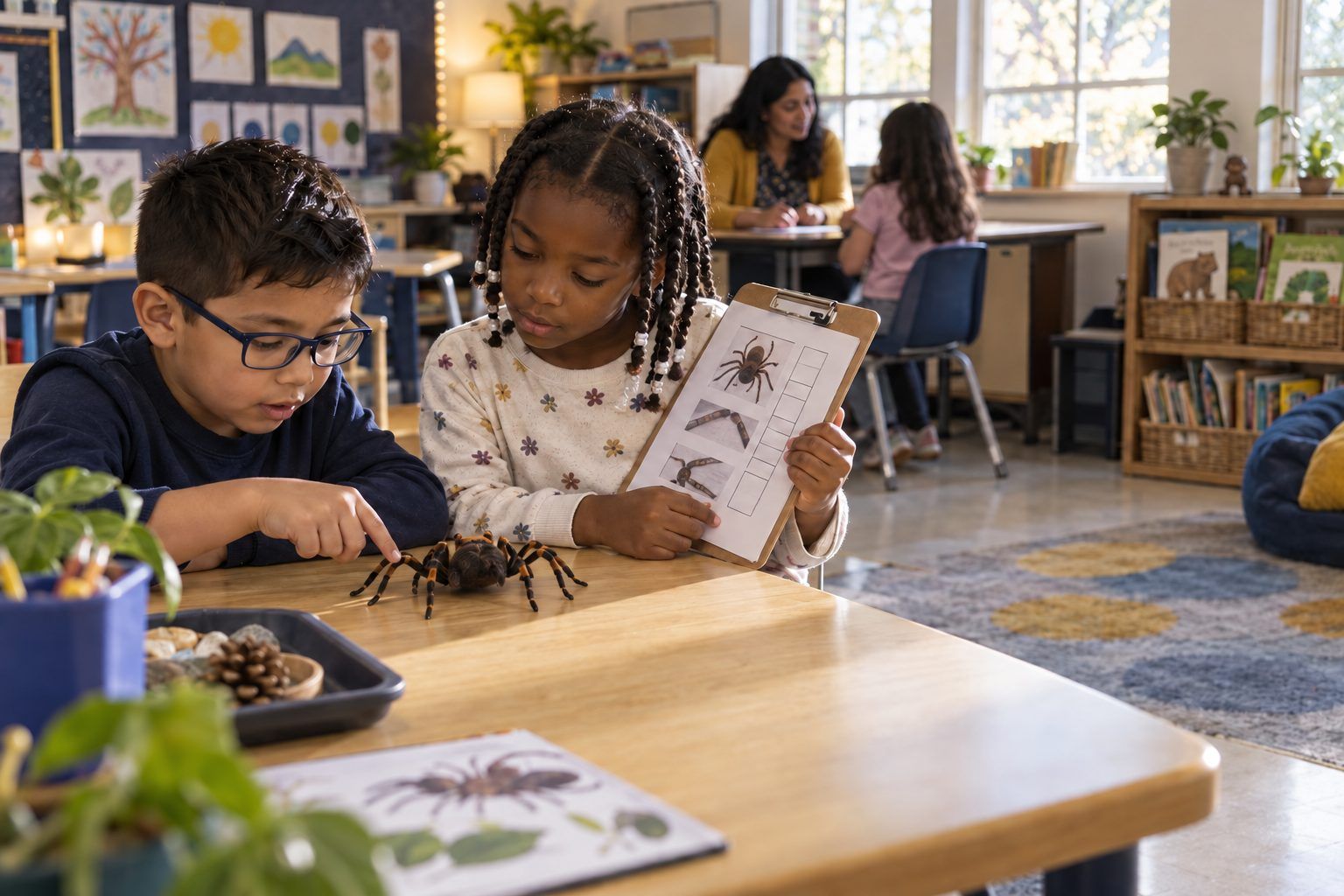
In a proud robot voice, read: "Robo Helper says: A spider has 6 legs. I am 100 percent sure!" Ask: "Robo sounds SO sure. Do we believe it?" Let children react. Hold up the spider picture and count the legs together: 8. Say: "Robo sounded sure, but it was wrong. Sounding sure is not the same as being right. Today you'll learn a superpower called Ask Two."
Facilitator noteIf a child already knows spiders have 8 legs, great: ask "How do you know? Where did you learn it?" That's a source.
Model
Hold up two fingers: "Before I believe it, I check it in TWO places." Introduce the three stations: Book Nook (look in a book), Look and See (check with your own eyes), Grown-Up Desk (ask a trusted grown-up). Model with the card "Ice melts when it gets warm": go to Look and See ("The ice cube in the cup is melting. Check one!"), then Book Nook (show a page). Fill in a My Ask Two Card on the document camera: Robo said, check 1, check 2, circle RIGHT.
Facilitator notePoint out that you checked even though Robo was right. Checking isn't only for wrong answers; it's how learners own what they know.
Practice
Each pair draws a Robo Helper card and gets a My Ask Two Card. Pairs choose two stations that fit their question, visit them, and draw or write what they found. Then they circle RIGHT, WRONG, or NOT SURE YET. When done, they draw a new card. Circulate and ask: "Which station helped most for your question? Why?" At the Grown-Up Desk, the adult doesn't give the answer right away but asks, "Where could we look?" and helps the pair find it.
Facilitator note"Not sure yet" is a great answer when two checks disagree or can't be found. Praise it. It's honest and it means you keep checking.
Debrief
Gather on the rug. Pairs share one card: "Robo said ___. We checked ___ and ___. Robo was ___." Tally on the board how many Robo answers were right and how many were wrong. Ask: "Could you tell which ones were wrong just by listening to Robo's voice?" (No, Robo always sounded sure.) Then: "Some computers use AI to answer questions. They can be helpful and they can be wrong. A learning owner does what?" Children hold up two fingers: "Ask Two!"
Facilitator noteIf you run the projected demo, do it here, before the tally, and add the real chatbot's answers to the checking.
Reflect
Read the Handout C checklist aloud, one line at a time. Children color Yes or Not yet. Then each child finishes the last two lines of their My Ask Two Card with a drawing or a few words: "I am good at checking by…" and "Next time I will…" Ask two or three children to share their "Next time" goal.
Facilitator noteThis is S4.3 in action: children notice a strength and a next step. Keep goals small ("I will look in a book first").
Robo Helper can be entirely you, reading the cards in a robot voice. The books, real objects, and adults at the stations are the sources, so no device is needed. The lesson loses nothing essential without the projected demo.
During the Debrief, project a district-approved AI chatbot from your device. Let children pick two or three of the same questions ("How many legs does a spider have?" "Can penguins fly?" "Where do pumpkins grow?") and type them as the class watches, adding "Answer for a first grader." Read each answer aloud, then Ask Two as a class using a book and a projected library e-book or kid-friendly site. Whether the chatbot is right or wrong, the move is the same: check in two places. Children never use their own AI accounts; you type every question.
Does it need a screen? The projected chatbot makes the lesson real: children see that an actual AI tool answers in a smooth, sure voice, and they practice checking it with books and adults. The evidence of learning is the Ask Two card with two checks recorded, not the chatbot's answer.
What you should be able to see or collect if it worked.
Children check a robot helper's claims in a book, by observing, or with a grown-up, early inquiry and scientific observation that shows sure-sounding answers can be wrong.
Send home a blank My Ask Two Card. Families pick something a speaker, app, or TV show told them this week and check it in two places together (a book, a grown-up, or looking with their own eyes). In class, post "Ask Two" by the classroom library and use the two-finger signal whenever a surprising fact comes up.