Student learningfor Grades 3–5
Ad or Info?
Students sort mock posts, videos, and headlines into ads, information, and clickbait, hunt for persuasion tricks, and then create an honest, clearly labeled ad of their own.
All activities Student learning
Teams use the engineering design process to solve a real school or community problem, invite AI to critique their ideas, reject what doesn't hold up, and pitch a solution with a record of what changed.
Students pick a real problem they can observe at school or in their community, gather evidence, and generate their own ideas before any AI is involved. Then AI joins as a brainstorm critic: the teacher projects a district-approved chatbot (or uses a printed mock critique) that suggests ideas and pokes holes in the team's plan. Some of its suggestions are useful, some are unrealistic, and some include claims no one can verify. Teams must decide what to keep, verify, or reject, build a simple prototype, and pitch it. The grade rests on their reasoning and their record of what changed, not on the AI's ideas.
Hook
Ask: "What is one thing at our school that bugs you, wastes something, or leaves someone out?" Students write one per sticky note and post them. The class clusters similar notes, and teams of 3–4 choose one cluster. Share the rubric (Handout C) right away and say: "You won't be graded on whether AI gives you a good idea. You'll be graded on how well you decide."
Facilitator noteSteer teams toward problems they can actually observe and test this week. "World hunger" becomes "food thrown away at our lunch."
Explore
Teams fill in the first sections of Handout B. They write the problem as a question ("How might we reduce the food thrown away at Ridgeview's lunch?"), name who it affects, and break it into smaller parts (for example: what gets thrown away, when, why, who decides portions). Then they gather quick evidence: five minutes of observation, two short interviews with staff or students, or a tally. Roles: Lead Designer, Evidence Keeper, AI Skeptic, Pitch Captain.
Facilitator noteBreaking a big problem into parts is computational thinking (decomposition). Name it when you see it.
Create
Before any AI, teams brainstorm as many ideas as they can in five minutes (quantity first, no judging), then pick their top idea using their evidence. They record the top idea and why in Handout B. Say: "We think first so the AI critiques our thinking instead of replacing it."
Facilitator noteProtect this step. Teams who start with AI tend to adopt its first idea and stop thinking.
Model
Project your district-approved chatbot, or read Handout A aloud. Show how you use the critic prompt with one team's problem and idea, leaving out any names or personal details. Then model the three decisions on one suggestion. Keep: it fits our evidence and we can do it. Verify: it might be true but we need to check it (ask the cafeteria manager, look up the district rule). Reject: it's unrealistic, unfair, invents facts, or creates a new problem. Point out the "studies show 90%" line in Handout A: "No source, a very precise number. What do we do with that?"
Facilitator noteModel rejecting an AI idea respectfully and confidently. Students need permission to disagree with a fluent tool.
Practice
Each team gets a critique of its own idea: the teacher runs the critic prompt on the projector for each team in turn (about two minutes each) and prints or copies the output, or teams use Handout A if their problem is food waste. The AI Skeptic leads the team through every suggestion and weakness, marking Keep, Verify, or Reject in Handout B with a reason. Teams verify at least one claim by asking a real person or checking a trusted source, then revise their idea.
Facilitator noteKey for Handout A: Share table: Verify. It's a promising idea, but "allowed in every school" is an overconfident claim; rules vary, so ask the cafeteria manager about local and district health rules. Portion sizes: Keep, then verify with the cafeteria staff. Composting "90%": Reject the statistic (no source, suspiciously exact) and verify the idea; composting may reduce what goes to the landfill but not how much food is wasted. Ban packed lunches: Reject; it's unfair to families and doesn't address why food is wasted. AI cameras: Reject; it's expensive, raises privacy concerns, and could shame students. Weaknesses 1–3: Keep; all three are fair and useful critiques. Weakness 2 should send the team back to gather more evidence. Look for at least one rejected suggestion with a clear reason, and one changed idea that credits the critique it came from.
Create
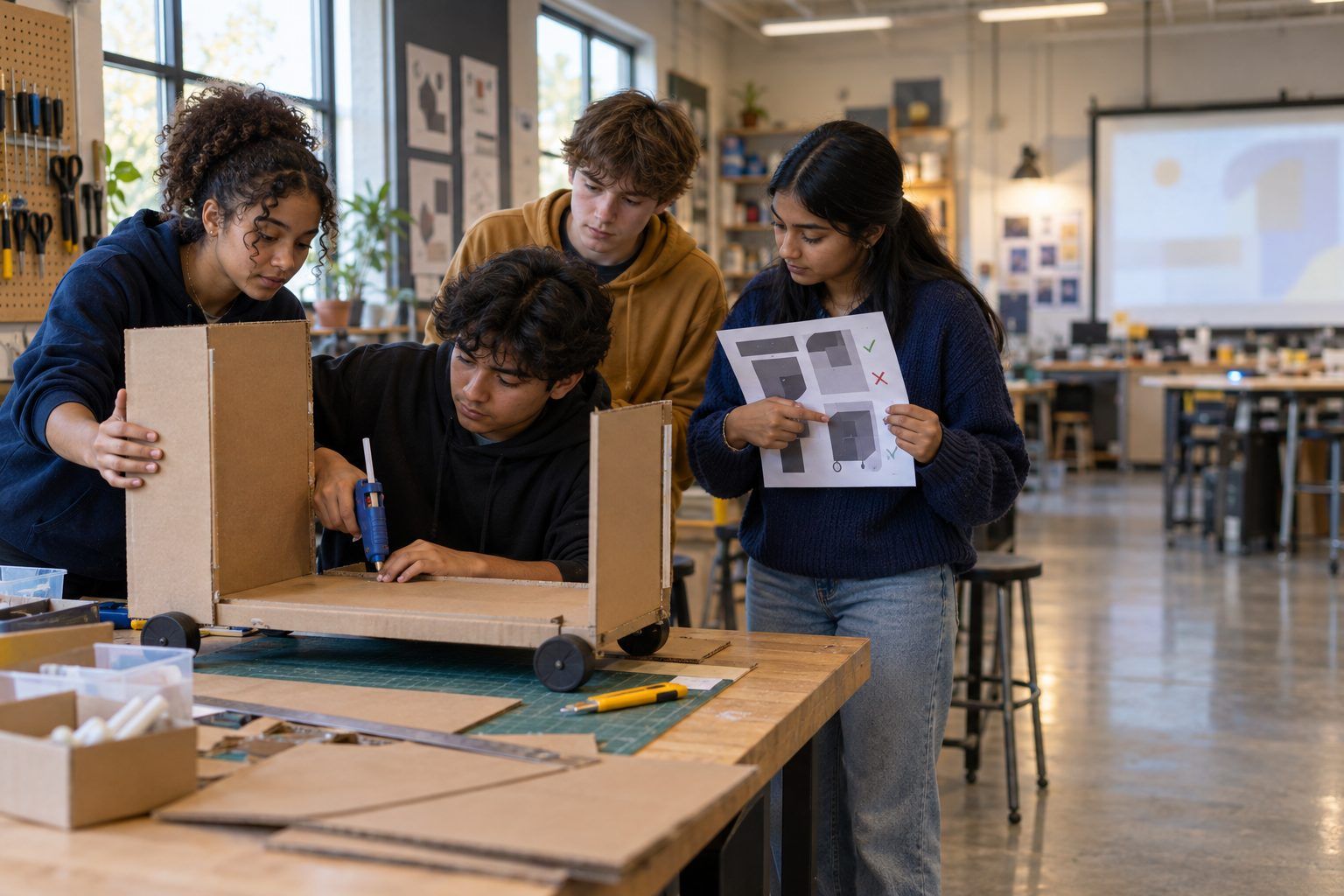
Teams build a quick prototype: a sketch, a cardboard model, a poster mock-up, a sign, or a step-by-step plan. If time allows, they test it with one other team and note one piece of feedback. They complete the "What changed" section of Handout B: our first idea, what the AI critique and our testing showed, and our final idea.
Facilitator notePrototypes should be rough. The point is to test thinking, not to make something beautiful.
Apply
Each team gives a two-minute pitch: the problem and our evidence, our solution and prototype, one AI idea we kept and one we rejected (and why), and what changed. Classmates give feedback using two sticky notes: "One strength" and "One question." If possible, invite a staff member connected to a problem (such as the cafeteria manager) to listen.
Facilitator noteHold teams to the "what changed" part. It's the strongest evidence that they, not the AI, owned the thinking.
Reflect
Students individually self-score on Handout C and answer on the back: "What did the AI help us see that we missed? What did we know that the AI didn't?" Collect Handout B and C.
Facilitator noteStudents usually realize their local evidence (what they saw and heard at school) was something no AI had.
Run the whole project with Handout A as the AI critic. It's a printed mock critique of a food-waste idea with useful suggestions, weak ideas, and an unverifiable statistic. For other problems, you (or a classmate acting as the "critic") can read the critic prompt's three questions aloud: What else could you try? What's weak about your plan? What needs checking? Evidence comes from observation and interviews, and prototypes are cardboard and paper.
The teacher runs the critic prompt for each team in a district-approved chatbot on the projector and pastes each output into the team's shared document. Students under 13 never use personal AI accounts. Students 13 and older with district-approved access may run the critic prompt themselves, but they must still complete Keep/Verify/Reject for every suggestion. Teams may build pitch slides and collect anonymous survey evidence with a school form tool.
Does it need a screen? A live critic responds to each team's actual idea, so students practice evaluating AI on their own work rather than a canned example, and the Keep/Verify/Reject log becomes visible evidence of human judgment. The printed mock critique teaches the same decisions when devices aren't available.
What you should be able to see or collect if it worked.
Students break down a real school problem, gather evidence, then keep, verify, or reject AI critiques before prototyping and pitching a solution.
Share the strongest pitches with your principal or the relevant staff member, and let one team try its solution for a week and report back with evidence. Students can use Handout B's steps at home to tackle a family problem, such as a messy shared space or a morning routine.