
Professional learningfor Coaches, Teachers, Leaders
Norms for the AI Era
A PLC builds trust first, then sorts real shared-planning dilemmas and drafts its own norms for AI use: disclose it, check it, and never put student data in a prompt.
All activities Professional learning
A campus team digs past blame to the root causes of a fictional viral rumor and AI-edited image incident, then writes the trust and AI-use norms it will hold itself to next time.
When an online rumor tears through a campus, adults tend to respond on their own: some address it in class, some ignore it, someone forwards the image to ask "is this real?", and a well-meaning email makes things worse. This protocol uses a fictional incident, an AI-edited photo of a student and a rumor about who made it, to practice a structured, no-blame root-cause analysis. Teams trace the problem to causes they can act on, then write two sets of norms: how they'll respond together next time, and how they'll use AI inside their own PLC.
Hook
Ask everyone to answer privately on a sticky note, then fold it: "On a scale of 1–5, how confident are you that our team would respond to a viral incident the same way, on the same day?" Collect and read the spread aloud without comment. Say: "That spread is today's problem. We're going to look at a fictional campus, figure out why things went sideways, and leave with agreements we'd actually keep."
Facilitator noteAnonymous first, then public. Trust grows when people see their private worries named without anyone being singled out.
Explore
Everyone reads Handout A silently and marks each moment with S (a student decision), A (an adult decision), or X (a system or policy gap). Then a quick round-robin: each person names one moment and its letter, with no discussion yet.
Facilitator noteHold the round-robin tightly. The protocol structure is what keeps a heated topic productive: everyone speaks once before anyone speaks twice.
Model
Model one chain on the board, starting with "Students shared the photo more than a hundred times before lunch." Why? They believed it was real. Why? Nothing about it looked edited, and friends they trusted were sharing it. Why did that settle it? Students have practiced spotting fakes, not checking a source before sharing. Why? Our media literacy lessons focus on spotting visual errors. Why? We haven't updated them since image-editing tools got this good. Root cause we can act on: our lessons teach looking harder instead of checking the source and context.
Facilitator noteStop when you reach something the team can change. "Kids are on their phones too much" is a symptom and outside the room's control.
Practice
Teams fill Handout B, running a five-whys chain in each of the four rows: Student knowledge and skills, Adult response and communication, Systems and policies, and Culture and trust. Roles: a facilitator who keeps asking "why?", a recorder, a timekeeper (about four minutes per row), and a norms checker who calls out blame language ("If Mr. Pratt had just…") and redirects it to the system ("What made that choice likely?").
Facilitator noteLook-for: teams find that the adult chain includes an AI misstep (a draft email with a student's name pasted into a chatbot) and a media literacy misstep (forwarding the image to ask whether it was real). Both are adult practice problems, not just student ones.
Debrief
Each person gets three dots to vote on the root causes most within the team's control. The facilitator asks the team with the top-voted cause: "If we fixed only this, what would have gone differently at Mesquite Hills?" Then: "What would have to be true about trust on our team for us to raise a concern like this in the moment?"
Facilitator noteThis is the collaborative leadership move: the team, not the coach, names what to work on. Your job is to keep asking about evidence and control.
Create
Teams use Handout C to draft two short sets of norms. Incident response norms (3–4): for example, "Within one school day, every advisory uses the same short script, and no adult forwards the content, even to ask about it." AI-use norms for our PLC (3–4): for example, "We say when AI helped draft something we share," "No student names or details go into an AI tool," "We don't record or transcribe meetings with AI without everyone's agreement." Each norm must be observable: someone could see whether the team kept it.
Facilitator notePush vague norms such as "be respectful" and "use AI responsibly" toward behavior: "What would we see or hear?"
Reflect
Teams read their norms aloud and do a fist-to-five on each; anything below three gets revised or dropped. Set a date, four to six weeks out, to review: "Did we keep them? What evidence shows it?" Revisit the opening trust question and ask whether anyone would now answer it differently.
Facilitator noteNorms without a review date are decoration. The review is where trust gets built.
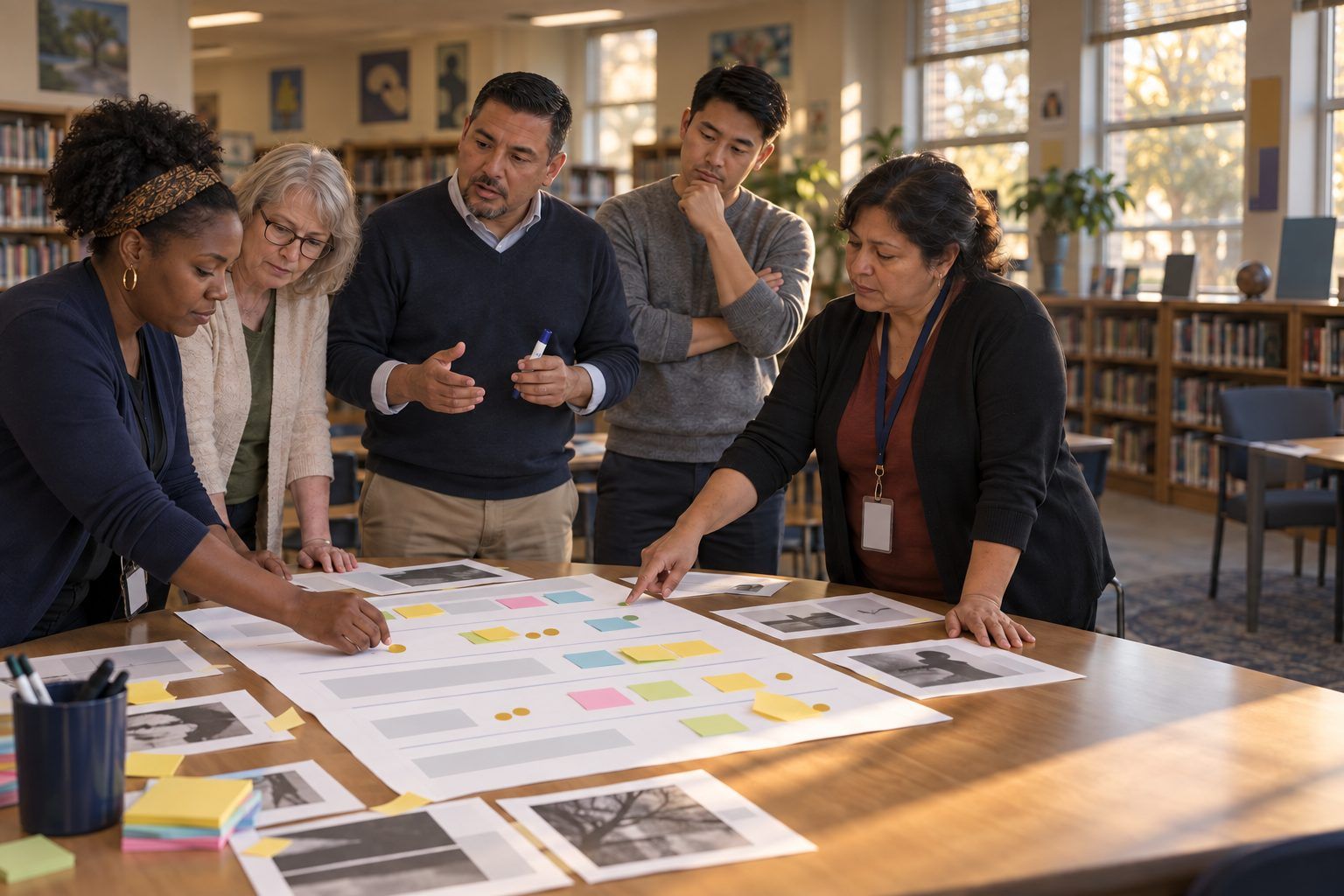
The protocol is designed for paper and conversation: printed case, chart-sized organizer, sticky notes, and dots. A structured, device-free discussion helps a sensitive topic stay focused on the system rather than on screens or side conversations.
For virtual or hybrid teams, use a shared whiteboard with the four root-cause rows and digital sticky notes, an anonymous poll for the trust check, and a shared document for the norms that becomes the team's living agreement. Link the finished norms at the top of every PLC agenda.
Does it need a screen? The unplugged path is the better choice for the analysis itself because it keeps the conversation human and focused. A shared norms document earns its place afterward: it keeps the agreement visible at every meeting and gives the team a record to check at the review date.
What you should be able to see or collect if it worked.
Staff trace a viral AI-edited photo rumor to root causes, preparing to teach students to check source and context and respond as upstanders instead of forwarding harmful content.
Post your norms at the top of your next PLC agenda and open that meeting by reading them. Teachers: teach the "check the source and context, don't just stare at the image" move in advisory or class within two weeks and bring one piece of student evidence to the norms review.