
Welcome, and thank you for being here. This session walks through the TCEA Essential Learning Expectations, the ELEs, a shared framework that gives teachers, students, coaches, school leaders, and anyone working with AI the same language for better learning. Over the next half hour we will look at how the framework is built, then move role by role through the indicators, the guiding questions, and a sample activity you can use tomorrow. Everything you see is on the public site at this address, so you do not need to copy anything down. Let us start with the big picture.
Five roles, one destination
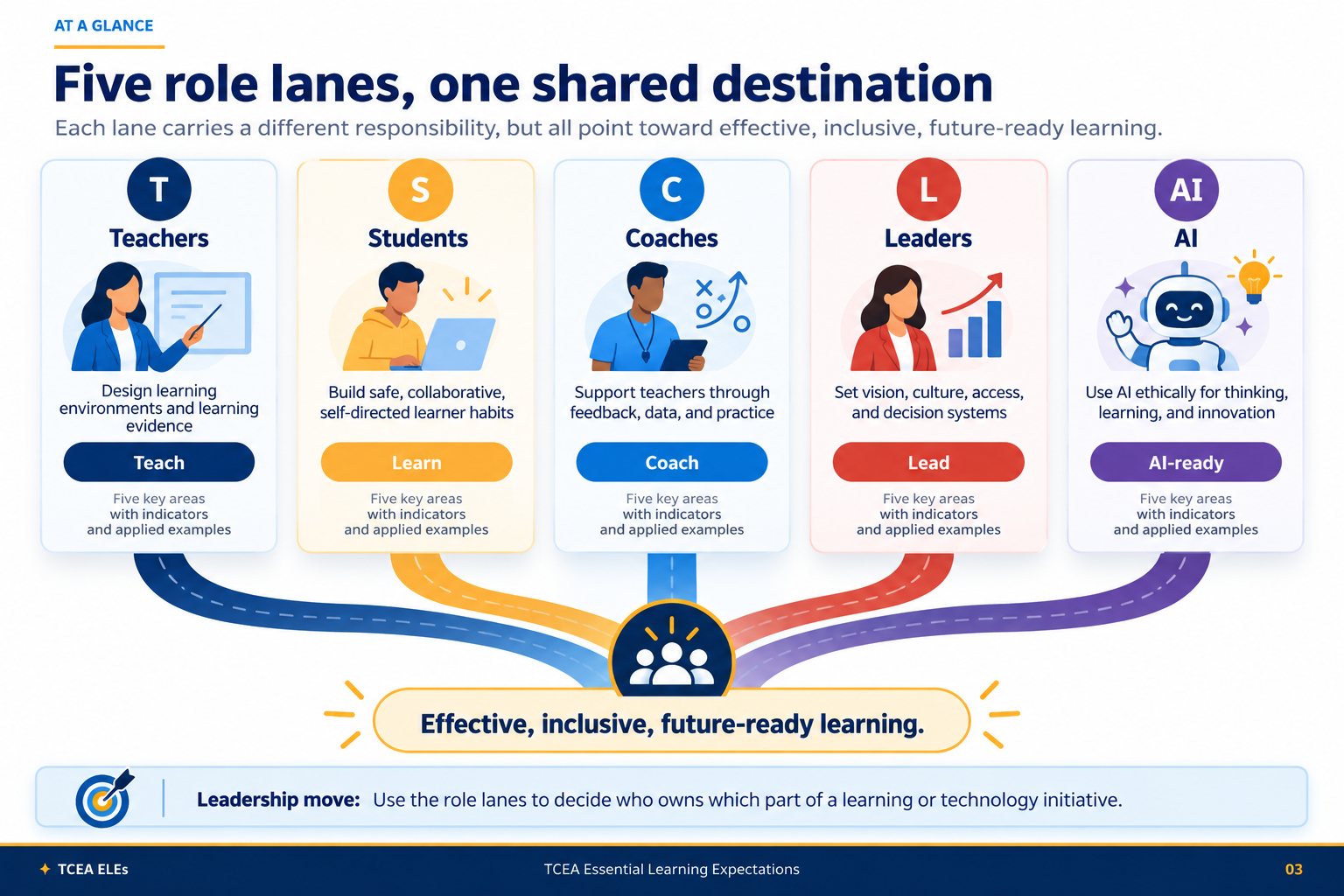
This is the picture I want to anchor the session on. Think of five lanes on the same road. Teachers design learning, students take the lead in it, coaches build teacher capacity, leaders set the conditions, and AI stays ready as a tool in service of all of them. The lanes are distinct because the work is different from each seat, but the destination is identical: learning that is effective, inclusive, and future-ready. As we move through each role, notice how often the same idea, say inclusive access or evidence of learning, shows up from a different angle. That overlap is the point.

We begin with teachers and teacher librarians, because this is where most of the day-to-day work lives. The five key areas here are technology integration, digital literacy, inclusive teaching, relationship building, and critical thinking. Notice that technology sits beside relationships and inclusion, not above them. The framework is grounded in John Hattie's visible learning work, which is why feedback and clarity run through it. As I show the indicators, think about which of these five areas is your current strength and which one you would most like to grow this year.
A tool with no plan
A teacher rolls out a buzzy AI writing tool overnight. Engagement jumps, but a third of the class has no device at home, quiet students use it to avoid thinking, and when grades return no one can tell whether real learning happened. Was it the tool, the task, or the teaching?

This is the problem the teacher ELEs are built to prevent. Technology Integration asks you to choose a tool for a learning purpose, not for novelty. Digital Literacy and Critical Thinking push you to design the task so the tool supports thinking instead of replacing it. Inclusive Teaching surfaces the device-access gap before you launch, not after. And the framework's habit of pairing every move with evidence means you plan how you will know it worked. The problem stays messy, but you walk into it with purpose, equity, and evidence instead of hope.

Next, the students. Their five areas are tech savvy, online safety, collaborative learner, self-directed learner, and creative problem solver. The student indicators are written in young, plain language on purpose, so learners can read and own them. This is the role where the guiding questions sound almost childlike, things like "Do I stay safe and make good choices online," and that simplicity is a strength. As we look at these, think about how you would put the indicators in front of students themselves, not just talk about students in their absence.
Alone with the screen
At midnight a student finds a shocking claim online, reposts it to friends, and shares a little too much about where she lives. By morning the claim has spread and her location is public. No one ever taught her to check a source or guard her privacy. What does she do now?

The student ELEs are written for exactly this midnight moment, and in the student's own voice. Online Safety builds the habit of protecting personal information before anything is shared. The tech-savvy and critical-thinking strands teach her to pause and check a claim across more than one source. The collaborative and self-directed expectations give her the confidence to ask an adult for help instead of hiding the mistake. Because the indicators read as I know, I can, and I am aware, she owns these skills rather than waiting for a rule to catch up. The night is still hard, but she is equipped to handle it.

Now the leaders and administrators. Their areas are visionary technology leadership, technology-enhanced instructional leadership, data-informed decision making, fostering a digital learning culture, and technology-enabled community engagement. This is the role where the correlations shift from TEKS to the TEA Principal Standards, because the work is about systems and conditions rather than a single classroom. As we look at the leader indicators, notice that none of them are about buying tools. They are about vision, evidence, culture, and community. Keep that framing in front of any leadership team you run this with.
The rollout that stalled
A district signs a six-figure platform deal over the summer and pushes it to every campus in August, with no shared vision and no plan for families without home internet. By winter logins have cratered, teachers have reverted to what worked, and the devices sit unused. Where did it go wrong?

The leader ELEs would have slowed this decision down in the right places. Visionary Technology Leadership asks you to name and communicate the why before the what. Data-Informed Decision Making expects evidence that the tool improves learning, not just a vendor's promise. Fostering a Digital Learning Culture and Community Engagement put teachers and families in the room before the purchase, so access gaps surface early and adoption is shared rather than mandated. Running the Five-Question Rollout Check would have caught most of this in planning. The work is still complex, but it is governed by vision, evidence, access, and community.
Five questions before a digital initiative
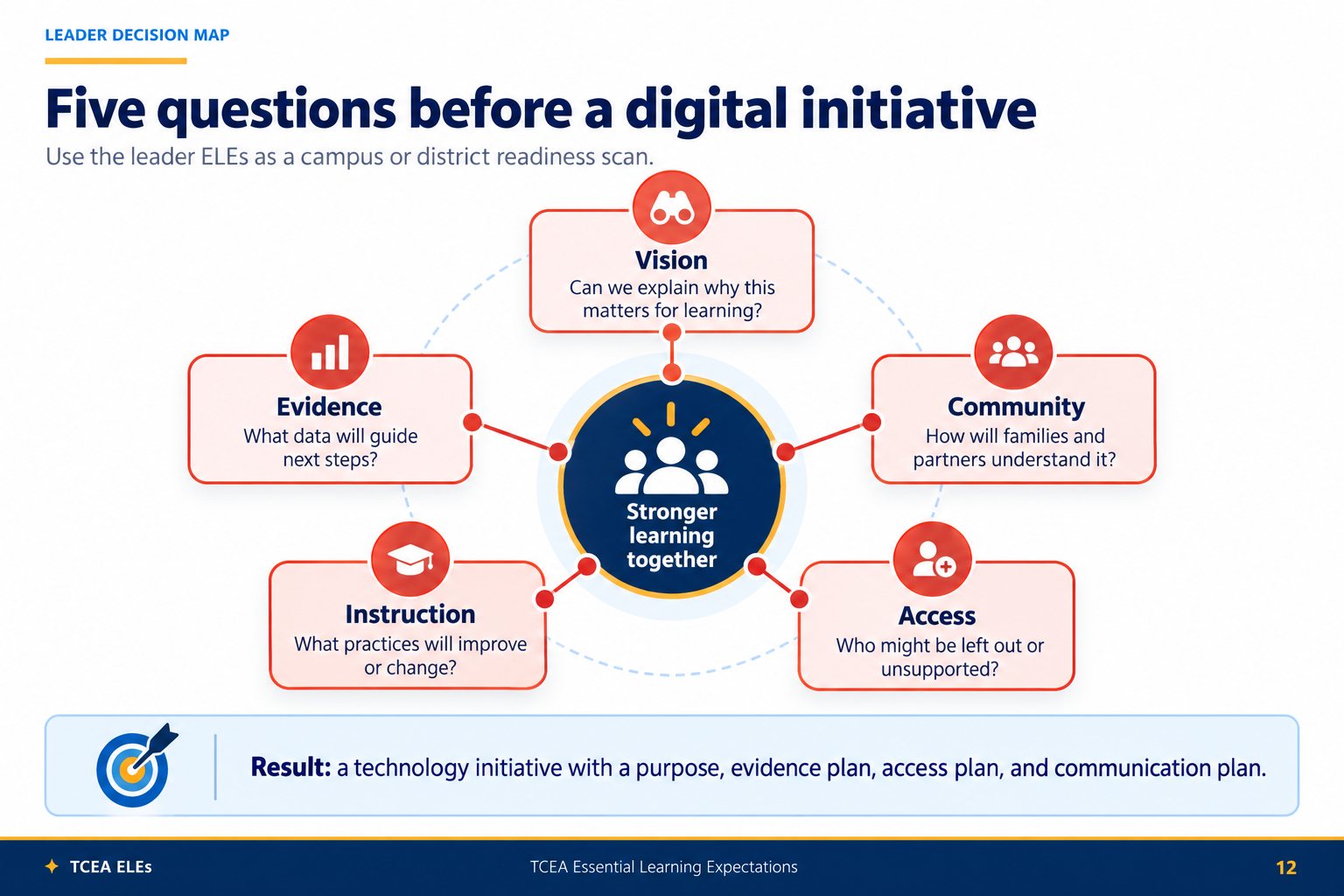
This is a tool I hand to every leadership team. Before you roll out a new app, platform, or AI tool, run it through five questions: Does it serve our vision. What evidence says it will help. How does it change instruction. Who might it leave out. And how will we bring the community along. Most failed rollouts skip question four, access, and question five, community, and then wonder why adoption stalls. Put this image on the wall of the next planning meeting and do not let a purchase order move until all five have an answer. The next slide turns this into an activity.

Fourth, the instructional coaches. Their areas are teacher support, technology integration, data-driven coaching, professional development, and collaborative leadership. Coaches sit in a unique spot, close to the classroom but working through adults, so their indicators lean on adult learning theory and on the research that coaching changes teacher practice more than one-off workshops do. The coach's quote in the framework is Hattie's line that every student deserves a great teacher, not by chance but by design. That phrase, by design, is the whole job. Let us look at the coach indicators and a cycle you can use Monday.
The workshop that changed nothing
A coach delivers a slick ninety-minute session on a new tool to the whole staff. Everyone nods, a few try it that week, and a month later nothing in classrooms has changed. There was no follow-up and no data on student learning. Was the PD wrong, or the way it was delivered?

The coach ELEs replace the one-and-done workshop with a cycle. Teacher Support and Data-Driven Coaching mean you start from a real goal and watch for evidence that practice, and then student work, actually changed. Professional Development grounded in adult learning theory favors small, repeatable moves over a single big event. Collaborative Leadership builds a culture where teachers keep refining together instead of waiting for the next session. Picture the loop: listen, co-plan, model, measure, adjust. Changing adult practice is genuinely hard, but a coaching cycle gives it the traction a workshop never had.
A practical coaching loop
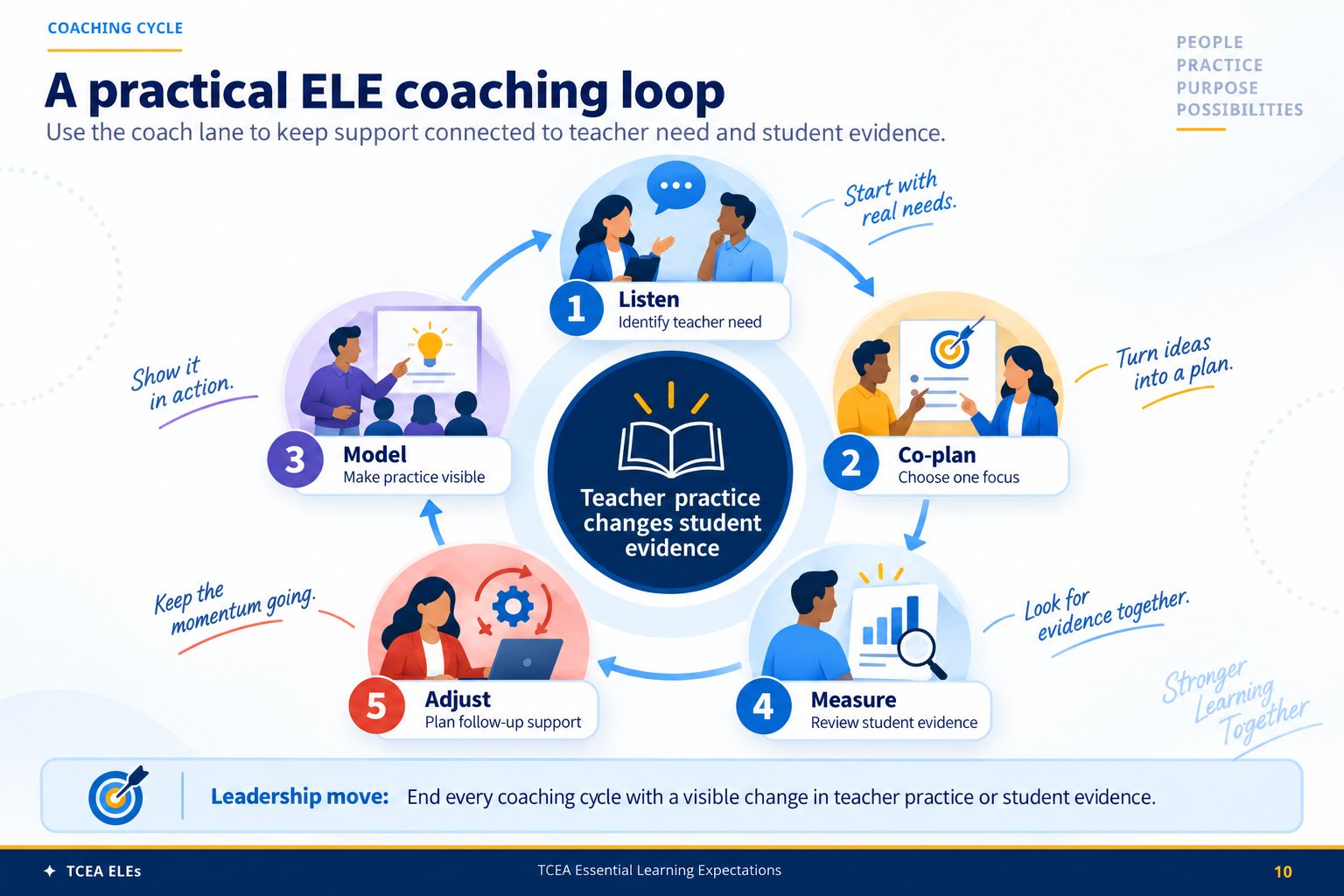
This loop keeps coaching honest. It runs listen, co-plan, model, measure, adjust. The reason it is a loop and not a line is the last two steps. If you cannot measure whether teacher practice changed, and whether that change showed up in student evidence, you were not coaching, you were just visiting. Notice that it starts with listen, not tell. Most coaching that stalls skips straight to modeling before the teacher has named their own goal. When you run this with a group, ask which step they personally shortchange. For many of us it is measure, because it is the slowest. The next slide gives you a twenty-minute way in.

Finally, AI in education. Its areas are AI literacy, ethical AI use, AI-enhanced learning, AI and critical thinking, and AI collaboration and innovation. This role is different from the other four. It is not a separate group of people; it is a strand that cuts across teachers, students, coaches, and leaders alike. The framework pairs it with Kurzweil's line about machines that create, but the indicators stay grounded and cautious, built around literacy, ethics, and critical thinking. As we close the role tour, think about AI less as a tool to adopt and more as a set of habits every role needs.
Confident, and wrong
With no shared norms, half the staff quietly ban AI and half lean on it. A teacher pastes student names into a free chatbot for feedback, a leader drops its confident summary into a decision, and a biased, wrong answer slips by unquestioned. What is fair, private, or verified here?

The AI ELEs are built for this gap, and they deliberately cut across every role. AI Literacy means knowing these systems can be confidently wrong and biased, so outputs get checked rather than trusted. Ethical AI Use sets shared expectations for privacy, fairness, and transparency, so student names never go into an ungoverned tool. AI and Critical Thinking trains everyone to question an answer before acting on it. Because AI runs as a strand through teaching, learning, coaching, and leadership rather than a walled-off committee, the norms are shared. The dilemmas stay real, but the school meets them with literacy, ethics, and healthy skepticism.
AI cuts across every role
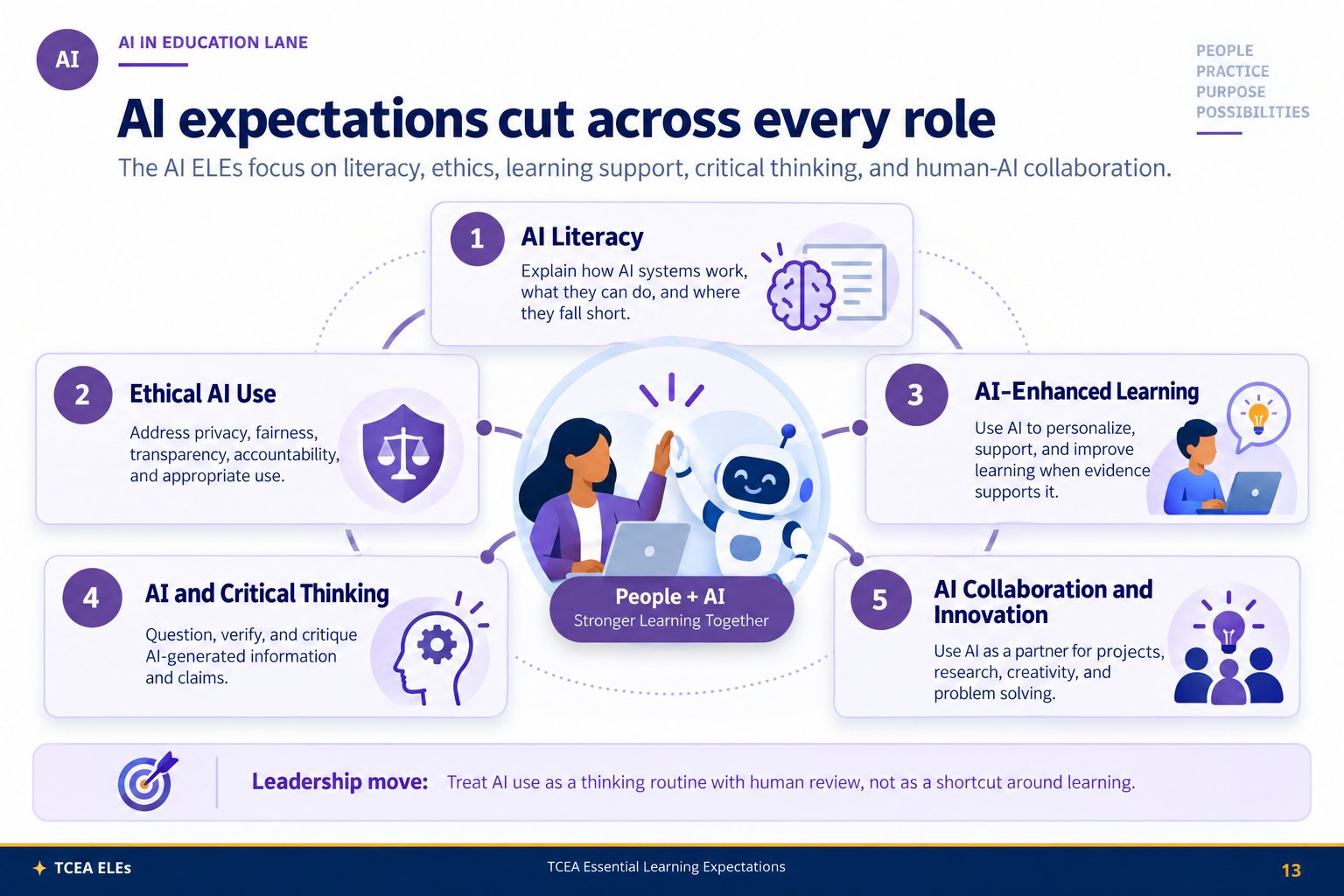
This image makes the cross-cutting point visible. The five AI areas, literacy, ethics, enhanced learning, critical thinking, and collaboration, are not the property of a single department. A teacher needs AI literacy to choose a tool. A student needs it to question an answer. A coach needs it to evaluate a platform. A leader needs it to write policy. So when you plan AI learning, do not stand up a separate AI committee walled off from everyone else. Weave these habits into the role work people already do. That is the whole design intent behind making AI a role in its own right.
Same focus, different seat
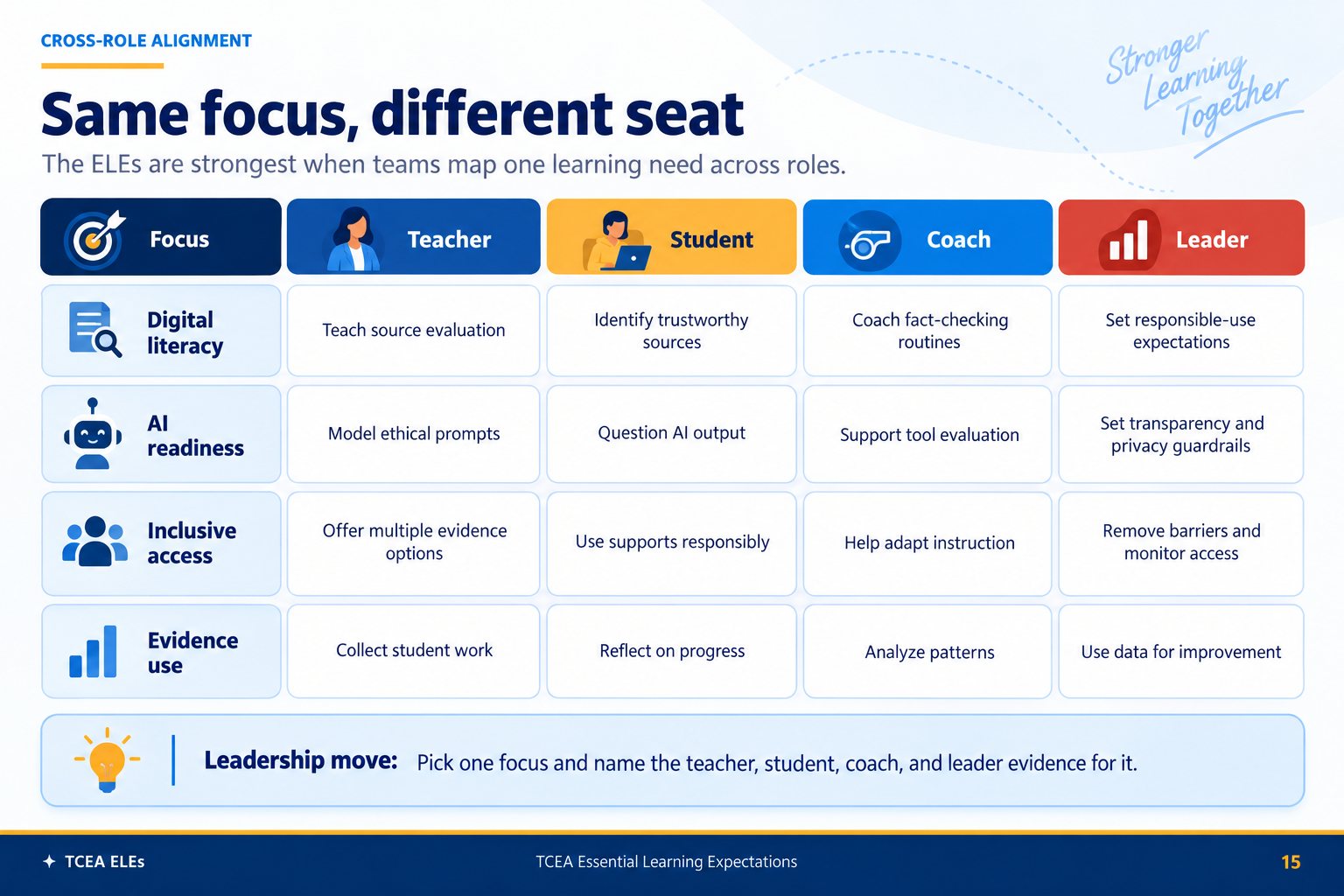
Before we close, one picture to tie the roles together. Read across any row and you see the same goal handled from four seats. Take inclusive access: a teacher differentiates a lesson, a student values diverse perspectives, a coach spreads what works, and a leader funds the devices and the bandwidth. Same goal, four different moves. This is why the ELEs put every role in one framework instead of five separate documents. When a team can see their counterparts' column, hand-offs stop falling through the cracks. If you facilitate a mixed-role group, have each seat read their own column aloud, then name one hand-off they rely on from the seat next door.
Five ways the ELEs put learning first
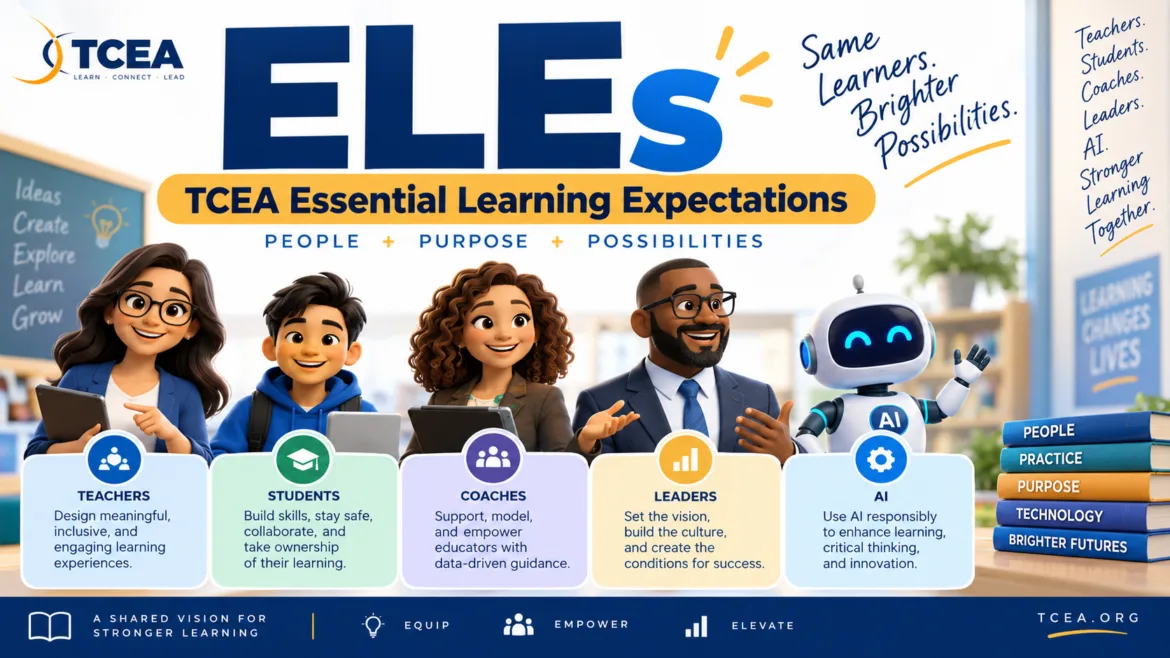
- Teachers design the learning environment, choosing tools by evidence, not availability.
- Students move from tool users to owners of their own learning.
- Coaches turn expectations into practice: listen, co-plan, model, measure, adjust.
- Leaders set the conditions and fund inclusive access.
- AI cuts across every role: literacy, ethics, and purposeful use.
I wrote a short overview of these expectations on the TCEA blog, and it is a good companion to this session. It walks through five ways the updated ELEs put learning first, and you will recognize them because they are our five roles. Teachers design the environment and choose tools by evidence. Students grow from using tools to owning their learning. Coaches move expectations into practice with a listen, co-plan, model, measure, and adjust cycle. Leaders set the conditions and fund inclusive access. And AI runs across every role. One line from the piece sums up the stance: technology use by itself is not evidence of learning. Share the link with your team as a quick on-ramp before they dig into the framework.