Student learningfor Grades K–2
Robot Guesses
Children train a pretend robot with picture-word cards and discover that AI makes guesses from patterns, and that a guess can be wrong.
All activities Student learning
Students build a paper "word-guessing machine" from sentence cards, watch it invent a confident false fact about a lake, and find out why a longer prompt helps but never makes a chatbot know things.
A generative AI chatbot writes by guessing what word is likely to come next, based on patterns in the writing it learned from. In this game, teams become that machine. They tally which word follows which in eight short sentence cards, then "write" new sentences by drawing slips from cups. The sentences come out grammatical and often silly. Then, in the lake round, the machine produces a sentence that sounds like a fact and is false, even though every piece of it came from true cards. Students test whether a longer prompt fixes the problem and leave able to say, in their own words, why a chatbot can sound sure and still be wrong.
Hook
Pause before the last word each time: "Peanut butter and…" (the class says jelly). "Once upon a…" (time). "Twinkle, twinkle, little…" (star). Ask: "Did anyone look that up? How did you know?" Take answers, then say: "You predicted. You've heard those words together so many times that your brain guessed what comes next. A generative AI chatbot does something like that, one word after another, with a huge amount of writing. Today your team is going to build a tiny one out of paper."
Facilitator noteSome students will shout silly endings ("peanut butter and pickles!"). Welcome them: they are proof that more than one next word is possible, which matters when the class starts drawing slips.
Model
Show Story Card 1 under the document camera or write it on the board: the dog ran to the park . Point to each word and ask, "What word came right after it?" Put a tally on Handout B: after the, a mark for dog; after dog, a mark for ran; after ran, a mark for to; after to, a mark for the; after the again, a mark for park. Explain the one special rule: "When you draw park, bone, door, mat, bus, bench, or apple, the sentence is over. Put a period."
Facilitator noteStudents often forget that "the" shows up twice in one card, so it gets two tallies. Catch it here, out loud, so every team starts right.
Explore
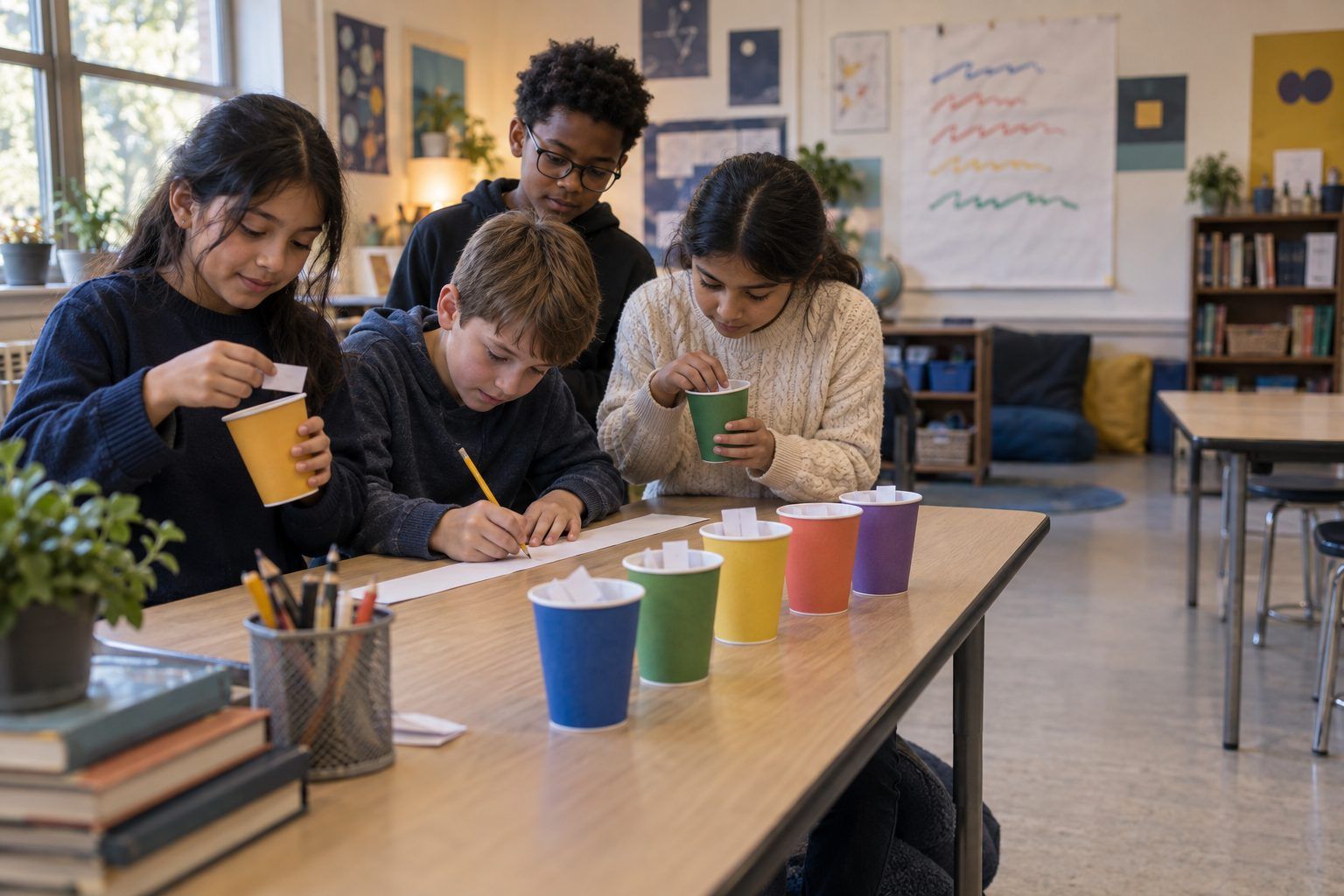
Teams split Story Cards 1–8 so each person tallies two cards on the shared Handout B. Then they make one slip for each tally mark, write the next word on it, and drop it in a cup labeled with the first word. For example, the ran cup gets three slips that all say to. Say: "Your cups ARE your machine. This is what we call training: the machine only knows what was in these cards."
Facilitator noteSuggested jobs: Reader (reads each word pair aloud), Tallier, Slip Maker, Cup Keeper. Look-for: the "the" cup should have 16 slips with lots of different words. Ask a team, "Why is this cup so much fuller and messier than the ran cup?"
Practice
Every sentence starts with the. Draw a slip from the the cup, write the word down, put the slip back, then draw from that word's cup. Keep going until the sentence ends. Each team writes five sentences and copies their best and silliest onto the "Our machine said…" chart. Ask the room three questions: "Do these sound like real sentences? Are they true? Did the machine ever see these exact sentences?"
Facilitator noteExpect sentences like "the cat sat on the bus." Grammar is fine because the word patterns are real; the meaning is off because the machine keeps track of word order, not the real world. Faster option: close your eyes and tap a pencil on the tally marks in that word's row instead of drawing slips.
Apply
Open the envelope. Read Lake Cards 9–12 aloud. They are the only facts the machine has about two made-up lakes. This time the machine looks at the last two words to guess the next one. Most two-word pairs have only one possible next word, so teams just follow the card. There are only three kinds of forks: after Wrenmere is or Mossmere is it could be in or the; after is in it could be Harlow or Pike; and after is the it could be deepest or largest. At each fork, flip the coin. Each team generates three sentences starting "Mossmere is" and three starting "Wrenmere is." Before long a team gets "Mossmere is the deepest lake in the state." Stop the class: "No card says that. Card 11 says Wrenmere is the deepest. Where did this come from? Is the machine lying?"
Facilitator noteThis is the big idea. The false sentence is built entirely out of true pieces. The machine isn't lying or broken; it has no list of facts to check against, only patterns of which words go together. Name it: when an AI tool says something false in a confident voice, people call that a hallucination.
Practice
Now give the machine three words to look at. After "Wrenmere is in," the cards only ever have Harlow. After "Mossmere is the," they only have largest. Teams regenerate and notice the false sentences disappear. Ask: "So does a longer, clearer prompt make a chatbot always right?" Guide students to two ideas: a clearer prompt usually helps, AND it can't fix what the machine never learned or learned wrong. If Card 11 had a mistake in it, no prompt could make the machine know better.
Facilitator noteAdd the safety piece while prompts are on everyone's mind: "A longer prompt means you're telling the machine more. Names, addresses, and private stuff about you or your friends never go in a prompt."
Reflect
Be honest about the difference: "Real chatbots learned from far, far more writing than eight cards. They use pieces of words, not just whole words. They look back at much more than two or three words, and people trained them more so they answer helpfully. But the main move is the one you just did: guess what's likely to come next. That's why a chatbot can be helpful, sound sure, and still be wrong. So what do we do? We check with a trusted source: a book, a website a grown-up trusts, an expert." Students complete Handout C. Collect it as evidence.
Facilitator noteListen for students who say the chatbot "lied" or "is dumb." Push back gently: "Did our paper machine lie? What was it actually doing?" You want explanations built on patterns and guessing.
The whole lesson is built to run with no devices: cards, tally sheets, slips, cups, and a coin are the entire machine. If slips take too long, have teams generate by closing their eyes and tapping a pencil on the tally marks in each word's row. If you're short on time, build one class machine at the front with student helpers and let teams take turns drawing.
After the lake round, project a district-approved chatbot from the teacher's device (students never use their own accounts). Ask it, "How deep is Wrenmere Lake?" Wrenmere is made up, so any specific answer is invented. If it makes up a depth or a location, connect it straight to the lake round: "It did what our cups did." If it says it can't find that lake, praise that and ask, "What would we do if it had given us a number?" Then ask it the same question twice and compare the two answers: different wording each time shows the same draw-a-slip guessing at work. For older students, teams can tally in a shared spreadsheet the teacher projects.
Does it need a screen? This one is better unplugged. Drawing slips makes the guessing machine something students can see and touch, which no chatbot screen shows. A short, teacher-driven demo at the end earns its screen time because students recognize the same behavior in a real tool and practice checking it.
What you should be able to see or collect if it worked.
Students tally which word follows which and generate sentences by chance draws, seeing how prediction from patterns can produce a confident false fact.
At home, students play "finish my sentence" with family members and then teach them the lake round in one sentence: "A chatbot guesses the next word from patterns, so it can sound sure and still be wrong, and that's why we check." In the next AI lesson, have students use their Handout C explanation before any teacher-projected chatbot demo.