Student learningfor Grades K–2
Ask Two
A confident robot helper says things that are sometimes right and sometimes wrong, and children become learning owners by checking each answer in two places before they believe it.

All activities Student learning
Students audit a week of their own AI use, sort each instance into thinking worth keeping and busywork worth delegating, and confront overreliance, writing personal rules for when to struggle and when to let the machine carry it.
The debate in the news swings between "AI will hollow out a generation's thinking" and "it's just the next calculator." This activity puts the question where students can actually answer it: in their own week. Students log every place they used (or wanted to use) AI for schoolwork, then audit each one, was the AI carrying thinking that was the whole point of the task, or handling genuine busywork around the real learning? They meet cognitive offloading as a concept with a real research tension (some studies tie heavy reliance to weaker recall and effort, while careful use as a tutor or checker can support learning) and sort their own log against it. The goal is not guilt or a ban; it is judgment. Students name where overreliance is quietly costing them the skills they came to build, and where delegation is smart, then write rules they can keep and test. It is the ELE question aimed at themselves: what evidence shows the tool improved my learning, not just my output?
Explore
Post two paraphrased headlines: one warning that AI is destroying students' ability to think, one shrugging that it is just a modern calculator. Ask: "Which is true for you?" Point out that neither headline knows how any individual actually uses AI. Today students get the only data that can answer it, a week of their own use, and audit it.
Facilitator noteSet the balanced frame immediately. The answer is not a slogan; it depends on what each student offloads. Their own log is the evidence.
Explore
Students read Handout C, a short, fair summary: some studies link heavy reliance on AI (and search, and GPS before it) to weaker memory and less mental effort, an effect researchers call cognitive offloading; other work shows AI used as a tutor, a prompter of questions, or a checker after you think can support learning. The honest conclusion: it depends on whether the tool carries the thinking that is the point. Students underline the one finding that most matches their own experience.
Facilitator noteKeep correlation honest: offloading studies show associations, not that AI dooms thinking. The usable truth is the distinction between carrying the thinking and carrying the busywork.
Practice
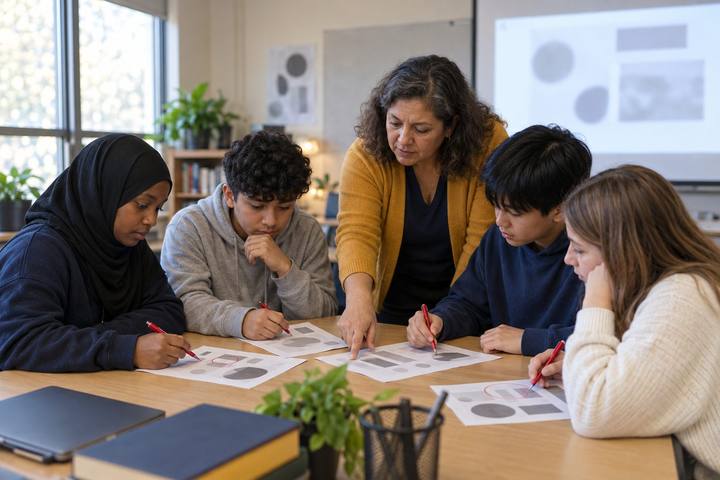
Using their completed Handout A log, students move to Handout B and audit each entry on the offload line: on one side, the AI carried thinking that was the actual learning goal (it chose the argument, solved the problem you're learning to solve, wrote the analysis); on the other, it handled real busywork around the learning (formatting a works-cited list, fixing spelling, reformatting notes you already made). For each, they mark a verdict and a one-line reason. They total how much of their week fell on each side.
Facilitator noteThe hard calls are the middle ones ("AI explained a concept I was stuck on"). Coach students to ask: did I understand it afterward, or just move on? That test sorts most gray cases.
Apply
In small groups, students share (only what they're comfortable with) one place their audit revealed overreliance, AI carrying thinking in a class whose whole point is to build that thinking (writing, problem-solving, language). Groups discuss: what skill is quietly not developing, and how would you know? Then each student names their single highest-risk habit.
Facilitator noteMake it about the skill at stake, not shame. A student who offloads all their writing isn't lazy; they're trading away the exact capacity the course exists to build. Name the trade, not the person.
Reflect
On Handout B, students write two or three personal rules tied to real situations, for example: "In English, I draft before I touch AI, then use it only to question my argument," or "I let AI format citations but never pick my sources." Each rule names a way to check it worked (I can explain my draft without notes; my test grade and my homework match). Close on the ELE question turned inward: "What evidence shows the tool improved my learning, not just my output?"
Facilitator noteRules without a check don't stick. Insist each rule names observable evidence the student can look for next week, so this becomes a habit they monitor, not a one-day worksheet.
Fully workable on paper: the week's log can be reconstructed from memory, the reading is printed, and the audit, analysis, and rules are all pen-and-paper. No device is required at any point; the thinking is about the student's choices, not the tool.
Students may privately consult their own chat history or device to reconstruct their week accurately, which makes the audit sharper. A class can build an anonymous tally of common offload types (no names, no content) to see patterns, which often reveals that everyone offloads the same few tasks.
Does it need a screen? This activity is better the more honest the data, and a student's real history makes the audit concrete; but the learning is self-knowledge and judgment, so it runs just as well from memory on paper. No AI is used during the lesson, by design.
What you should be able to see or collect if it worked.
Students audit a week of their own AI use, weigh mixed evidence on cognitive offloading, and set personal rules for when to struggle versus delegate, owning their learning.
Students run their rules for two weeks and bring back evidence (a test grade next to a homework grade, an essay they can defend without notes) showing whether their AI use helped learning or just output. The class refines the rules based on what the evidence showed.