Activity Bank
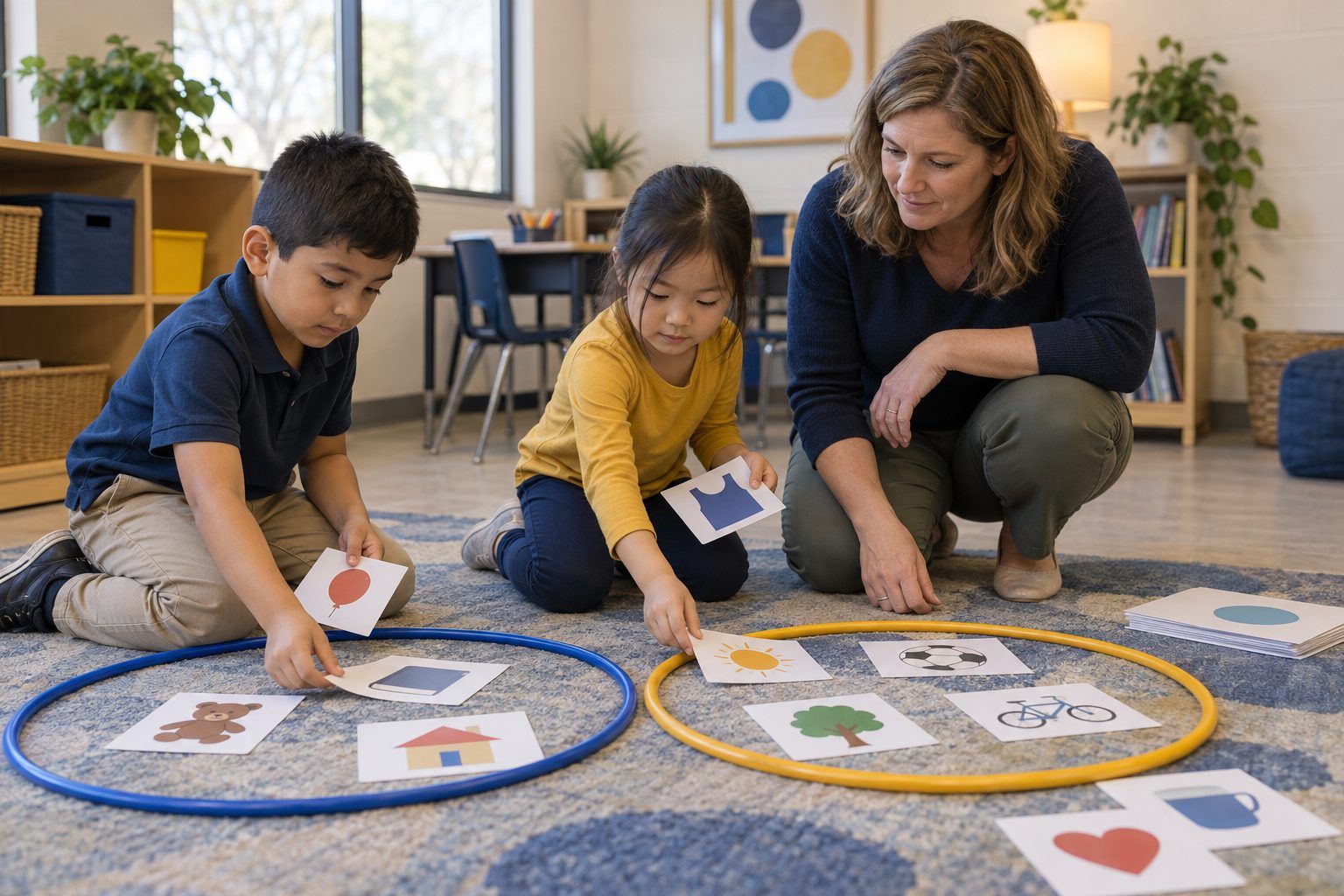
Two first graders sort picture cards into hoops while a teacher listens nearby.

All activities Student learning

The Dinner Table Deal

Young children notice how it feels when a screen interrupts time together, act it out, and make a simple "table deal" with their family about one screen-free time, so everyone, grown-ups too, gets a turn to be listened to.

Print handouts

Overview

Little kids feel it when a grown-up's eyes slide to a phone in the middle of their story, and grown-ups feel it when a child won't look up from a tablet at dinner. This lesson gives young children gentle words for that feeling and a tiny, fair plan to fix it. Children act out two short scenes, one where a screen interrupts time together and one where it doesn't, and notice the difference in their bodies and feelings. They learn that this is not about screens being bad; screens help us a lot, and there is a right time for them. Then they take home a "table deal": one screen-free time the whole family picks together, where everyone, kids and grown-ups, puts devices away so they can really listen to each other. The deal is on purpose a two-way promise, because children learn balance best when the adults they love practice it too.

Objectives

  • Students will name how it feels to be interrupted by a screen and how it feels to be listened to.
  • Students will act out and tell the difference between screen-free together time and interrupted time.
  • Students will help their family choose one screen-free time and a kind way to ask for it.
  • Students will explain that the deal is for everyone in the family, grown-ups too.

Materials

On paper

  • Handout A: Two Scenes, picture cards to act out (1 teacher set, enlarged)
  • Handout B: How Did It Feel? (1 per student, or 1 enlarged for the class)
  • Handout C: Our Family Table Deal (1 per student, sent home)
  • Crayons; a pretend phone (a block or a card) for role-play

On screen

  • Optional: a document camera to show the scene cards
  • Optional: a family may snap a photo of the finished deal to keep, no child's face needed

Before you start

  1. Print and enlarge Handout A's two scene cards and Handout B for modeling.
  2. Print Handout C for every child to take home.
  3. Have a pretend phone ready (a wooden block, a folded card) so no real device is needed.
  4. Read the family note on Handout C and add your name so families know who to contact.

Step by step

  1. 10–3 min

    Hook

    The slide-away eyes

    Start telling the class an exciting little story, then stop halfway and pretend to stare at a block in your hand like a phone. Wait a few seconds. Ask: "How did that feel when my eyes went away?" Let children say it: "sad," "you weren't listening," "I wanted you to look." Say warmly: "That is a real feeling. Today we're going to find a kind way to help everybody get listened to, kids and grown-ups."

    Facilitator noteChildren will instantly recognize this. Keep it playful, not shaming. The feeling of being half-listened-to is the whole hook.

  2. 23–10 min

    Explore

    Two scenes

    Using Handout A, act out two short scenes with volunteers. Scene 1: a family at dinner where one person keeps looking at a pretend phone; the others try to share news. Scene 2: the same dinner, but the phone is in a basket and everyone listens. After each, ask the actors and the watchers: "How did your body feel? How did your feelings feel?" Fill in Handout B together with faces or words for each scene.

    Facilitator noteBoth kids and grown-ups can be the one on the phone in Scene 1, switch it, so children see it is a family habit, not just a kid problem.

  3. 310–15 min

    Model

    A kind way to ask

    Teach a gentle sentence anyone in the family can use: "I want to hear you, so I'm putting my phone away." And a way to ask for it: "Can we have phones away so I can tell you something?" Practice in pairs: one child asks kindly, the partner answers, "Yes, I'm listening," and puts the pretend phone in a basket. Remind them grown-ups can say it too, and it feels good to be the one who gets listened to.

    Facilitator noteGive the exact words. Young children follow a script; "be kind about phones" is too abstract, but "I want to hear you" they can actually say at home.

  4. 415–22 min

    Create

    Start our table deal

    Children begin Handout C: draw the one time their family could make screen-free (dinner, bath time, the drive to school, bedtime stories). Draw where the phones will wait (a basket, a shelf). Draw everyone's faces listening. Circulate and ask, "When is your family's listening time? Who puts their phone away, just you or grown-ups too?" Help them see the answer is everyone.

    Facilitator noteKeep choices flexible. Some families don't eat dinner together; "the car," "bedtime," or "breakfast" are all fine screen-free times.
  5. 522–25 min

    Reflect

    Listening feels like…

    In a circle, each child says one word for how it feels to be really listened to ("happy," "important," "warm"). Close together: "Screens are good. People need listening too. Our deal is for everybody." Tell children to finish the deal at home and bring back how it went.

    Facilitator noteEnd on the balanced note: screens aren't the villain. The deal protects a little listening time; it does not ban devices.

Paper or screen

Unplugged

The whole lesson is unplugged: role-play with a pretend phone, a feelings chart, and a drawn family deal. A block or folded card stands in for a device, which keeps the focus on the feeling of being listened to, with no real screen in the room.

Digital

If a family wants, they can take a photo of their finished table deal to keep on the fridge or a parent's phone as a reminder, with no child's face needed. A class could also make a shared drawing of "listening time" ideas to project, built only from children's pictures.

Does it need a screen? This is best unplugged. The learning is about noticing feelings and practicing kind words face to face, and a real device would pull attention toward the screen, which is exactly what the lesson asks everyone to set aside for a moment.

Evidence of learning

What you should be able to see or collect if it worked.

  • Children name a feeling for being interrupted by a screen and a feeling for being listened to.
  • Children act out or describe the difference between the interrupted scene and the listening scene.
  • The table deal names one screen-free time, where phones wait, and that grown-ups join too.
  • Children use or recall a kind sentence for asking to be listened to.

Adaptations

Kindergarten
Do only Scene 1 and Scene 2 and the feelings chart with faces; children draw just the screen-free time, no words needed.
Grade 2
Add a sentence on the deal: children write the kind words their family will use and one thing they'll do instead during listening time.
Emergent bilinguals
Teach the kind sentence in the child's home language too, and let children answer the feelings chart with faces or colors.
Children in different family settings
Use "the people I live with" instead of assuming a dinner table, and let any shared moment (a bus ride, a bedtime) be the screen-free time.

Standards connections

Young children name feelings about screen interruptions and co-make a two-way family listening-time agreement, early respectful-communication and balance work.

TEKS
social interactions (c)(8)privacy, safety, and security (c)(10)TEKS sections: Technology Applications §126.5–§126.7

See how all activities align

Reflect

  • How does it feel when someone really listens to you? (Student ELE 3.2: I communicate my ideas clearly to others.)
  • Why is it fair for grown-ups to put their phones away too? (Student ELE 3.3: I value diverse perspectives in group work.)
  • What will your family do together during your screen-free time?

What comes next

Children finish the table deal at home with their family and try it for a few days, then share in a class circle one thing that felt good and one thing that was hard. Families are encouraged to keep the deal and change the time if a different one fits better.

Pairs well with