Activity Bank
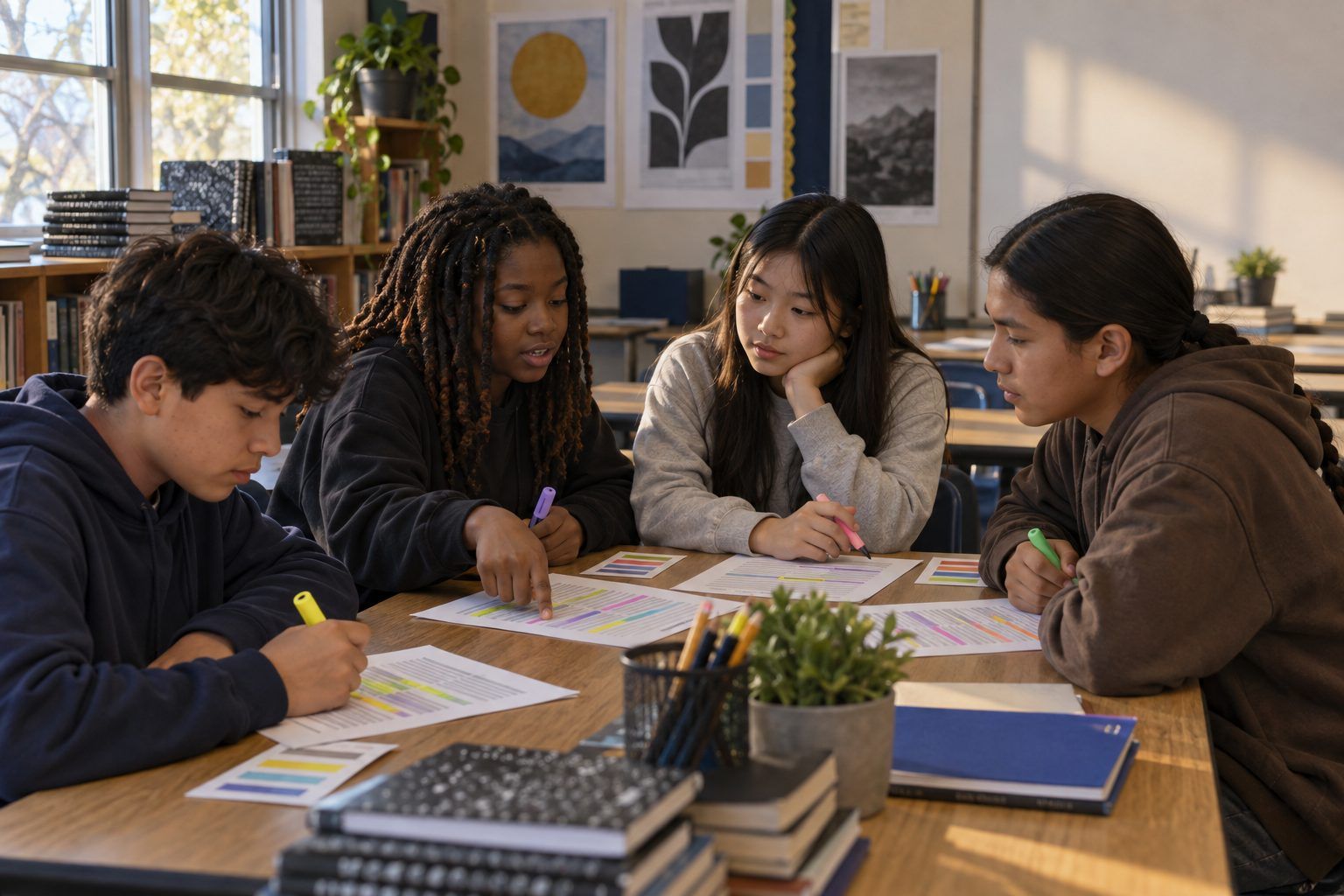
Eighth graders highlight printed chatbot responses in different colors, each noticing something different.

All activities Student learning

Bias in the Machine

Students read six mock AI outputs through different perspectives, find who is stereotyped or missing, and rewrite the prompts to fix it.

Print handouts

Overview

Generative AI learns from huge amounts of text and images made by people, so it can repeat the patterns in that material, including stereotypes and blind spots. In this activity, teams read six printed mock chatbot responses to everyday prompts. Each team member reads through a different Perspective Lens, so the group notices more together than anyone would alone. Teams name the assumption in each output, identify who is missing, and rewrite the prompt or the output so it works for more people.

Objectives

  • Students will identify at least one assumption, stereotype, or missing group in a mock AI output and support it with words from the text.
  • Students will explain how reading through different perspectives helped their team notice things one reader missed.
  • Students will write a revised prompt or a corrected output, and explain why checking AI output for bias is a human job.

Materials

On paper

  • Handout A: Mock AI Outputs (1 per team; optionally cut into six strips)
  • Handout B: Who's Missing? Organizer (1 per team)
  • Handout C: Perspective Lenses and Rewrite (1 per team, lenses cut apart)
  • Highlighters in four colors (one per lens)

On screen

  • Optional: a generative AI chatbot your district approves, driven by the teacher on a projector
  • Optional: a shared slide per team to post the best rewrite

Before you start

  1. Print Handout A for each team. For shorter class periods, give each team only two or three outputs and jigsaw the rest.
  2. Cut the four Perspective Lenses from Handout C so each team member gets one.
  3. If you plan the live comparison, test two of the Handout A prompts in your district-approved tool ahead of time. Outputs vary; you are looking for patterns, not an exact match.
  4. Set norms: we critique the output, not people or groups. Invite students to share their own experience only if they want to.

Step by step

  1. 10–5 min

    Hook

    Draw a scientist

    Give students 60 seconds to sketch "a scientist at work" on scrap paper. Hold several up. Ask: "What did most of us draw? Where did that picture in our heads come from?" Then say: "AI tools learn from what people have written and pictured, millions of times over. Today we check whether they picked up the same habits."

    Facilitator noteKeep it nonjudgmental. The point is that everyone carries patterns, and AI learns patterns from us.

  2. 25–17 min

    Explore

    Read through a lens

    Each team member takes one Perspective Lens from Handout C and a highlighter color. Students read Handout A silently first, highlighting anything their lens makes them notice. Then they go round-robin: each person shares one thing nobody else highlighted. The Recorder tallies how many noticings came from only one lens.

    Facilitator noteThe tally is your evidence for S3.3. Most teams find that several important noticings came from just one person.

  3. 317–30 min

    Practice

    Who's missing?

    Teams complete Handout B for at least four outputs: the assumption the AI made, the words that show it, who is left out or stereotyped, and a fix. Remind them to quote the output. Circulate and ask: "Is this output wrong, or just narrow? Would it hurt anyone if a student turned it in as-is?"

    Facilitator noteSome outputs are subtle (Output 5 assumes home internet and a quiet room). If a team says "nothing is wrong here," ask them to read it through the lens they haven't used yet.

  4. 430–38 min

    Create

    Rewrite it

    Each team picks one output and uses the bottom of Handout C to write a better prompt (for example, adding "include characters of different genders and backgrounds") or a corrected output. If you have a district-approved chatbot, run two teams' revised prompts live on the projector and compare the results to the originals.

    Facilitator noteA better prompt helps but doesn't guarantee a fair output. If the live result is still narrow, that's a great teaching moment: humans still have to check.

  5. 538–50 min

    Debrief

    Why it matters, who decides

    Each team shares its sharpest noticing and its rewrite in 60 seconds. Then discuss: "Where does AI bias come from? Who should fix it: the company, the user, the teacher?" and "How did having different lenses on your team change what you found?" Close by asking students to finish this sentence aloud: "Before I use an AI answer about people, I will…"

    Facilitator noteLook for students who connect bias to training data (patterns in what people have made) rather than saying the AI "has opinions."

Paper or screen

Unplugged

Designed to run fully on paper. The six outputs are printed mock responses, clearly labeled as written for this lesson, so no device or account is needed. Colored highlighters make each lens's contribution visible on the page.

Digital

The teacher runs the original and revised prompts in a district-approved chatbot on the projector and pastes results into a shared class slide. Students compare live outputs with the printed mocks. Grades 9–12 students with district-approved accounts may test prompts in pairs and log differences. Students under 13 do not use AI tools directly.

Does it need a screen? A live run shows that real outputs vary each time and that a better prompt helps but doesn't guarantee fairness. That turns "AI can be biased" into evidence students observe. The printed mocks carry the core thinking.

Evidence of learning

What you should be able to see or collect if it worked.

  • Handout B quotes specific words from an output as evidence of an assumption, rather than general statements like "it's biased."
  • The team tally shows noticings that came from only one lens, and students can say how that changed their answers.
  • Rewritten prompts or outputs include people who were missing, and students explain why a person still needs to check the result.

Adaptations

Grades 3–5
Use Outputs 1 and 6 only, read them aloud, and ask two questions: "Who is in this story?" and "Who could be in it but isn't?"
Grades 9–12
Add a policy step: teams write a two-sentence guideline for their school on checking AI-generated content about people before it's published or turned in.
Emergent bilinguals
Add a fifth lens: "A student whose first language isn't English." Invite students to check whether names, foods, and holidays reflect their own communities, if they choose to share.

Standards connections

Students read mock AI outputs through perspective lenses, quote words that reveal an assumption, and explain how training-data patterns produce stereotypes.

TEKS
computational thinkingresponse skillsSocial studies skills (sources, frames of reference, bias, and evidence)TEKS sections: Technology Applications §126.17–§126.19, high school Technology Applications courses (19 TAC Chapter 126); ELAR §110.22–§110.24, §110.36–§110.39

See how all activities align

Reflect

  • How well do I work with others when we learn together? What did someone else notice that I missed?
  • Why might an AI tool repeat a stereotype even though no one told it to?
  • When should I trust an AI tool to describe people, and when should I check or write it myself?

What comes next

In the next research or writing assignment where AI is allowed, students add one line to their work: "I checked AI output for who's missing by…" Families can try the "draw a scientist" question at dinner and compare answers.

Pairs well with