Professional learningfor Teachers, Librarians, Coaches
Lateral Reading Relay
Teams race to verify viral claims and an AI-written summary by leaving the page, not staring harder at it.
All activities Professional learning
A looking-at-student-work protocol that asks one question of a class set: did students actually verify what the AI told them, and how can we tell?
Teachers now ask students to "check what the AI says," and most students write "I checked it." This protocol treats that assignment as data. A PLC reads a fictional set of eighth-grade research notes, describes what is actually on the page, places each sample on a verification evidence continuum, and plans the instruction the pattern calls for. The move for coaches: shift the conversation from "Are students cheating with AI?" to "What does our students' work show about how they verify, and what do we teach next?"
Hook
Write on the board: "I checked it and it's right." Ask: "If a student wrote this, what do you actually know?" Take two or three answers. Say: "Today we look for the checking itself. Not the answer, not the effort. The evidence of the move."
Facilitator noteThe honest answer is: you know the student knows they were supposed to check. That's all.
Explore
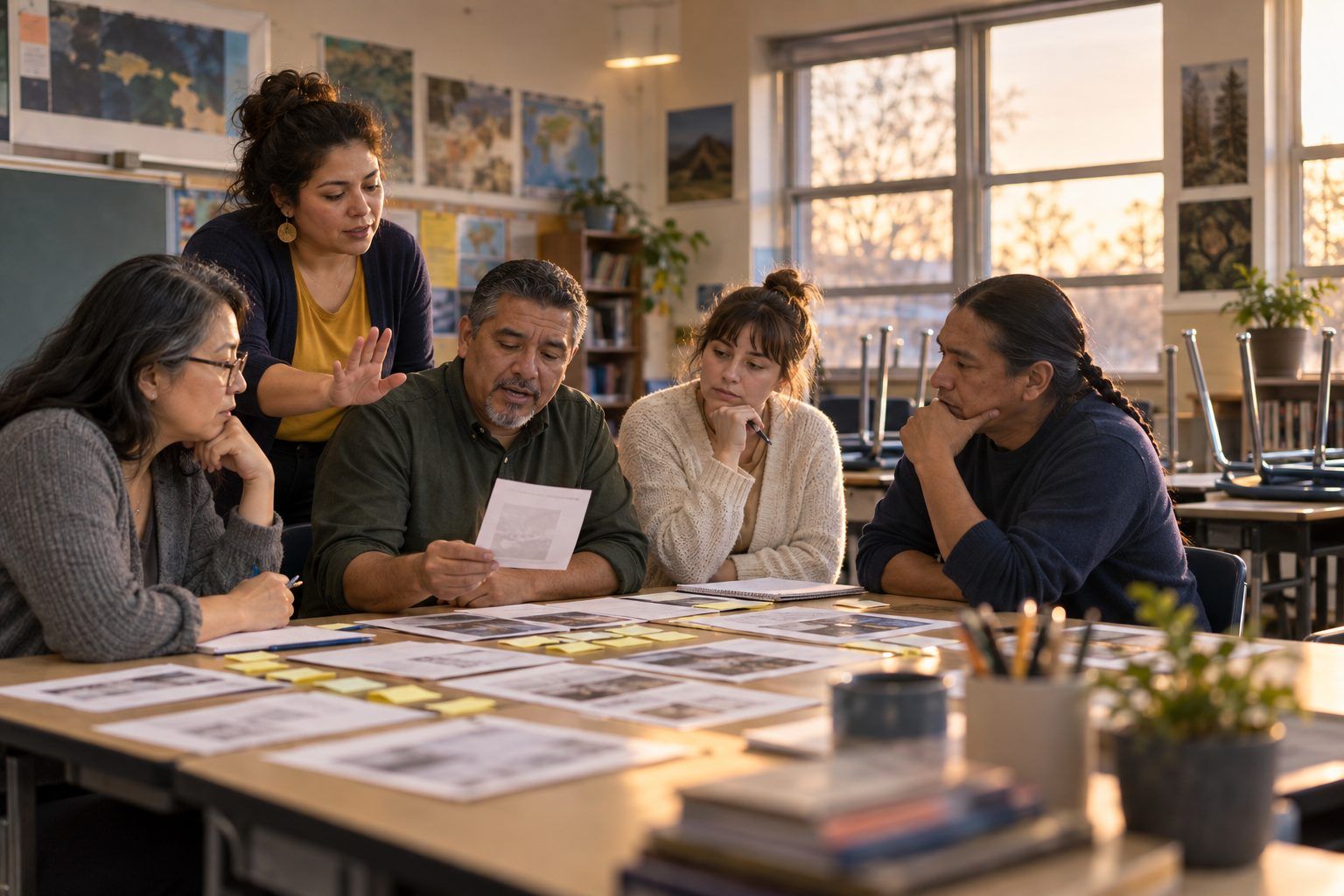
Everyone reads Handout A silently. On one color of sticky note, write only what is on the page: "Student C quotes a page number," not "Student C is careful." After six minutes, go around the table once; each person reads one note. The facilitator redirects any judgment: "What in the work makes you say that?" The note-taker records descriptions on Handout C.
Facilitator noteThis step feels slow. It is where the team stops seeing "good kids" and "lazy kids" and starts seeing moves.
Practice
Using Handout B, pairs place each of the seven samples at a level for each criterion, then compare with the table. Tally how many samples reached Checked a claim or higher. Discuss the tricky ones: Student E checked a site that repeated the AI's exact wording; Student F didn't use AI at all; Student G found a mismatch and kept the AI version anyway.
Facilitator noteLook-for: the team treats E as a media literacy gap (circular sourcing) and G as a disposition gap (trusting the machine over a source). They need different instruction.
Debrief
Ask the coaching question in its data form: "If this were our class, what does this pattern say about what we taught, and what we assumed?" Push the team from student labels to instructional causes: "Did we ever model what a check looks like? Did the assignment ask for evidence of the check, or just the answer?"
Facilitator noteIn this set, the assignment said "verify two claims" but never showed how or asked students to write down what they compared. Most gaps trace back there.
Apply
In the last column of Handout C, the team plans one move for each level: for students with no check, a teacher think-aloud verifying one AI claim; for claimed checks, a required verification log (claim · where I checked · match or mismatch · what I changed); for circular sources, a mini-lesson on finding a source that didn't copy the first one; for mismatch but kept the AI, a discussion of why a documented source outranks a fluent answer. For each move, write what student work will look different next time.
Facilitator noteKeep the plan small enough to try within a week. The measure is the next class set, not a survey.
Reflect
The team sets a date to bring the next set of student work and agrees on which criterion on Handout B they will tally. Each person writes one sentence: "Next time, I'll know my move worked if…"
Facilitator noteThis is the Measure and Adjust part of the coaching cycle. Put the date on the PLC calendar before people leave.
The protocol is designed for paper: printed work, sticky notes, and a shared record. Looking at student work at a table, with everyone holding the same page, keeps the conversation grounded in evidence and makes it easy to point to a line.
Put de-identified scans of student work in a shared folder and use a shared copy of Handout C. In a virtual PLC, participants add "I notice" comments directly on the scanned work, then the facilitator groups them. If students did their verification in a digital log or document with version history, the team can look at when and how the check happened.
Does it need a screen? Paper is the better choice for the protocol itself. A digital verification log earns its place in the classroom afterward because it timestamps each check and preserves the claim, the source, and the revision together, which is richer evidence than a finished paragraph.
What you should be able to see or collect if it worked.
A PLC reads student Dust Bowl notes for evidence of real checking, then plans instruction on verifying AI claims against independent sources.
Revise one upcoming assignment so students must record each check (claim, source, match or mismatch, change). Bring the next class set to the PLC and tally the same criterion to see what changed.