Activity Bank
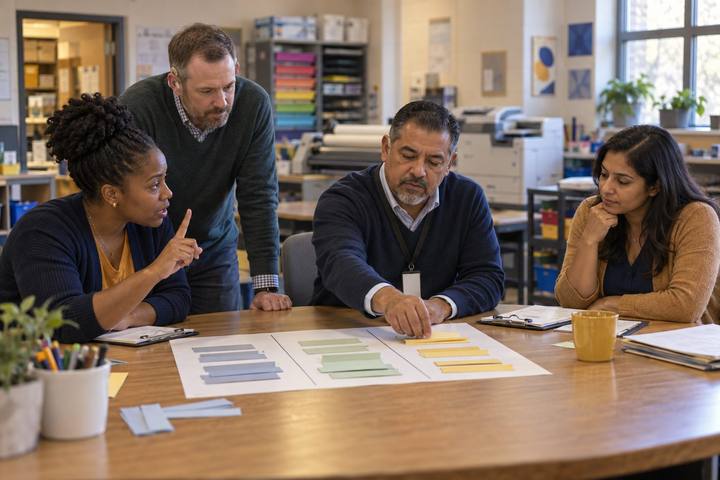
A school leadership team sorts classroom observation notes into columns on butcher paper.

All activities Professional learning

Instructional Rounds for Digital Learning

Leadership teams run a full rounds protocol on five written classroom vignettes, noting only what students do with technology and AI, then find patterns and name the next level of work for teachers, coaches, and themselves.

Print handouts

Overview

Walkthroughs often end in a verdict ("great tech use!") that tells a teacher nothing and tells a campus even less. Instructional rounds work differently: a team agrees on a problem of practice, gathers descriptive evidence of what students are actually doing, looks for patterns across classrooms, and names the next level of work for the whole system, not for one teacher. In this session, teams practice the protocol on five written vignettes from a fictional middle school whose problem of practice is about students reasoning together with technology and AI. They set their notes beside the campus walkthrough app's summary to see what each kind of data can and can't tell them. Unlike building a look-for rubric, rounds are about learning to see and deciding together what the campus does next.

Objectives

  • Participants will distinguish descriptive notes from evaluative and interpretive ones and rewrite evaluative notes as evidence.
  • Participants will collect descriptive evidence about what students do with technology and AI, anchored to a problem of practice.
  • Participants will identify patterns across classrooms and compare them with digital walkthrough data to decide what that data can and cannot tell them.
  • Participants will name a next level of work for teachers, coaches, and leaders, including a collaboration structure that has students reason together.

Materials

On paper

  • Handout A: Coyote Run Middle School: Problem of Practice and Five Classrooms (1 per person; also print each vignette large and post it around the room as a "classroom")
  • Handout B: Describe, Don't Judge Sort (1 set per team, cut apart)
  • Handout C: Patterns and Next Level of Work (1 per team, enlarged if possible)
  • Sticky notes (one color per team), chart paper, markers, a timer

On screen

  • None required. Optional: a shared document or spreadsheet where teams type their sticky-note evidence so patterns can be sorted and tallied

Before you start

  1. Print the five vignettes from Handout A on separate sheets and post them around the room as five "classrooms" with space for sticky notes beside each.
  2. Print and cut Handout B, one set per team.
  3. Read the problem of practice aloud to yourself. Rounds only work if everyone sticks to it; be ready to redirect notes that wander.
  4. If you are using this with your own campus next, draft your own problem of practice ahead of time so you can share it in the last step.

Step by step

  1. 10–5 min

    Hook

    What did you actually see?

    Read one walkthrough note aloud: "Great lesson, students were really engaged with the laptops." Ask: "If you were the teacher, what would you learn from this? If you were the principal planning PD, what would you know?" Then ask a volunteer to describe, in one sentence, only what someone could have seen or heard. Say: "Rounds are built on that second sentence."

    Facilitator notePeople often defend the first note as "positive." Acknowledge the intent, then point out that praise without evidence can't be acted on or built on.

  2. 25–15 min

    Explore

    Describe, don't judge

    Teams sort the Handout B strips into Descriptive, Evaluative, and Interpretive. For every Evaluative strip, they write a descriptive rewrite on a sticky note: what might the observer actually have seen? Check against the key and discuss the ones teams disagreed on.

    Facilitator noteInterpretive notes ("students seemed confused") aren't banned; they're held until the pattern step, where the team can test them against evidence. Evaluative notes ("poor use of AI") are the ones to rewrite.

  3. 315–20 min

    Model

    The problem of practice and a model note

    Read the Coyote Run problem of practice aloud. Then model three descriptive notes on Vignette 1 as a think-aloud: "Teacher projected a chatbot's summary. Six students raised hands to say a character was missing. One student asked, 'Why did it change her name?' Pairs compared whiteboards before sharing." Point out that each note is about what students do, and connects to the problem of practice.

    Facilitator noteModel the discipline of leaving things out. The room decor and the teacher's pacing may be interesting, but they aren't the problem of practice.

  4. 420–40 min

    Practice

    Rounds: visit four classrooms

    Teams rotate to Vignettes 2–5 posted around the room, five minutes per classroom. Each person reads silently and writes descriptive notes, one per sticky note, about what students are doing with technology, with AI, and with each other. No talking during the visit. Before moving on, each team posts its sticky notes beside the vignette.

    Facilitator noteWalk the room and gently return evaluative notes: "What did you see that made you think that?" Rotating silently keeps the observation individual, which is how real rounds protect against groupthink.

  5. 540–55 min

    Apply

    Patterns, then the walkthrough data

    Each team collects the sticky notes from all five classrooms and clusters them into patterns across classrooms on Handout C (for example, "When there was one device per group with roles, students argued about sources; with one device per student, talk was about the task, not the thinking"). Then read the walkthrough app summary on Handout A. Ask: "What does the app's data tell us about our problem of practice? What can't it tell us? What would we want our digital walkthrough tool to capture next time?"

    Facilitator noteThe app says technology was in use in most visits and engagement was high. The rounds notes show how students used it, and in two classrooms that wasn't reasoning together. Both data sources matter; they answer different questions.

  6. 655–67 min

    Create

    Next level of work

    In the last column of Handout C, teams write the next level of work for three groups. Teachers: one collaboration structure that has students reason together with technology (shared device with roles, pair verification of AI output, peer feedback on drafts). Coaches: what they'd co-plan or model. Leaders: what the campus provides (time, training, schedule, a revised walkthrough question, a pause on something). Each team shares its single most important next step.

    Facilitator noteRounds recommendations are for the system, never for one teacher. If a note starts with "The teacher in Classroom 2 should…", ask the team to rewrite it as "Our campus needs to…".

  7. 767–75 min

    Reflect

    Your own problem of practice

    Individually, each leader drafts a problem of practice for their own campus about what students do with technology or AI, in two or three sentences. It should be observable, within the campus's control, and tied to student learning. Pairs swap and ask: "What would we see students doing if we solved this?"

    Facilitator noteA strong problem of practice names student behavior ("students accept AI answers without checking them"), not a tool ("teachers need to use the new platform more").

Paper or screen

Unplugged

The whole protocol runs on paper: posted vignettes as classrooms, sticky notes as observation data, and chart-paper pattern maps. That makes it a safe way to practice the discipline of descriptive notes before visiting real classrooms, where the stakes and emotions are higher.

Digital

In a virtual session, post each vignette on its own slide and give teams a shared document with one column per classroom for their notes; breakout rooms rotate through slides on a timer. For live rounds on your campus, observers can type notes into a shared form tagged by classroom and problem-of-practice focus, which makes tallying patterns faster. Keep notes free of student names and share raw notes only with the rounds team.

Does it need a screen? Paper is better for practicing, because the handwritten sticky note forces one observation at a time. In live rounds, a shared digital form helps teams tally patterns across many classrooms and set them beside walkthrough-tool data, which is hard to do on chart paper.

Evidence of learning

What you should be able to see or collect if it worked.

  • Teams rewrite every evaluative strip on Handout B as a plausible descriptive observation.
  • Sticky notes describe student actions with technology and AI (verifying, questioning, building on each other) rather than device presence or teacher judgments.
  • Handout C names at least one pattern across classrooms and at least one thing the walkthrough app's data cannot show.
  • The next level of work includes a specific action for leaders, not only for teachers.

Adaptations

Elementary campuses
Swap Vignettes 2 and 4 for a grade 1 center rotation with tablets and a grade 4 read-aloud where the teacher projects an AI-generated question set that students critique.
Teacher-led PLCs
Teachers can run rounds on each other's classrooms with consent. Keep the same rules: descriptive notes, patterns not people, next level of work for the team.
Short on time
Run a 45-minute version with three vignettes (1, 2, 3), a combined sort-and-model, and the pattern step. Save the next level of work for the next leadership meeting.

Standards connections

Leaders practice descriptive classroom observation and pattern-finding about how students reason with technology and AI, then plan system-level next steps.

See how all activities align

Reflect

  • How do I support and evaluate effective technology integration without reducing it to a device count? (Leader ELE 2.1)
  • What does my current walkthrough data tell me about what students are doing with technology, and what does it leave out? (Leader ELE 3.1)
  • Where does my campus need to learn together, and where have we been asking individual teachers to fix a system problem?

Take it to your students

Share your draft problem of practice with your campus team this week and schedule one short live round (three classrooms, 10 minutes each) within the month. Use the same three rules: describe, find patterns, name the next level of work.

Pairs well with