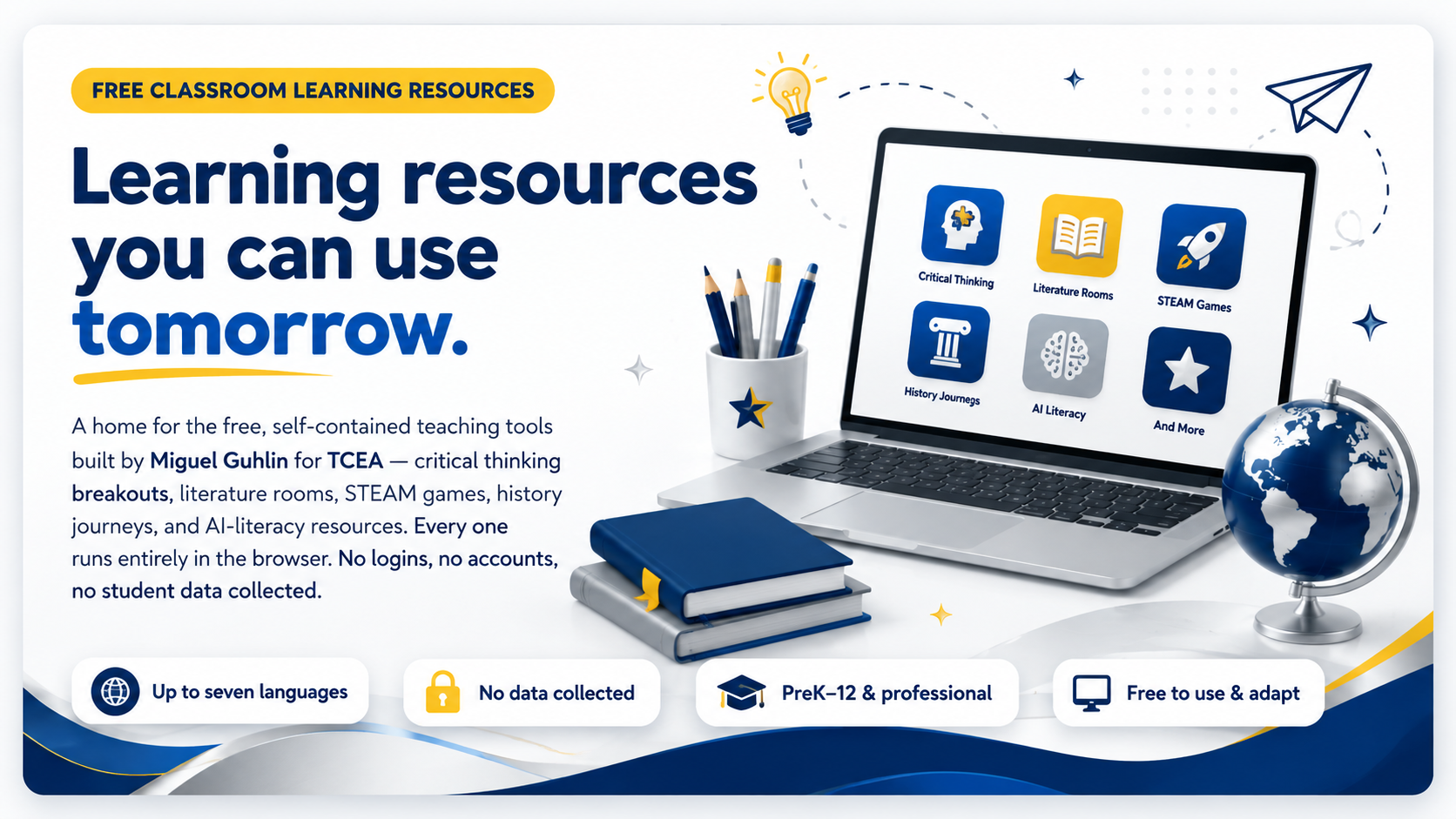
Explore the resources
Each opens its own self-contained site. Start with the Activities Hub — it gathers most of the classroom suites in one searchable place.
Learning Activities Hub
The main collection: Critical Thinking Online Breakouts (CTOBs), Science Detectives, Lab Safety Certification, Bible as Literature, PlotPoint literature rooms, Say It Make It STEAM barrier games, Problem-Solving Teaching, Relic Rooms, Digital Math Tools, Digital Citizenship, and Gen AI Literacy.
Open the hub →Language Bridge
A bilingual and ESL activity center for emergent bilingual students: Cognate Detective, Academic Language Lab, and Newcomer Navigator. 22 interactive activities across K–12, each with an English/Spanish switcher, a teacher view, ELPS/TEKS correlations, and color printables. No logins, no data collected — and it works on paper.
Open Language Bridge →Teacher Printables
Classroom-ready resources you can download, print, and adapt — no carts, no checkout. Middle-school science labs and cue cards (Phase Change stations, Supplemental Aids, CER & ACE Case Files) plus classroom-management tools like Student Refusal Forms and Getting to Know You.
Open Teacher Printables →ELE Activity Bank
95 ready-to-run activities built on the TCEA Essential Learning Expectations: professional learning for teachers, coaches, and leaders, plus K–16 classroom activities for Gen AI literacy, digital citizenship, and media literacy. Each has a facilitator guide and a print-ready packet, with standards alignment to the TEKS, ELPS, UDL, and SST.
Open the activity bank →Suffrage Sojourn
A no-combat, interactive journey through five turning points in the unfinished history of voting rights — from the Declaration of Sentiments to the Voting Rights Act. Primary-source shelf in teacher mode; original period-style illustration.
Begin the journey →Contraband
Banned and challenged books, turned into rigorous, standards-aligned learning rooms — vocabulary, evidence investigation, close reading, and discussion — built on the PlotPoint engine. 156 titles for grades 6–12, a free public-domain sample room, and print-ready ACE posters. No text from any copyrighted work is reproduced.
Open Contraband →TCEA Vibe-Coded Solutions
A single searchable launch page for the wider collection of HTML tools, dashboards, course references, prompt libraries, classroom games, and downloadable assets built for TCEA professional learning.
Browse the directory →AI for the Defense
Ethical, accurate, accountable generative AI for Texas criminal defense. Session decks, hands-on activities, a prompt library, and a BoodleBox bot — built for the Texas Criminal Defense Lawyers Association.
Open the resources →Getting to Know You
Self-contained, seven-language classroom activities for building community and belonging at the start of the year — or any time you need a fresh start. Part of the Activities Hub.
Get started →Digital Citizenship & Gen AI Literacy
The Digital Citizenship (TEKS Technology Applications, grades 3–8) and Gen AI Literacy breakout suites now live inside the Learning Activities Hub, where they are kept up to date alongside the other suites.
Find them in the hub →Licensing & reuse
These materials were created by Miguel Guhlin, Director of Professional Development at TCEA (the Texas Computer Education Association), as part of his work there. They complement TCEA's professional-learning programs — the blog, workshops, and conference sessions. Copyright is held by TCEA. Two licenses apply, depending on which part you reuse:
| Part | License | What it covers |
|---|---|---|
| Content | CC BY-NC 4.0 | Activity text, questions, scenarios, instructional design, artwork, translations |
| Code | MIT | HTML, CSS, and JavaScript source |
Yes, without asking: use these with your students, print and share them with colleagues, host your own copy on a school or district server, and adapt, translate, or remix them for your classroom — as long as you credit the original.
Not without written permission: selling them or any adaptation, or bundling them into paid training, a paid course, or a commercial product or subscription. Commercial use needs separate written permission from TCEA — ask; it simply isn't granted by the public license.
How to credit:
Each resource carries its own full Licensing & Provenance page with the details, exclusions, and works-by-other-people notes specific to it.
Provenance & how it's made
These resources grew out of TCEA's professional-learning work. Shared instructional scaffolding — UDL guidance, ELPS supports, and lesson-plan structure — is adapted from TCEA breakout and professional-development materials, and several suites are distilled from TCEA workshop curricula.
Works by other people are excluded from the license above and remain the property of their copyright holders. Literature activities favor public-domain texts; a few are original educational companions to works still in copyright — they reproduce no text, excerpts, or illustrations from those works and are not affiliated with or endorsed by any author, estate, or publisher. Historical journeys quote only short public-domain primary-source passages and link each source directly; scene artwork is original illustration, not reproduced historical work.
Content, code, artwork, and the multilingual translations are produced with the help of generative-AI tools and refined under Miguel Guhlin's direction and editorial review — a human stays in the loop on every decision. Translations are machine-assisted and flagged for local educator review before classroom use.
Privacy
Every activity runs entirely in the student's browser. There are no logins and no accounts, nothing is uploaded, and no student data is collected or transmitted. Progress, where an activity saves any, stays on the device.
Contact
For permissions, licensing questions, corrections, or to report an accessibility barrier, contact Miguel Guhlin at mguhlin@tcea.org. Students and families: please reach your teacher or school first — they deploy these locally and can respond fastest.