Activity Bank
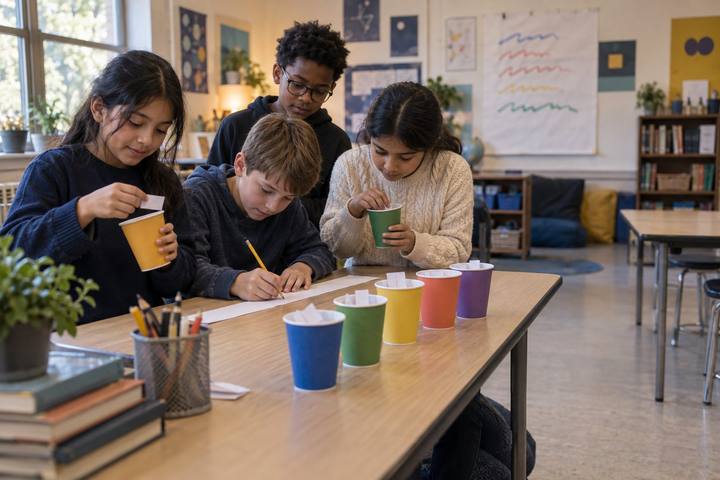
Educators laugh at a confident but wrong sentence their paper language model just produced.

All activities Professional learning

The Human Language Model

Educators become a tiny language model with paper slips and a cup, and discover firsthand why fluent AI text can be confidently wrong.

Print handouts

Overview

Generative AI chatbots don't look facts up the way a search engine or a database does. They generate text by repeatedly predicting a likely next piece of text based on patterns learned from enormous amounts of training data. In this unplugged session, teams "train" a ten-sentence language model by hand, generate new sentences by drawing slips from a cup, and then ask their model a factual question. The fluent, plausible, wrong answers that come out are the most memorable explanation of hallucination most educators will ever get, and one they can run with students the next day.

Objectives

  • Participants will build a next-word frequency table from a small training text and use it to generate new sentences by chance draws.
  • Participants will explain in their own words why a system that predicts likely next words can produce fluent text that is false (a "hallucination").
  • Participants will distinguish accurately between what the paper model shows and how real large language models differ (tokens, longer context, learned weights, scale).
  • Participants will draft a one-minute explanation of hallucination for their own students or colleagues.

Materials

On paper

  • Handout A: The Tiny Training Library (1 per team)
  • Handout B: Next-Word Tally Sheet (1 per team)
  • Handout C: Model Run Cards (1 set per team, cut apart)
  • Blank paper slips or sticky notes (about 60 per team), one paper cup per team
  • Chart paper titled "Our model said…" and markers

On screen

  • Optional: a generative AI chatbot your district approves, projected by the facilitator only, for the closing comparison
  • Optional: a shared slide where teams post their strangest generated sentence

Before you start

  1. Print Handouts A and B for each team; print and cut Handout C so each team has a face-down stack.
  2. Pre-cut slips (or use small sticky notes) and put a cup at each table. Teams will write one slip per tally mark.
  3. Read the facilitator key on the Handout C backs, especially the "how real models differ" notes. Accuracy matters: the paper model is a simplification, and you'll say so.
  4. Optional: decide on one factual question to ask your district's approved chatbot at the end, about a small or local topic where training data is thin.

Step by step

  1. 10–5 min

    Hook

    Finish my sentence

    Say slowly: "Once upon a…" and let the room finish it ("time"). Then: "Peanut butter and…" ("jelly"). Then: "The capital of France is…" ("Paris"). Ask: "Did you look any of those up, or did you predict them?" Tell them: "Today you're going to become a language model. A very small one. By the end you'll be able to explain to anyone why AI sometimes makes things up."

    Facilitator noteThe third sentence is deliberate. Prediction and knowing a fact can feel identical from the inside. That's the whole session in one moment.

  2. 25–15 min

    Explore

    Train your model

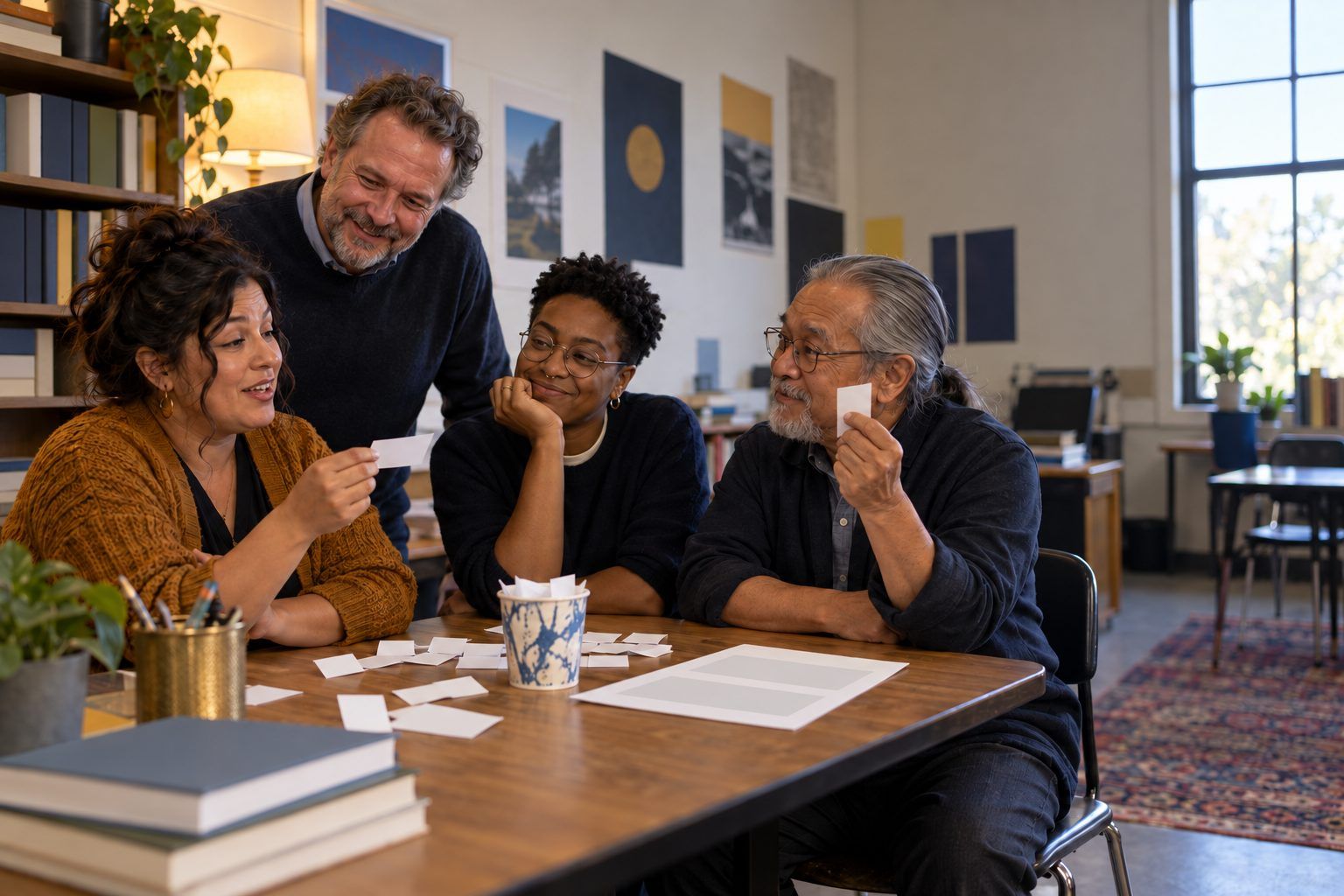
    Teams read Handout A, the ten-sentence "training library." On Handout B they tally, for each listed word, which word came right after it every time it appeared (ignore capital letters; count a period as the word END). Then they write one slip per tally mark, e.g., the word "the" is followed by "teacher" four times, so they write four "teacher" slips and file them under "the." Group slips by starting word in small piles or envelopes.

    Facilitator noteThis is "training": turning text into statistics about what tends to follow what. Teams that ask "what about meaning?" are asking exactly the right question. The model never gets meaning, only patterns.

  3. 315–25 min

    Practice

    Generate: draw the next word

    Teams draw Card 1 from Handout C. Start with "The." Put all the slips that follow "the" into the cup, shake, draw one, write it down. Now empty the cup and load the slips that follow that word. Keep going until you draw END. Generate at least four sentences. Read the best (and worst) aloud and post them on the "Our model said…" chart. Expect gems like "The principal opened the award in May."

    Facilitator notePoint out that the draw is random but weighted: "teacher" comes up more often after "the" because it appeared more often in training. That's why the same prompt can give different answers on different tries.

  4. 425–33 min

    Apply

    Ask your model a fact

    Teams draw Cards 4–6, the fact questions. For "Who won the spelling bee in June?" they generate an answer by starting "The" and drawing until END, re-drawing only if the sentence doesn't mention the spelling bee. Record answers. Most teams get something fluent and specific, e.g., "The teacher won the spelling bee in June," that appears nowhere in the training text. Ask: "Is your model lying?"

    Facilitator noteLand the key idea: the model isn't lying or "confused." It has no mechanism for checking truth. It produced a likely-sounding continuation, which is exactly what it was built to do. That's a hallucination.

  5. 533–40 min

    Model

    Honest differences: paper vs. real models

    Walk through Cards 7–9 aloud. Real models (1) work with tokens, often word pieces, not whole words; (2) weigh a long stretch of prior context, not just one previous word; (3) learn billions of numerical weights in a neural network rather than keeping literal tally piles; and (4) are further tuned with human feedback to be helpful and follow instructions. Some tools also search the web or a document and feed what they find into the prompt, which helps but does not guarantee accuracy. Then ask: "What stays the same?" (Output is generated by predicting likely text from learned patterns. Fluency is not evidence of truth.)

    Facilitator noteResist the urge to say "it's just autocomplete." It's far more capable than that, and people who later see a strong answer will feel misled. Say instead: "It is prediction at enormous scale, which is why it is both impressive and unreliable in specific ways."

  6. 640–46 min

    Create

    Your one-minute explanation

    Each participant draws Card 10 and writes a one-minute explanation of hallucination for their own audience: second graders, high school seniors, a parent, or a faculty senate. It must include (1) prediction from patterns, (2) why that can produce false statements, and (3) one thing to do about it (check a trusted source). Partners read each other's aloud and give one "clear" and one "accurate?" note.

    Facilitator noteListen for explanations that slip into "it looks things up" or "it thinks." Gently redirect to "it predicts likely words."

  7. 746–50 min

    Reflect

    Where does AI belong?

    Close with: "Knowing how this works, where in your subject would an AI chatbot's answer be most likely to sound right and be wrong?" Collect answers on the chart. Optional: project your district-approved chatbot and ask your pre-planned local or obscure question. Compare its fluency with the paper model's.

    Facilitator noteTypical answers: local history, recent events, specific citations and page numbers, niche statistics, names of small-town people. These are thin-data zones where plausible invention is most likely.

Paper or screen

Unplugged

The whole session is unplugged by design. The cups, slips, and tally sheet make the invisible machinery physical: participants literally hold the probabilities in their hands. Skip the optional chatbot comparison or replace it with Card 11, a printed mock chatbot answer, to discuss the same pattern.

Digital

For a virtual session, share Handout A in a shared document, have teams tally in a shared table, and use any random-picker tool loaded with the slip words (entered as many times as they were tallied) in place of the cup. The facilitator can close by projecting a district-approved chatbot and asking the same prompt three times to show variation from sampling. Participants don't need accounts.

Does it need a screen? This one is better unplugged. Drawing weighted slips from a cup makes prediction and randomness tangible in a way no screen demo does, and it keeps the focus on the concept rather than on any one product. The optional live chatbot comparison adds only one thing: seeing that a real system shows the same fluency-without-verification pattern.

Evidence of learning

What you should be able to see or collect if it worked.

  • Handout B tallies are correct and teams can explain that the cup draw is weighted by frequency.
  • At least one generated "fact" answer is identified by the team as fluent, specific, and absent from the training text, and named as a hallucination.
  • Written one-minute explanations use prediction language ("predicts likely next words") rather than retrieval language ("looks it up") and include a verification move.
  • In the Reflect step, participants name a specific thin-data zone in their own subject.

Adaptations

K–2 and 3–5 teachers
With young students, use only sentences 1–5, tally just "the" and one other word as a class on the board, and have the teacher draw from the cup. Keep the takeaway to one line: "AI guesses the next word. Guesses can be wrong, so we check."
Higher Ed faculty
Add a round where teams remove sentence 8 from the library and retrain, then discuss what happens to facts that appear once, or never, in training data. Connect to why AI-generated citations and references must be checked individually.
Emergent bilinguals
Build a second library of five sentences in a student's home language. Compare how word order changes the tally, and discuss why a model trained mostly on English text may perform less reliably in other languages.

Standards connections

Educators build a next-word frequency table by hand and watch it hallucinate, a classroom-ready model of how generative AI predicts from patterns.

TEKS
computational thinkingdata literacy, management, and representationTEKS sections: Technology Applications §126.5–§126.7, §126.8–§126.10, §126.17–§126.19, high school Technology Applications courses (19 TAC Chapter 126)

See how all activities align

Reflect

  • How am I developing and applying AI literacy in educational contexts? What do my students currently believe AI is doing when it answers?
  • Where in my subject is fluent-but-false AI output most likely, and how will students catch it?
  • Which part of today's model is a simplification I need to be honest about when I teach it?

Take it to your students

Run the Tiny Training Library with your students this week (Cards 1–6 are classroom-ready), then have each student write a two-sentence explanation of hallucination as an exit ticket. Bring five tickets to your PLC and sort them: prediction language or look-it-up language?

Pairs well with