Professional learningfor Teachers, Librarians, Coaches
Lateral Reading Relay
Teams race to verify viral claims and an AI-written summary by leaving the page, not staring harder at it.
All activities Professional learning
A gallery walk through ten mock viral posts (deepfakes, cheapfakes, out-of-context photos, and a few real ones) that teaches teachers to check where media came from instead of squinting for glitches.
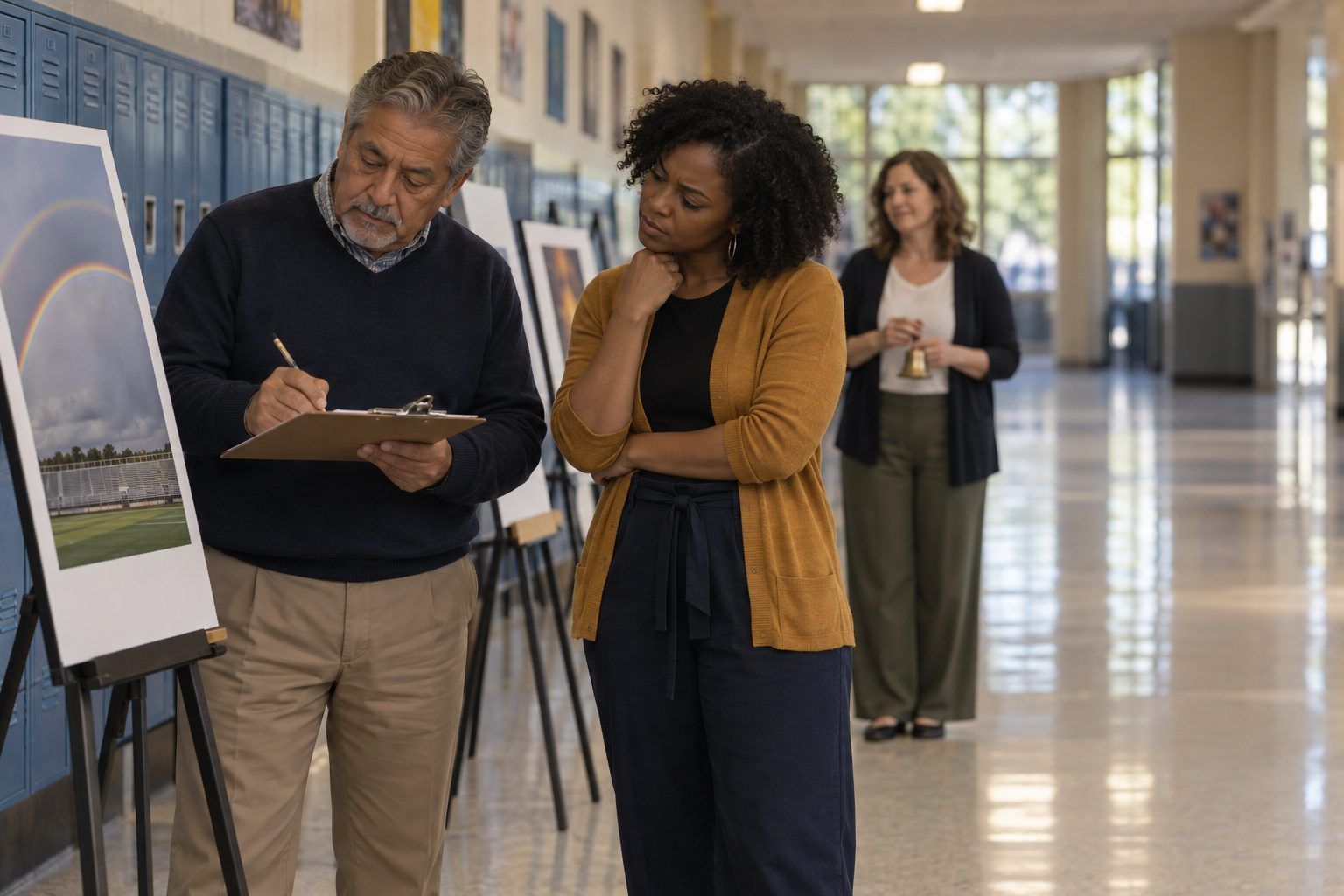
Synthetic media gets the headlines, but much misleading media is cheaper: a slowed-down clip, a cropped sign, a real photo with a false caption. And as generators improve, hunting for extra fingers and warped text becomes less reliable. In this gallery walk, pairs visit ten stations of mock media, label each one, and discover that the verification moves that work (who posted it, where's the original, what do others say) are the same whether the media was made by AI or by a video editor. Then they plan how to teach those moves, including the honest answer "can't tell yet."
Hook
Read Station 9 aloud (the double rainbow over the stadium) and ask for a fist-to-five: "Five means definitely fake." Most hands go high. Reveal: in this scenario it's authentic, confirmed by several photographers from different angles. Say: "Our eyes are poor lie detectors, in both directions. Today we practice what works better."
Facilitator noteDon't lecture yet. Let the surprise do the work.
Model
Introduce the labels on the chart. Authentic: real and in its true context. Out of context: real media with a false caption, date, or place. Cheapfake: edited with ordinary tools (slowed, cropped, spliced, or text altered). Synthetic: generated or heavily altered by AI, including cloned voices. Can't tell yet: not enough information, so don't share. Then the three questions: "Who posted this, and are they who they claim? Where is the original, full, earliest version? What do other reliable sources say?" Add: "Some cameras and AI tools now attach provenance labels (sometimes called content credentials), but labels can be missing or stripped, so their absence proves nothing."
Facilitator noteName the trap: spotting glitches (odd hands, garbled text) sometimes works today but gets less reliable as tools improve. Teach students questions that will still work next year.
Explore
Pairs start at different stations and rotate on the chime every 90 seconds (about 15 minutes for ten stations, plus transition). At each station, they fill a row of Handout B: first impression, the clue that made them pause, the verification move they would make, and a label. Each person also places a colored dot on the one station they would most likely have shared without checking.
Facilitator noteListen for pairs who label by gut and pairs who label by move. When you hear "it just looks fake," ask: "What would you check to find out?"
Debrief
Gather at the stations with the most dots and read their keys first. Then run through the rest quickly. For each, ask: "Which move would have caught this?" Tally on chart paper how many stations were solved by Who, Where, and What others say, and how many by visual clues alone. Close with the "liar's dividend": when fakes are common, people may dismiss real evidence as fake. Stations 6 and 9 are real. Verification protects the truth as well as exposing fakes.
Facilitator noteThe punchline: the same three questions caught the AI voice clone, the slowed clip, and the false caption. Students don't need a separate skill set for AI.
Transfer
Each person completes Handout C, planning a 10–15 minute version for their own students: which three stations (adapted to their grade), which label set (younger students can use just Real, Changed, Made up, Not sure yet), and what students must write before they're allowed to decide. Partners swap and ask: "What evidence will show me students used a move, not a guess?"
Facilitator notePush teachers toward "Not sure yet, don't share" as a celebrated answer. Students rarely hear that uncertainty is the responsible choice.
Everything runs on paper: stations are printed descriptions of the media, and each card's key reports what a lateral search or reverse image search would find. When pairs say what they'd check, hand them that portion of the key, just as a search would. The thinking move, asking who, where, what others say before deciding, is fully preserved.
In the Model step, demonstrate one reverse image search on a public-domain photo so participants see how quickly an earlier appearance of an image can surface. Optionally, generate a realistic image live with your district's approved AI image tool to show how little effort it takes. In a virtual session, put the stations in a slide deck, send pairs to breakout rooms with Handout B as a shared table, and run the dot vote with annotation stamps. Participants don't need AI accounts.
Does it need a screen? The live demos show two things paper can't: how fast a reverse image search can find an earlier appearance of a photo, and how easily a convincing synthetic image is made. Seeing both is what convinces teachers that provenance checks, not visual inspection, are the skill worth class time.
What you should be able to see or collect if it worked.
Teachers label authentic, out-of-context, cheapfake, and synthetic media by provenance, then plan a student version that requires a verification move.
Within two weeks, run a three-station version with students and collect their field notes. Count how many students wrote a verification move versus a visual guess, and bring that count to your PLC as your baseline.