Activity Bank
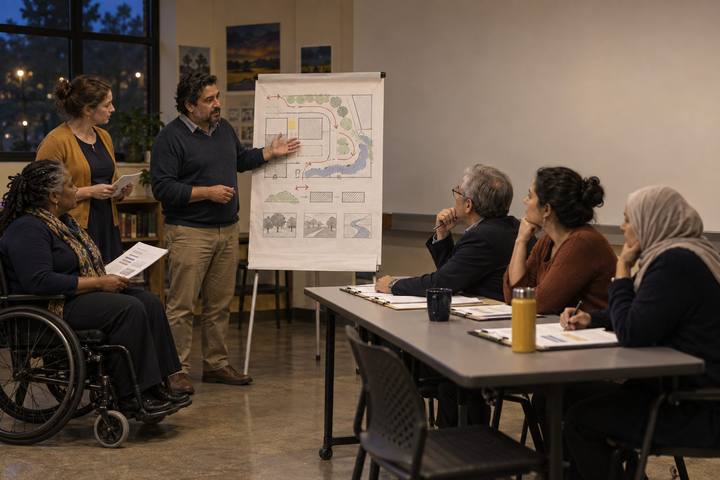
A grade-level teacher team sorts shared-planning dilemmas about AI into columns on small classroom chairs after school.

All activities Professional learning

Norms for the AI Era

A PLC builds trust first, then sorts real shared-planning dilemmas and drafts its own norms for AI use: disclose it, check it, and never put student data in a prompt.

Print handouts

Overview

Shared planning folders now hold quizzes, rubrics, and parent letters that a chatbot helped draft, and teams rarely talk about it. One teammate feels uneasy using an unmarked AI-written quiz; another quietly pasted student writing into a tool to get feedback ideas. This session gives a PLC a structured way to talk about it before it becomes a conflict: a Hopes, Hesitations, and Needs round built on three kinds of trust, a sort of realistic dilemmas, and a one-page set of team norms on disclosure, verification, and privacy that the team agrees to revisit.

Objectives

  • Participants will take part in an equal-voice trust protocol in which each speaker paraphrases the previous one before adding their own view.
  • Participants will sort shared-planning scenarios by what the team should do and justify each placement with a privacy, accuracy, or transparency reason.
  • Participants will draft team norms for AI use that include disclosure, a verification step, and a no-student-data rule, plus a date to revisit them.
  • The coach will identify at least one individual teacher's learning need from the protocol and plan a specific follow-up.

Materials

On paper

  • Handout A: Trust Protocol Cards (1 set per team, cut apart)
  • Handout B: Shared Planning Dilemmas Sort (1 set per team, cut apart, plus the mat)
  • Handout C: Our Team's AI Norms (1 per team, plus copies for each member afterward)
  • A talking piece (any small object) and a timer

On screen

  • Optional: the team's shared planning folder, open on one screen, so norms can be tested against real files
  • Optional: a shared document for the final norms, pinned at the top of the planning folder

Before you start

  1. Print and cut Handout A and Handout B. Keep the three Trust Type cards separate; you will read them aloud in the Hook.
  2. Look up your district's guidance on AI use and student data so you can answer "Is this allowed?" questions accurately in the sort. If there is no guidance, say so.
  3. Bring a notebook page for yourself titled "Follow-ups." You will note individual needs during the protocol, privately.

Step by step

  1. 10–5 min

    Hook

    Who made this quiz?

    Describe a fictional moment: "You open your team's shared folder and find a new ten-question quiz for Friday. It's polished. Question 7 has two correct answers. There's no name on it and no note about how it was made." Ask: "What's your first feeling? What's your first question?" Take three answers. Then read the three Trust Type cards from Handout A aloud: communicative, relational, and competence-based trust. Say: "Norms only work on a team that trusts each other enough to say the uncomfortable thing. We start there."

    Facilitator noteAnswers usually split between "who made it?" and "did anyone check it?" Both are norm questions: disclosure and verification.

  2. 25–18 min

    Explore

    Hopes, Hesitations, and Needs

    Seat the team in a circle and use the talking piece. Run three rounds from the Handout A prompt cards: Hopes ("One way AI could help our team plan better is…"), Hesitations ("One thing that worries me about AI in shared planning is…"), and Needs ("To trust a resource a teammate shares, I need to know…"). The rule for every speaker after the first: paraphrase the person before you ("What I hear you saying is…") before adding your own answer. Anyone may pass once per round. The coach speaks last in each round and records Needs answers on chart paper, without names.

    Facilitator noteListen for individual needs, not just team themes: the teacher who has never used a chatbot, the one who worries about accusing students, the one who uses AI heavily and feels judged. Note each privately on your Follow-ups page. Following up within a week, with exactly what you promised, is what builds competence-based trust.

  3. 318–30 min

    Practice

    Sort the dilemmas

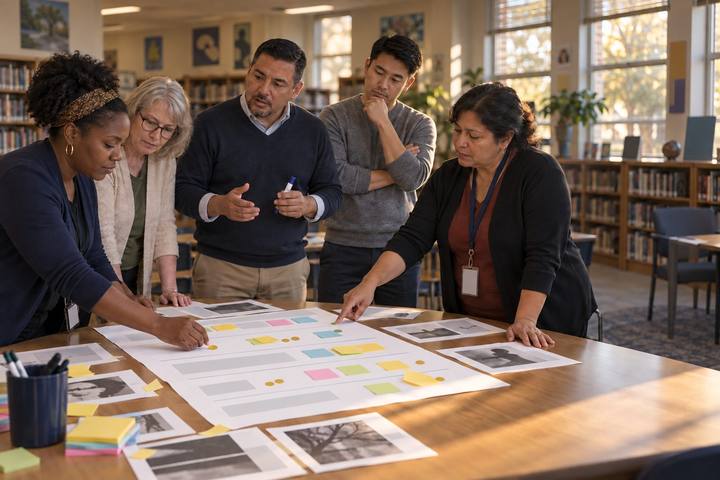
    The team sorts Handout B strips onto four columns: Go ahead, Go ahead and disclose, Stop: remove student or colleague data first, and Pause: ask the team or district. For every strip, someone must say the reason out loud using one of three words: privacy, accuracy, or transparency. Disagreements are welcome; place the strip on the line between columns and move on.

    Facilitator noteStrips on the line are the most useful part of the sort. They are exactly where the team needs a norm. Don't resolve them yet.

  4. 430–42 min

    Create

    Draft the norms

    Using the Needs chart and the strips on the line, the team completes Handout C. Push for norms written as actions a visitor could observe: "We add a one-line note to any shared resource AI helped draft: tool, what it did, who checked it" rather than "We are transparent." Required: a disclosure norm, a verification norm, a no student data in prompts norm, a trust norm about how the team raises concerns, and a revisit date.

    Facilitator noteTeams sometimes try to ban AI or require it. Steer toward norms about how the team works together, and let individual teachers decide about their own classrooms within district policy.

  5. 542–47 min

    Apply

    Test the norms

    Read the two test cases at the bottom of Handout C aloud. For each, the team asks: "Do our norms tell us what to do?" If not, revise one norm on the spot.

    Facilitator noteThe test cases are designed to find gaps: one about a parent letter translated by AI, one about a teammate who is uncomfortable using any AI-drafted material.

  6. 647–50 min

    Reflect

    One word, and a win

    Close with a quick round: one word for how the team feels about AI in planning now. Then invite one person to name a teammate's idea from today that will help students. Say: "We'll put these norms at the top of our folder and look at them again on the date we chose."

    Facilitator noteNaming a colleague's contribution is a small act of relational trust. It also signals that the norms are the team's, not the coach's.

Paper or screen

Unplugged

Everything runs in a circle with a talking piece, printed strips, and a paper norms sheet. A team with no devices loses nothing; the conversation is the work. Post the finished norms on the wall of the planning room.

Digital

Open the team's shared planning folder on one screen during the Apply step and test the norms against two or three real files: would they meet the disclosure norm? Move the final norms into a shared document pinned at the top of the folder, and add a disclosure-note template the team can copy. For a virtual PLC, run the rounds by calling names in a fixed order and use a four-column shared board for the sort.

Does it need a screen? This is better unplugged: trust is built face to face, and a screen invites side conversations. The digital step earns its place only when the team checks its norms against the real files in its shared folder, which turns abstract agreements into a concrete habit.

Evidence of learning

What you should be able to see or collect if it worked.

  • Every speaker after the first paraphrases the previous speaker before adding a view.
  • Sort placements are justified out loud with a privacy, accuracy, or transparency reason, and disputed strips are named rather than hidden.
  • The norms on Handout C are observable actions and include disclosure, verification, no student data in prompts, a way to raise concerns, and a revisit date.
  • The coach leaves with at least one named individual follow-up and a date to deliver it.

Adaptations

New or tense teams
Run only the Hopes and Needs rounds at the first meeting, and hold Hesitations for the second meeting once the paraphrase habit is familiar.
Campus leaders
Use the Pause column as your to-do list: each strip there is a question the campus or district needs to answer in writing.
Higher Ed departments
Swap two strips for syllabus-level dilemmas, such as sharing an AI-drafted course policy or rubric across sections.

Standards connections

A PLC builds trust through a structured protocol and drafts norms for disclosure, verification, and privacy in AI-assisted planning.

UDL 3.0
8.49.48.3

See how all activities align

Reflect

  • To what extent am I fostering a collaborative culture among the educators I work with? (Coach ELE guiding question)
  • Which kind of trust, communicative, relational, or competence-based, is weakest on this team, and what is one thing I will do about it?
  • What would it look like, a month from now, for these norms to be working?

Take it to your students

Deliver every follow-up you promised within a week. On the revisit date, open the shared folder with the team and check three recent resources against the norms. Ask students, too: a teacher can model the disclosure norm by telling a class which parts of a handout AI helped draft and how the teacher checked them.

Pairs well with