Children sort online messages into kind clicks and stop-and-tell moments, turn unkind words into kind ones, and practice asking a trusted grown-up for help.
Many young children already send hearts, stickers, and messages in games, class apps, and video chats with family. Words on a screen still land on a real person. In this lesson children watch a paper heart get crumpled by unkind words, sort messages into Kind Click (a heart made with their hands) and Stop and Tell (a stop hand), rewrite unkind messages into kind ones, and rehearse the exact words to use with a trusted grown-up. Messages that celebrate differences are part of the kind set, so children also practice welcoming friends who like different things.
Objectives
Students will sort online messages into kind and unkind or unsafe, and explain one choice.
Students will change an unkind message into a kind one, out loud or in writing.
Students will practice telling a trusted grown-up, using the sentence "I saw something online that made me feel ___. Can you help?"
Students will give a kind response to a friend who likes something different from them.
Materials
On paper
Handout A: Kind Click or Stop and Tell? sort strips (1 teacher set, cut apart)
Handout B: Fix-It Cards (1 set per 2–3 pairs, cut apart)
Handout C: My Kind Click (1 per student)
A large paper heart cut from construction paper; two signs: KIND CLICK (heart hands) and STOP AND TELL (stop hand); crayons
On screen
Optional: the class's own approved messaging, comment, or learning app, shown by the teacher on the projector
Optional: a slide with a mock chat window so the sort items look like real messages
Before you start
Cut out a large paper heart and practice the crumple-and-smooth demonstration.
Cut apart the 12 strips from Handout A and the 8 Fix-It Cards from Handout B.
Post the two signs on opposite sides of the room.
Decide who children should name as trusted grown-ups at school (you, the counselor, the principal) so you can say their names.
Step by step
10–4 min
Hook
The wrinkled heart
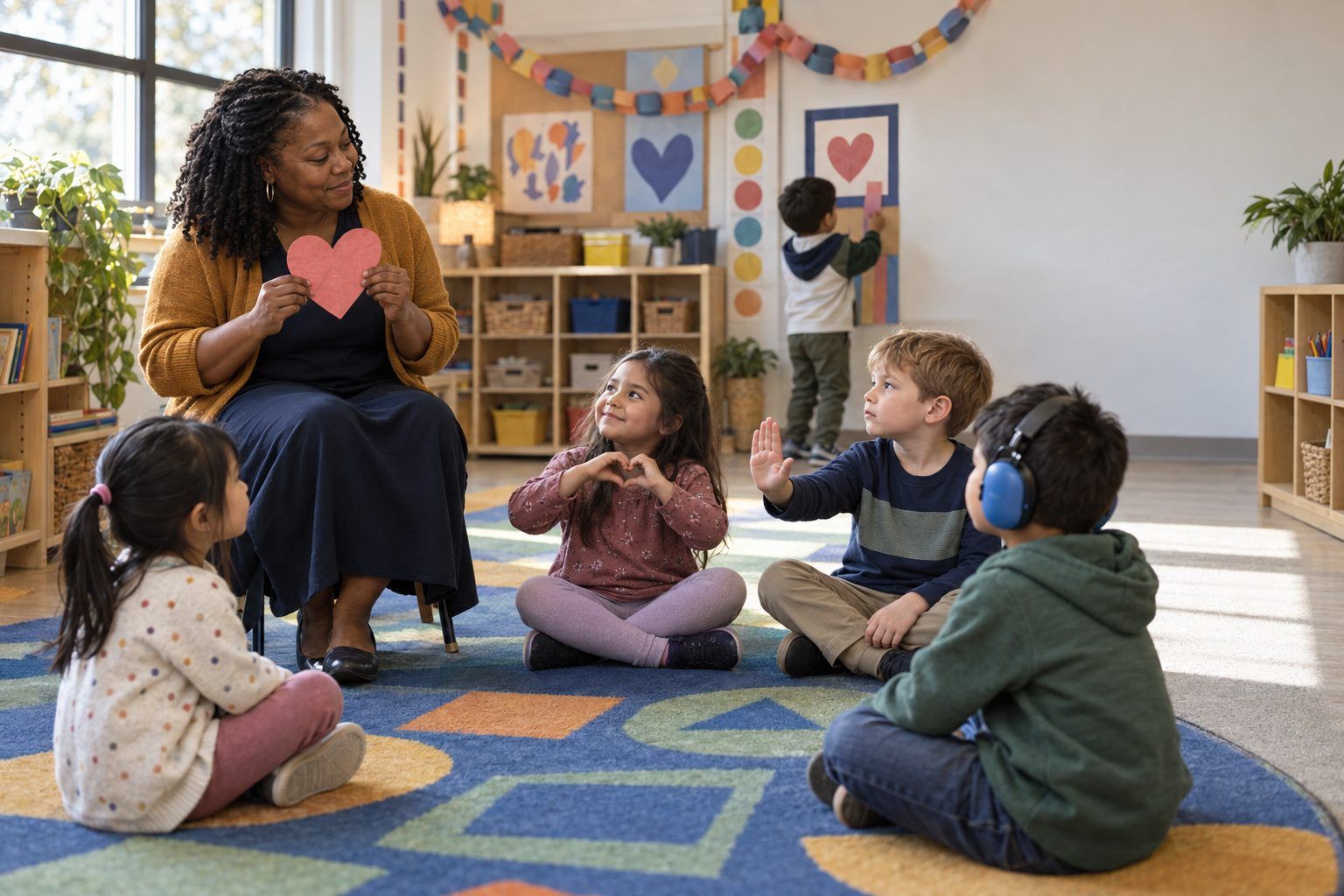
Hold up the paper heart and name it after a pretend child, "Remy." Read three unkind online messages sent to Remy ("Your drawing is ugly." "Nobody wants to play with you." "Everyone laugh at Remy's video."). Crumple the heart a little with each one. Then say "Sorry, Remy" and try to smooth it. Ask: "Is the heart the same as before?" Say: "Words on a screen still go to a real person. Today we practice kind clicks."
Facilitator noteName Remy as pretend so no child in class feels singled out. Keep the heart posted for the rest of the week.
24–8 min
Model
Two signals
Teach the two hand signals. KIND CLICK: make a heart with your hands. STOP AND TELL: hold up a flat hand like a stop sign, then point to a trusted grown-up. Explain: "STOP AND TELL means: don't send a mean message back, don't keep it a secret, tell a grown-up." Model one strip from Handout A out loud: "'Can I help you with that level?' That's helpful and kind. Heart hands!"
Facilitator noteStress the "don't send a mean one back" part. Young children often think fighting back is fair.
38–16 min
Practice
Sort the messages
Read each strip in a normal voice (not a mean voice). Children show heart hands or the stop hand. Hand the strip to a child who walks it to the matching sign. Ask one child per strip: "How would that message make someone feel?" For strips about liking different things, ask: "Is it OK that your friend likes something different? What could you say?"
Facilitator noteThe strip about sharing a funny photo of a friend without asking often surprises children. It may feel fun, but it isn't kind if the friend didn't say yes.
416–24 min
Apply
Fix-it and tell-a-grown-up
Give each pair a Fix-It Card. Partners read (or you read) the unkind message and together say a kind message instead. Share three or four aloud. Then role-play telling: one partner is the child, one is the trusted grown-up. The child says: "I saw something online that made me feel ___. Can you help?" The grown-up answers: "Thank you for telling me. Let's look at it together." Switch roles.
Facilitator noteThe Fix-It Card backs give a sample kind message. Accept any kind version the pair invents; their own words stick better.
524–30 min
Reflect
My Kind Click
Children complete Handout C: draw or write a kind message for a friend, draw a friend who likes something different and a kind thing to say to them, draw their trusted grown-up, and finish "When I see something mean online, I will…" Invite a few children to read their kind message to the wrinkled heart.
Facilitator noteCollect Handout C as evidence. The key sentence is the "I will" line: look for "stop and tell a grown-up."
Paper or screen
Unplugged
The lesson is fully unplugged: the paper heart, printed strips, hand signals, and role-play need no devices. You can write the sort messages in speech bubbles on the board to make them look like a chat.
Digital
Project the messaging or comment feature of an app your class already uses (or a mock chat on a slide) and type two or three sort messages into it so children see how they look on a screen. As a class, compose one kind comment together on a classmate's shared work, with the classmate's permission, and let the class decide if it passes the kind-click test before you post. Children do not need their own accounts; you type.
Does it need a screen? Kindness and help-seeking are best practiced face to face, so this lesson is unplugged at its core. Seeing and composing a real message on the projector adds a bridge: children connect the kind words they practiced to the screen where they'll use them.
Evidence of learning
What you should be able to see or collect if it worked.
Children choose STOP AND TELL for messages that are mean, share others' photos without asking, or ask for passwords, and explain how the message would make someone feel.
Pairs turn unkind messages into kind ones in their own words.
Children use the full tell-a-grown-up sentence in the role-play and on Handout C.
Children give kind responses to classmates who like different games, foods, or activities.
Adaptations
Kindergarten
Use 8 strips and focus on the two signals; skip writing on Handout C and let children dictate their kind message.
Grade 2
Pairs write their own Fix-It Card (an unkind message on the front, a kind fix on the back) and trade with another pair.
Emergent bilinguals
Hand signals carry the meaning. Offer the kind-message sentence frames in both languages and let children say the fix in either one.
Social-emotional support
Let the school counselor co-teach the tell-a-grown-up role-play, and name the counselor as a trusted grown-up.
Standards connections
Children sort kind and unkind online messages, rewrite unkind ones, and rehearse telling a trusted grown-up, the K–2 social-interactions strand of digital citizenship.
How would you feel if you got that message? How can we make someone's heart feel better?
How well do I work with others when we learn together? (Student ELE guiding question)
Who will you tell if you see something mean online?
What comes next
Send home the tell-a-grown-up sentence so families can practice it, and invite families to write one kind message together to a relative, on paper or on screen. Next lesson, use the kind-click signals during classroom partner work, not only online.
Children sort everyday activities, notice how their bodies and feelings respond to sitting still and to moving, and make a family balance plan, learning that screens aren't bad and choices matter.
Students work through real-world sharing dilemmas, audit account security and privacy habits, and write a personal safety plan they explain to a family member.
Students rank passwords from weak to strong, build silly-but-strong practice passphrases, and sort tricky moments into keep it secret, share with a trusted grown-up, or tell a grown-up now.