Activity Bank
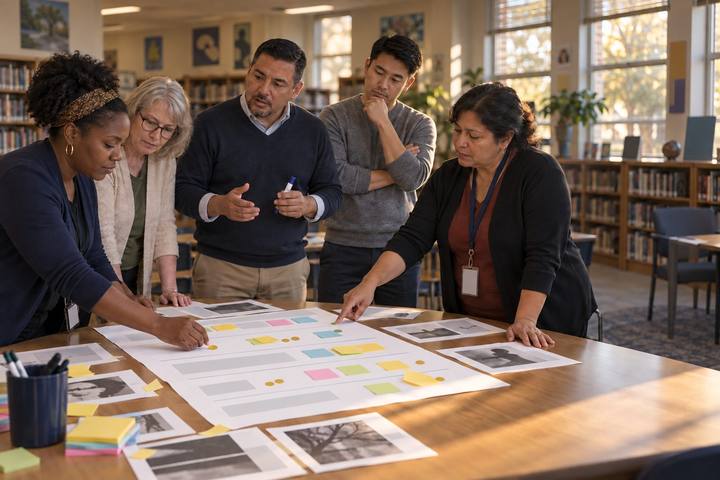
A principal waits her turn while her leadership team silently writes pre-mortem cards.

All activities Professional learning

Headlines From Year Three

Leaders write the success story and the failure story of their own AI or tech initiative three years out, then run a pre-mortem on the failure so they can build guardrails before launch.

Print handouts

Overview

Most initiative plans describe only the future where everything works. In this session, leadership teams write two headlines about their own campus AI or technology initiative, dated three years from now: one where they got it right and one where it went wrong. Then they run a pre-mortem, the technique psychologist Gary Klein developed: assume the failure headline came true and explain why. Teams sort the reasons through TCEA's five-question leadership check and turn the biggest risks into guardrails with owners and check dates, before the initiative has a chance to fail.

Objectives

  • Participants will write a success headline and a failure headline, each with a lede, for a real initiative three years out.
  • Participants will generate failure reasons independently, then sort them by the five-question check (vision, evidence, instruction, who's left out, families) to find the blind spots in their plan.
  • Participants will draft at least three guardrails, each with an early-warning signal, an owner, and a check date.
  • Participants will rewrite the success headline's lede so it names evidence the team will actually collect.

Materials

On paper

  • Handout A: Worked Example: Pecan Creek ISD (1 per person)
  • Handout B: Pre-Mortem Risk Map (1 per team, or enlarge to 11x17)
  • Handout C: Two Headlines and a Guardrail Plan (1 per team)
  • Index cards or sticky notes (10 per person) for silent pre-mortem writing
  • A visible timer

On screen

  • An anonymous form or shared document for the silent pre-mortem (one per team)
  • Optional: a generative AI chatbot your district approves, projected by the facilitator, for a second-pass risk list after the human pre-mortem

Before you start

  1. Ask each team to bring one initiative in a single sentence: what it is, who it serves, when it starts. It can be an AI tool rollout, a device program, a phone policy, a new platform, or an AI guidance document.
  2. Read Handout A so you can walk teams through the worked example quickly.
  3. If you're running the pre-mortem digitally, set up one anonymous form or shared doc per team with a single question: "It's three years from now and this initiative failed. Why?"
  4. Decide who will keep each team's Handout B as a living risk register, and tell teams at the start that it gets revisited.

Step by step

  1. 10–5 min

    Hook

    Two stories about the same plan

    Read the two headlines from Handout A aloud, the success first and then the failure. Ask: "Both are about the same school and the same tool. What would you need to know today to tell which one is coming?" Take three answers. Then say: "We're going to write both stories about your own initiative, and then we'll work out how the failure story comes true."

    Facilitator notePoint out that the failure headline in the example isn't a scandal. It's a quiet fade. Most initiatives end that way, not with a crash.

  2. 25–17 min

    Create

    Write both headlines

    On Handout C, each team writes two headlines dated three years from today, each with a two-sentence lede (who, what, when, and what changed). Headline craft rule: a headline names the people who were affected and what changed for them, not the tool. "Live Oak Adopts AI Writing Assistant" is a press release. "Live Oak Students Revise More, and Can Explain Why" is a story. Write the success headline first, then the failure headline.

    Facilitator noteCoaches in the room: listen for success headlines that describe usage ("every teacher logs in weekly"). Ask, "What would a student be doing differently?" That is the ELE question: technology use by itself is not evidence of learning.

  3. 317–32 min

    Explore

    The pre-mortem

    Say: "It is three years from now. The failure headline came true. Take five minutes, in silence, and write every reason why, one per card." No talking and no ranking. Then go around the team one reason at a time, round-robin, until every card is on the table. The most senior leader shares last. A recorder lists every reason, duplicates included.

    Facilitator noteSilence and the leader going last are the point of the technique. People will write risks on a card that they would never say first in front of their supervisor. Digitally, the anonymous form does the same job.

  4. 432–45 min

    Apply

    Map the risks to the five questions

    Teams sort every pre-mortem reason onto Handout B under one of the five questions: What is the vision? What evidence will guide us? What changes in instruction? Who might be left out? How will families understand the change? Then study the map. Crowded rows show risks the team already senses. Empty rows are the bigger finding. An empty "who might be left out" or "families" row usually means nobody on the team was thinking about it, not that the risk is absent.

    Facilitator noteAsk each team to add at least one reason to any empty row before moving on: "Who would say this plan failed them?"

  5. 545–57 min

    Create

    Draft the guardrails

    Teams choose the three reasons that are most likely and most damaging. For each one, complete the row on Handout B: the early-warning signal you'd see first (something observable in the first semester), the guardrail (what you'll do now to prevent it or catch it early), and an owner plus a check date. A guardrail can be a decision to stop, pause, or shrink the initiative if the signal appears.

    Facilitator noteOptional digital second pass: project an approved AI chatbot, describe the initiative in general terms (no names, no student data), and ask for likely failure reasons. Compare its list to the team's. Keep only the reasons the team can defend with local knowledge.

  6. 657–65 min

    Debrief

    The stranger test

    Teams swap Handout C with another team, who read the success headline and the guardrails and answer two questions in writing: "What evidence would prove this headline true?" and "Which guardrail would you want to see first?" Swap back. Each team rewrites its success lede so it names evidence the team will actually collect: student work, teacher practice, family feedback, access data.

    Facilitator noteA strong rewritten lede sounds like: "...and student revision logs show more second drafts, while families surveyed in two languages say they understand what the tool does."

  7. 765–70 min

    Transfer

    Put the check date on the calendar

    Before anyone leaves, each team puts its first guardrail check date on a real calendar and names who brings Handout B to that meeting. Close with: "Which of your two headlines is the default if we do nothing different on Monday?"

    Facilitator noteSuggest a 90-day review in which the team rereads both headlines and asks whether any early-warning signal has appeared.

Paper or screen

Unplugged

Run the whole session on paper. The silent pre-mortem works well on index cards, which teams then physically sort onto an enlarged Handout B. Unsigned cards give some of the anonymity a form would. Keep the finished risk map and headlines in the initiative binder and bring them to every check-in.

Digital

Use an anonymous form or shared doc for the silent pre-mortem, then paste the responses into a shared version of Handout B for sorting. In a virtual session, run each team in a breakout room and do the stranger test by swapping document links. The shared risk register becomes a living document with check dates as calendar invites. If you use an AI chatbot for a second-pass risk list, the facilitator projects it and enters no names or student data.

Does it need a screen? Anonymous digital input brings up risks that staff hesitate to say aloud in front of a supervisor, and a dated shared risk register keeps the pre-mortem alive past the meeting. The optional AI comparison shows where a general model adds a generic risk you missed, and where only local knowledge could have spotted the problem.

Evidence of learning

What you should be able to see or collect if it worked.

  • Success headlines name what changed for students or teachers, not how much a tool was used.
  • Handout B has at least one reason in every row, and the team can say which row was empty before they looked.
  • Each guardrail has an observable first-semester signal, a named owner, and a real date.
  • The rewritten success lede cites evidence the team will actually collect, including evidence from families or students who could be left out.

Adaptations

Instructional coaches
Run it with one teacher team on a classroom-level change (a new AI feedback routine, a phone-free unit) and use the coaching cycle: the guardrails become what you'll measure and adjust.
Higher Ed
Use it for a department or program initiative, such as an AI course policy or a new tutoring service. Replace "families" with "students and the people who support them" and add accessibility services to the "left out" row.
District cabinet
Have each team member write the failure headline from a different stakeholder's newspaper: the student paper, the local weekly, the teacher association newsletter, a parent group's post.

Standards connections

Leadership teams run a pre-mortem on an AI initiative and set guardrails, so tool adoption is judged by what changes for students.

See how all activities align

Reflect

  • How clearly have I communicated what this initiative is for, and would my staff write the same success headline? (Leader ELE L1.1)
  • Which students or families appear in my failure headline, and what policy would protect their access? (Leader ELE L4.2)
  • What ethical line, such as data, disclosure, or human review, would I hold even if the initiative were going well? (AI ELE AI2.1)

Take it to your students

Share both headlines and the top three guardrails with the staff who will carry out the initiative and ask them to add one failure reason you missed. Put the 90-day check date on the calendar and open that meeting by rereading both headlines.

Pairs well with