Student learningfor Grades 6–8
Our Home Screen Map
A student and a family member map where and when screens actually live in their home, then negotiate a few device zones together, trading blanket rules for choices the whole family helped make.

All activities Student learning
A student leads their whole household in building a family media plan the way doctors recommend, covering sleep, meals, content, and screen-free time, so the rules are made with everyone instead of handed to the kids.
Most household screen rules are handed down and resented. Pediatric guidance suggests the opposite works better: a family media plan the whole household builds together, one that covers more than minutes, when devices sleep, whether screens come to meals, what content fits which ages, and protected screen-free time, and that holds adults to the same standards as kids. In this activity the student becomes the facilitator. They learn what a good media plan actually covers, practice running a fair family meeting in class, and then lead that meeting at home: gathering everyone's needs, proposing agreements, handling pushback, and writing a plan each person signs. The stance is balanced and realistic: the plan is not a ban list and not a promise that screens are harmless; it is a living agreement a family revisits, built on the idea that people follow rules they helped write. Students practice leadership, negotiation, and the self-advocacy of asking adults to model what they ask of kids.
Hook
Ask: "Think of a screen rule you've been given that you ignore the second no one's watching. Why?" Collect honest answers (didn't make sense, applied only to me, no one explained it). Then flip it: "What if you ran the meeting that made the rules? Today you learn to lead your family in building a media plan together, one that even applies to the grown-ups."
Facilitator noteStudents light up at the idea of leading. Channel it toward fair facilitation, not toward writing rules that only benefit themselves.
Explore
Students read Handout A, which lays out what pediatric guidance says a family media plan should cover: device bedtimes (screens out of bedrooms overnight so sleep is protected), mealtimes, content and age-fit, protected screen-free activities, how everyone treats each other online, and, crucially, that adults follow the plan too. In pairs, students rank which parts their own family most needs. Debrief that a plan is much more than a number of minutes.
Facilitator noteThe sleep piece is where evidence is strongest, so highlight device bedtimes. But keep the plan broad: minutes alone is the weakest, most-fought-over lever.
Practice
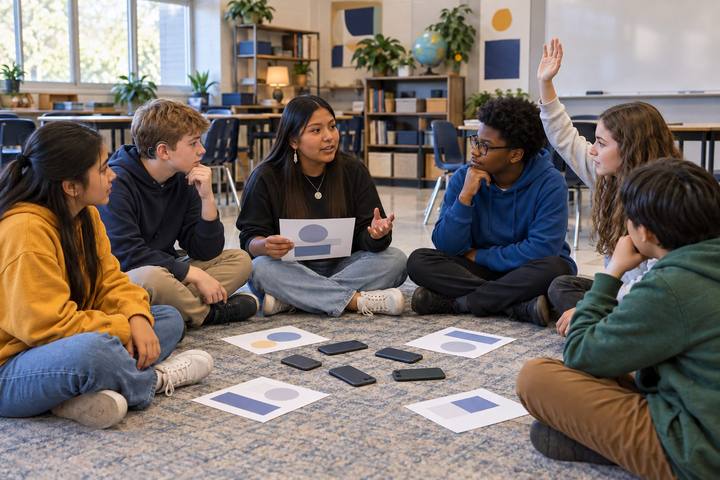
In groups of four, students role-play a family meeting using Handout B's script. One facilitates; others play a tired parent, a younger sibling, and a teen. The facilitator practices the moves: open with purpose, gather each person's needs before proposing anything, propose an agreement, invite pushback, and find a version everyone can accept. Groups swap the facilitator role once so everyone practices leading and being heard.
Facilitator noteCoach the hardest move: gathering needs before proposing solutions. Students, like adults, want to jump to rules; the fair meeting starts with listening.
Apply
At home, the student facilitates the actual family meeting with Handout B, then records agreements on Handout C across the plan's areas: device bedtimes and where phones charge, mealtime and screen-free times, content and age-fit for different family members, online kindness, and at least one agreement that applies to the adults. Everyone who agrees signs, and the family sets a review date. The student notes one place they had to compromise.
Facilitator notePrepare students for real pushback and for households that differ (shift work, shared devices, multigenerational homes). A plan that fits the real family beats a textbook-perfect one.
Reflect
Back in class, students debrief in small groups: "What was the hardest need to balance? What agreement surprised you? How did leading the meeting change how your family reacted compared with rules being imposed?" Capture why shared, revisable agreements tend to stick. Close on the balanced idea: a media plan is a living agreement, not a verdict on whether screens are good or bad.
Facilitator noteListen for students realizing that holding adults to the plan was both the hardest and the most powerful part. That mutual accountability is the heart of it.
The whole activity runs on paper: the reference sheet, the role-play script, the needs sheet, and the signed agreement. The family meeting is a face-to-face conversation; no device is required to build or keep the plan.
A family that prefers it can build the same plan with the AAP online Family Media Plan tool and keep a digital copy, and set the review date as a shared calendar reminder. The in-class role-play and reflection stay unplugged.
Does it need a screen? This is paper-first because the learning is facilitation and negotiation among real people. The optional digital tool only stores the plan a family already built together; it adds convenience, not learning.
What you should be able to see or collect if it worked.
Students facilitate a family meeting to build a whole-household media plan that applies to adults too, practicing leadership, negotiation, and shared goal-setting.
Families keep the media agreement visible and revisit it on the review date. In class, the facilitation skills carry into student-led conferences or group work, where the same meeting structure, gather needs, propose, invite pushback, agree, helps teams make decisions together.