Professional learningfor Coaches, Teachers
The Shallow Answers Coaching Cycle
Coaches role-play a full listen, co-plan, model, measure, adjust cycle on one familiar problem: students finish the digital work but say very little.
All activities Professional learning
A timed, listening-first protocol a coach and teacher use to redesign one upcoming lesson so students verify an AI answer or evaluate a source, and turn in proof that they did.
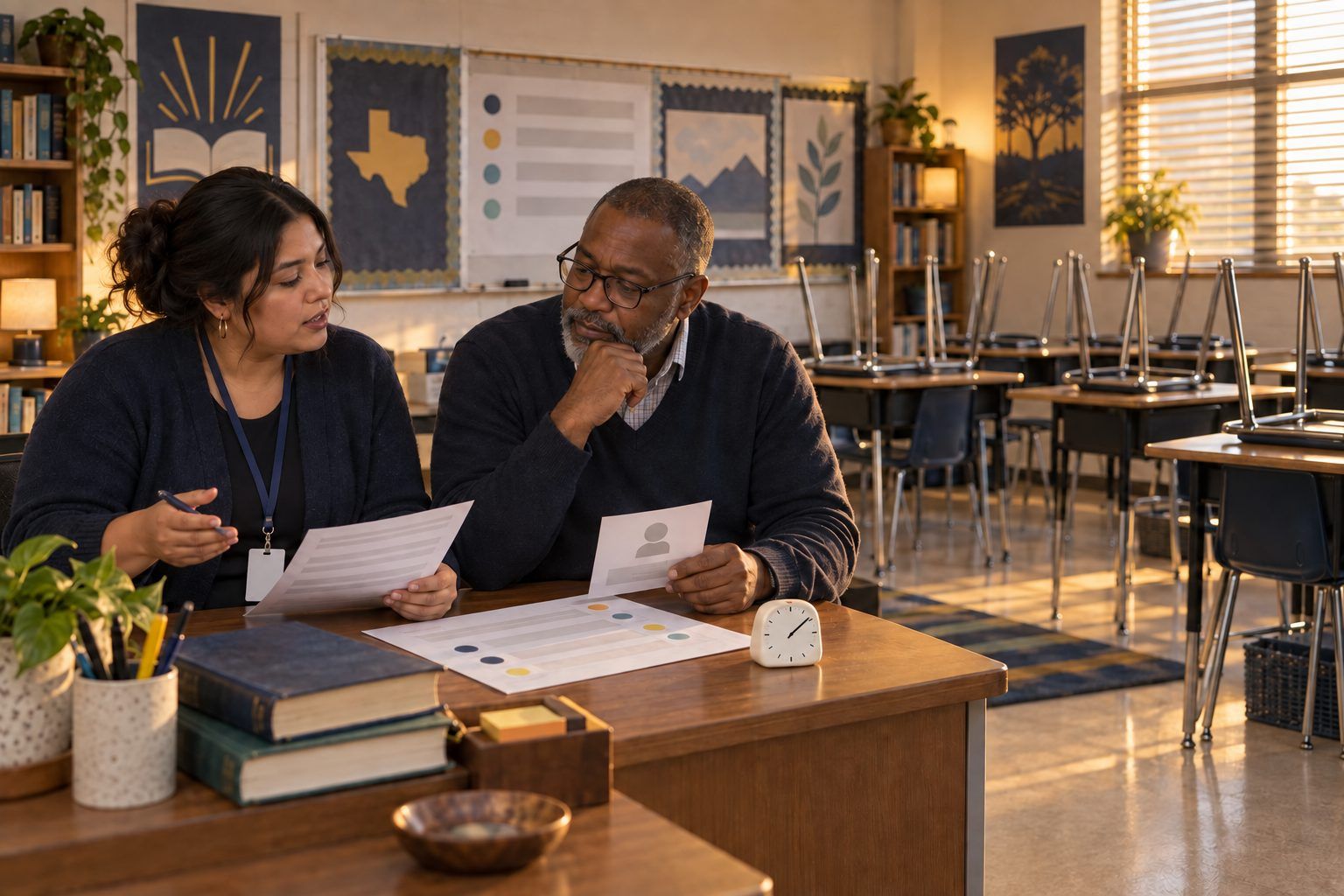
Most teachers have twenty minutes, not an afternoon, and most coaching conversations drift toward a tool before anyone has named the learning. Co-Plan in 20 sits in the Investigate and Innovate phase of the TCEA EIIR coaching cycle: a five-segment protocol that fits a planning period. The coach listens, uses the ARC moves (Acknowledge the reality, Reframe the problem from a student deficit to a design barrier, Commit to one high-leverage shift), redesigns one moment of the lesson, models it, and sets a date to look at student work. Participants run it in pairs on a real or persona lesson where students use AI output or online sources, then debrief what kept the conversation on the teacher's goal.
Hook
Ask coaches to recall their last planning conversation with a teacher and answer silently: "How many minutes passed before someone named a tool or an app?" Then ask: "How many minutes passed before someone named what students would turn in?" Take two or three answers. Say: "Today's protocol flips that order. We name the evidence first and decide about the tool, or no tool, last."
Facilitator noteMost people admit the tool came first. Keep it light; the point is noticing the habit, not judging it.
Explore
Everyone reads Handout B. Point out the five segments and their clock times: Listen and Acknowledge (0–4), Reframe and name the evidence (4–8), Commit to one shift (8–15), Model it (15–18), Plan the measure (18–20). The middle three carry the ARC protocol. Ask coaches to circle the one stem they rarely use and underline the segment they expect to be hardest.
Facilitator noteCoaches usually underline Reframe. "They believe everything it says" is a statement about students; "The lesson never gives them a moment to check" is a statement about design, and only the second one gives the teacher something to change.
Model
Invite a volunteer to play Teacher Persona 3 (Grade 8 ELA). You play the coach in front of the room for Segments 1 and 2 only. Use only listening stems for four minutes, then acknowledge: "What I hear you saying is that your students pick sources that agree with them, and it's frustrating because you've taught them what bias is. Did I get that right?" Then reframe out loud: "What if the problem isn't that they can't see bias, but that the assignment only ever asks them to find support? Where in the lesson are they asked to find the other side?" Finally ask the evidence question: "If this worked, what would you see on their paper?" Stop at the eight-minute chime and ask the room: "What did I not do?"
Facilitator noteThe answer you want: you did not suggest a fix, a tool, or a strategy. Name that restraint as a move, not a pause.
Practice
Pairs choose a real lesson or a Teacher Persona card from Handout A. The coach uses Handout B; the teacher holds the persona card and reveals the hidden detail only if the coach asks a question that earns it. Ring the chime at 4, 8, 15, and 18 minutes. Pairs fill in Handout C as they go. In Segment 2 the coach offers a reframe the teacher can accept or reject. In Segment 3 they commit to one shift (trace a claim, compare an AI answer to a source, read laterally about a website, or check a date), hold the goal firm, and list at least two ways students could show the check (a written note, a sorted card, a sentence stem said to a partner, a sketch). They also decide together whether AI belongs in the lesson at all. In Segment 4 the coach models the move as a 60-second think-aloud aimed at the teacher's students. In Segment 5 they write the artifact, the date, and the question they will ask of the student work.
Facilitator noteIf there is a third person, they take the Observer card and tally coach questions and coach suggestions in each segment. Watch for pairs that redesign the whole unit. One shift is the assignment; ARC stands for one commitment, not a list.
Debrief
Pairs report in one sentence each: "The teacher's goal was… The student evidence we'll collect is… We decided AI does / does not belong because…" Then ask the teacher-players: "When did you feel heard? When did you feel steered?" Chart the moves they name.
Facilitator noteTeacher-players often say the paraphrase was the moment they felt heard, and a suggestion in the first minutes was when they felt steered. That is C1.2 feedback running both ways.
Transfer
Coaches write the name of one teacher and a date on the back of Handout C and the first stem they will use. Teachers who brought a real lesson keep their completed Handout C and agree to send the coach three pieces of student work after teaching it.
Facilitator noteSuggest coaches offer the protocol by name: "Could I have twenty minutes of your planning period? We'll leave with one change and a date." A fixed time limit lowers the barrier, and showing up on the date you promised is what builds trust for the next conversation.
The protocol is designed for a table, a timer, and paper. The coach reads stems from Handout B, the pair fills in Handout C by hand, and the Segment 4 model is a spoken think-aloud using a printed source or an AI answer the teacher already has. If the lesson involves an AI answer, the teacher can bring a printed copy of one.
In a virtual session, send pairs to breakout rooms with a shared copy of Handout C and a countdown timer posted in the chat. In a real coaching conversation, keeping Handout C in a shared document gives the coach and teacher one record to reopen when the student work comes back. If the lesson uses an AI chatbot the district approves, the teacher can drive it on a projector in Segment 4 so the model uses a live answer.
Does it need a screen? Unplugged is the better default: the skill is listening, and a laptop between coach and teacher pulls attention away. A shared planning document earns its place afterward, when the student work comes back and both of you need to see what was planned and what changed.
What you should be able to see or collect if it worked.
A coach and teacher practice a timed co-planning protocol that adds a verification step for AI output or sources to a real lesson.
Run Co-Plan in 20 with the teacher you named this week. When the three pieces of student work come back, spend ten minutes together answering the question you wrote in Segment 5, then decide the next adjustment.