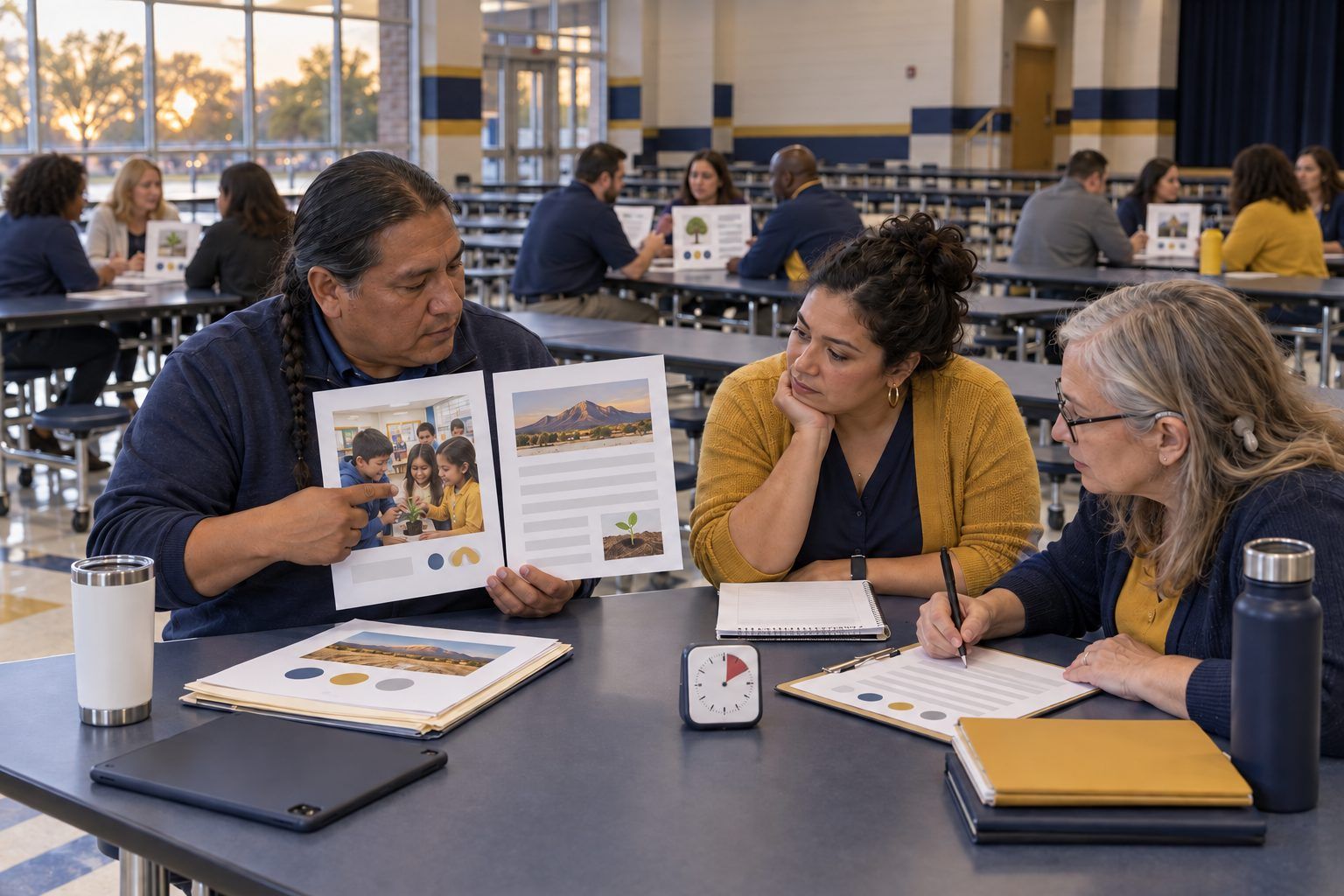
Professional learning · Coaches, Librarians · 90 minutes
Coach-to-Coach Microteaching
Coaches plan and deliver 10-minute micro-PD sessions on one digital literacy move, get protocol-based peer feedback, and revise before a teacher ever sees it.
Coaches are often asked to teach a skill to adults in the ten minutes at the start of a staff meeting, and those ten minutes rarely get rehearsed. In this session, each coach draws one digital literacy move (tracing a quote, checking an AI answer's sources, a privacy pause before uploading), plans a 10-minute micro-PD with a RISE goal and adult learning principles built in, delivers it to two colleagues, and receives feedback through a structured glow, grow, and try protocol. Coaches also test an AI-drafted set of feedback stems and decide what to keep. Everyone revises and re-delivers the weakest two minutes before leaving.
In this packet
- Handout A: Move Cards and AI-Drafted Stems (cut-apart cards)
- Handout B: Micro-PD Planner (worksheet)
- Handout C: Micro-PD Feedback Rubric (rubric)
- Facilitator key (last page)
TCEA ELE indicators
- C4.1 I know how to design and deliver effective professional development sessions.
- C4.3 I am aware of adult learning principles and how to apply them.
- C5.3 I am aware of strategies to build trust and promote teamwork.
- C1.2 I can provide constructive feedback to improve teaching strategies.
- AI4.2 I can teach others to question and verify AI outputs.
Full facilitator guide: mglearn.github.io/eles/activities/coach-to-coach-microteaching.html
Handout A for Coach-to-Coach Microteaching
Move Cards and AI-Drafted Stems
Cut apart. Each coach draws one Move card. The two AI-Drafted Stems cards are for the whole trio. Backs are the key idea and the common misconception.
Sheet 1 of 2
Move · Trace the quote
Before sharing a quotation from a post, find where the person actually said it and read the sentences around it.
Move · Check the AI's sources
When a chatbot cites a source, open it. Does it exist? Does it say what the chatbot claims?
Move · Who's behind this site?
Leave the page and search the organization's name to learn who runs and funds it before trusting its claims.
Move · Find the original image
Use a reverse image search, or look for the earliest post, to see where and when a photo first appeared.
Move · Check the date
Before reacting to a story, look for when it was published and whether it's being recirculated as new.
Move · The privacy pause
Before uploading anything to an app or AI tool, ask: whose information is in this, and where does it go?
Move · Disclose the AI help
Add a short note to work that AI helped with: which tool, what it did, what you changed and checked.
Move · Name the persuasion
Before sharing, name the technique the post uses: urgency, fear, flattery, bandwagon, or a strong emotion.
Handout A for Coach-to-Coach Microteaching
Move Cards and AI-Drafted Stems
Cut apart. Each coach draws one Move card. The two AI-Drafted Stems cards are for the whole trio. Backs are the key idea and the common misconception.
Sheet 2 of 2
AI-Drafted Stems · Glows
Mock chatbot output: "1. You did an amazing job! 2. Your energy was fantastic and really engaging. 3. The participants practiced the move with a real example, which built their confidence. 4. Great use of technology!"
AI-Drafted Stems · Grows
Mock chatbot output: "1. Consider adding more interactive elements. 2. You seemed nervous; work on your confidence. 3. The model could show a dead end as well as a success, so participants see what checking really looks like. 4. Next time, include a clear link to what students will do."
Handout B for Coach-to-Coach Microteaching
Micro-PD Planner
Ten minutes total. Name the adult learning principle each segment honors: why before what, use experience, real problems, choice, relevance now, practice with feedback.
My move and the teachers I'd teach it to:
RISE goal for this micro-PD. Relevant (why these teachers, why now) · Impactful (what changes for students) · Specific (what teachers will be able to do) · Energized (why they'll want to try it):
Why (1 min): the problem teachers will recognize. Principle honored:
Model (3 min): my think-aloud, including one dead end. The example I'll use:
Try (4 min): what participants do, on what example, and how I'll know they did it:
Transfer (2 min): what teachers do with students next week and the student evidence they bring back:
Revision after feedback: the segment I changed, what I changed, and which feedback prompted it:
Handout C for Coach-to-Coach Microteaching
Micro-PD Feedback Rubric
Score quietly after each session. Circle one level per row and write the moment that shows it in the margin.
| Criterion | Not yet | Emerging | Solid | Ready for teachers |
|---|---|---|---|---|
| Why before what | Starts with a definition or a tool. | Names a problem, but it's generic. | Opens with a problem these teachers recognize. | Opens with a problem these teachers recognize, and connects it to their students in under a minute. |
| Live model | Describes the move instead of doing it. | Does the move, but silently or too fast to follow. | Thinks aloud through the move on a real example. | Thinks aloud, including a dead end, so the checking looks real. |
| Participants practice | Participants only watch. | Participants practice for under two minutes. | Participants do the move on a real example for about four minutes. | Participants do the move and the presenter checks that each person did it. |
| Transfer to students | No mention of students. | Suggests students could try it someday. | Names what students will do next week. | Names what students will do and the student evidence teachers will bring back. |
| Respect for adult learners | Talks down to participants or ignores their experience. | Acknowledges experience but doesn't use it. | Invites participants' experience or a choice at one point. | Uses participants' experience and offers a real choice within the ten minutes. |
Facilitator only for Coach-to-Coach Microteaching
Answer key and notes
Handout A: Move Cards and AI-Drafted Stems
- Move · Trace the quote
- Why it matters: quotations are often clipped to reverse their meaning. Misconception: "If there's a name attached, it's real."
- Move · Check the AI's sources
- Why it matters: chatbots can produce plausible citations that don't exist or don't support the claim. Misconception: "It gave a source, so it's checked."
- Move · Who's behind this site?
- Why it matters: a professional look and a .org address tell you nothing about bias. Misconception: "I'll read the About page."
- Move · Find the original image
- Why it matters: real photos are often reshared with false context. Misconception: "I can tell by looking whether it's edited."
- Move · Check the date
- Why it matters: old stories resurface as breaking news. Misconception: "If it's in my feed today, it happened today."
- Move · The privacy pause
- Why it matters: student names and work end up in tools that keep or train on them. Misconception: "It's a school device, so it's safe."
- Move · Disclose the AI help
- Why it matters: disclosure builds trust and makes the student's own thinking visible. Misconception: "Disclosure means admitting you cheated."
- Move · Name the persuasion
- Why it matters: naming the technique slows the share. Misconception: "Only other people fall for that."
- AI-Drafted Stems · Glows
- Keep 3 (it names a rubric criterion). Revise 2 to cite a moment. Cut 1 and 4: generic praise, and 4 counts tool use as quality.
- AI-Drafted Stems · Grows
- Keep 3 and 4 (specific, tied to the rubric). Revise 1 to name which segment. Cut 2: it evaluates the person, not the session.