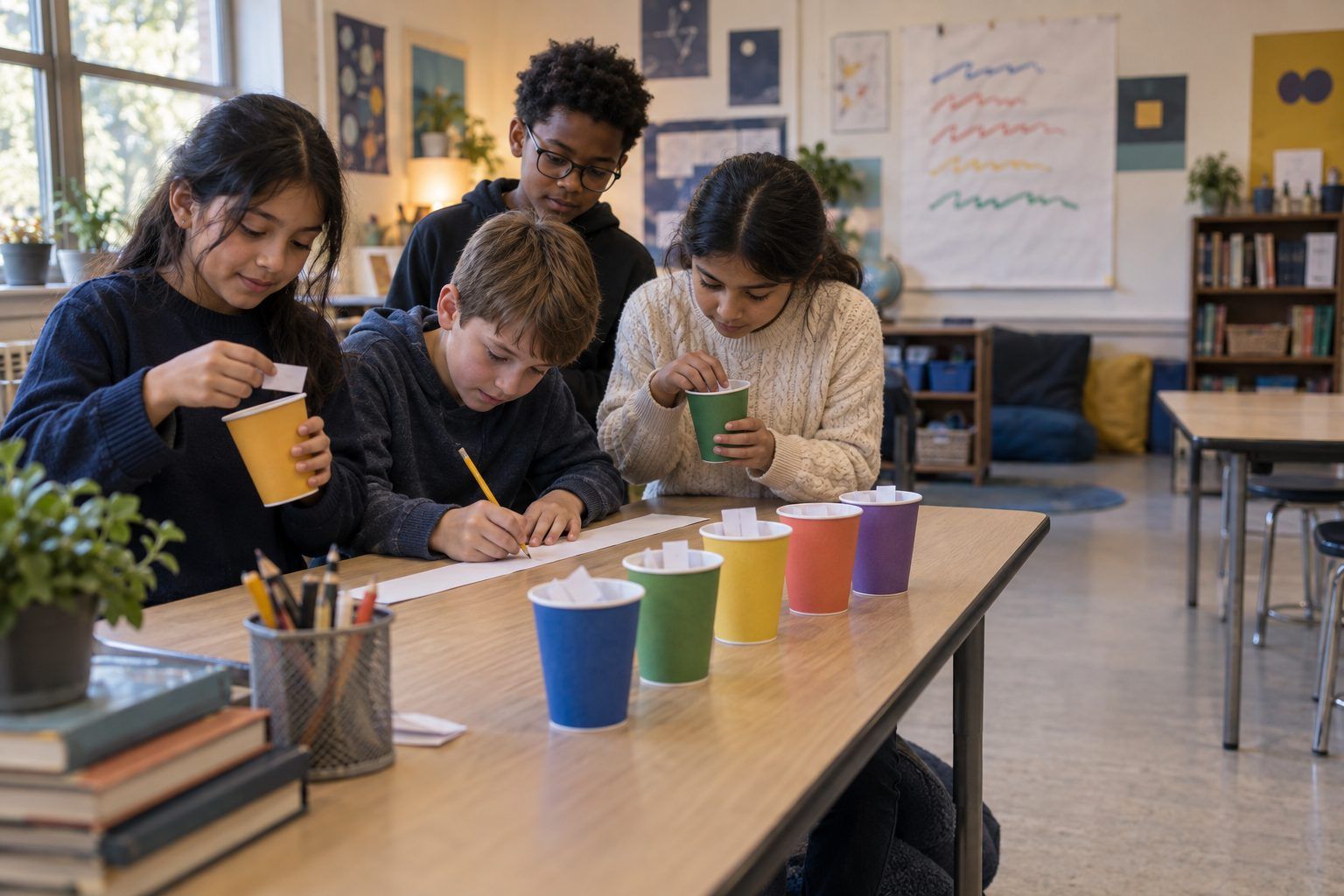
Student learning · Grades 3–5, Grades 6–8 · 45 minutes
Next Word, By Hand
Students build a paper "word-guessing machine" from sentence cards, watch it invent a confident false fact about a lake, and find out why a longer prompt helps but never makes a chatbot know things.
A generative AI chatbot writes by guessing what word is likely to come next, based on patterns in the writing it learned from. In this game, teams become that machine. They tally which word follows which in eight short sentence cards, then "write" new sentences by drawing slips from cups. The sentences come out grammatical and often silly. Then, in the lake round, the machine produces a sentence that sounds like a fact and is false, even though every piece of it came from true cards. Students test whether a longer prompt fixes the problem and leave able to say, in their own words, why a chatbot can sound sure and still be wrong.
In this packet
- Handout A: Sentence Cards (cut-apart cards)
- Handout B: Next-Word Tally Sheet (organizer)
- Handout C: How Did Our Machine Write That? (worksheet)
- Facilitator key (last page)
TCEA ELE indicators
- AI1.1 I know how AI systems work and their capabilities in educational contexts.
- AI1.3 I am aware of the current limitations and potential biases in AI systems.
- S5.3 I am aware of how to apply computational thinking in various subjects.
- S1.3 I am aware of how AI can assist me in my studies.
- AI4.1 I know how to promote critical thinking skills in relation to AI-generated information.
Full facilitator guide: mglearn.github.io/eles/activities/next-word-by-hand.html
Handout A for Next Word, By Hand
Sentence Cards
Cut apart. Use Story Cards 1–8 first. Keep Lake Cards 9–12 in the envelope until your teacher says to open it. The backs are the teacher's notes.
Sheet 1 of 2
Story 1
the dog ran to the park .
Story 2
the dog ate the bone .
Story 3
the cat ran to the door .
Story 4
the cat sat on the mat .
Story 5
the girl ran to the bus .
Story 6
the boy sat on the bench .
Story 7
the girl ate the apple .
Story 8
the boy ate the apple .
Handout A for Next Word, By Hand
Sentence Cards
Cut apart. Use Story Cards 1–8 first. Keep Lake Cards 9–12 in the envelope until your teacher says to open it. The backs are the teacher's notes.
Sheet 2 of 2
Lake 9
Wrenmere is in Harlow County .
Lake 10
Mossmere is in Pike County .
Lake 11
Wrenmere is the deepest lake in the state .
Lake 12
Mossmere is the largest lake in the state .
Handout B for Next Word, By Hand
Next-Word Tally Sheet
For each word, make a tally mark next to the word that came right after it. Make one slip for each tally mark and put it in a cup labeled with the first word. When you draw park, bone, door, mat, bus, bench, or apple, the sentence is over.
| After this word… | …came this word (one tally each time) | Number of slips |
|---|---|---|
| the | ||
| dog | ||
| cat | ||
| girl | ||
| boy | ||
| ran | ||
| sat | ||
| ate | ||
| to | ||
| on | ||
| LAKE ROUND (two words): Wrenmere is | ||
| LAKE ROUND (two words): Mossmere is | ||
| LAKE ROUND (two words): is in | ||
| LAKE ROUND (two words): is the |
Handout C for Next Word, By Hand
How Did Our Machine Write That?
Answer on your own after the lake round. Use your own words. Then share one answer with a partner.
The silliest sentence our machine wrote was:
Our machine wrote something false about a lake. No card said it. Where did it come from?
When we gave the machine three words instead of two, what changed? What could a longer prompt NOT fix?
Finish the sentence: "A chatbot can sound sure and still be wrong because…"
When a chatbot tells me a fact, I can check it by…
Draw your paper machine at work: the cups, a slip, and a sentence coming out.
Facilitator only for Next Word, By Hand
Answer key and notes
Handout A: Sentence Cards
- Story 1
- Adds: the→dog, dog→ran, ran→to, to→the, the→park. Model this one with the whole class.
- Story 2
- Second slip after "dog" (ate), and the first "ate→the."
- Story 3
- Second "ran→to." The ran cup will hold only "to" slips: a sure-thing guess.
- Story 4
- Introduces sat→on and on→the.
- Story 5
- Third "ran→to." The the cup keeps getting more different words.
- Story 6
- Watch for generated sentences like "the bench ran to the apple." Grammar right, meaning wrong.
- Story 7
- Adds ate→the and the→apple.
- Story 8
- After this card, the the cup has 16 slips with 11 different words. That mix is where the silly sentences come from.
- Lake 9
- True in our cards. With three words ("Wrenmere is in"), the only next word is Harlow.
- Lake 10
- With only two words ("is in"), the machine can't tell which lake it's talking about, so "Wrenmere is in Pike County" becomes possible.
- Lake 11
- Source of the hallucination: "is the" can be followed by "deepest."
- Lake 12
- Mixed with card 11, two-word guessing can produce "Mossmere is the deepest lake in the state." Every piece is true; the sentence is false.