Professional learning · Teachers, Librarians · 60 minutes
Whose Story Is Missing?
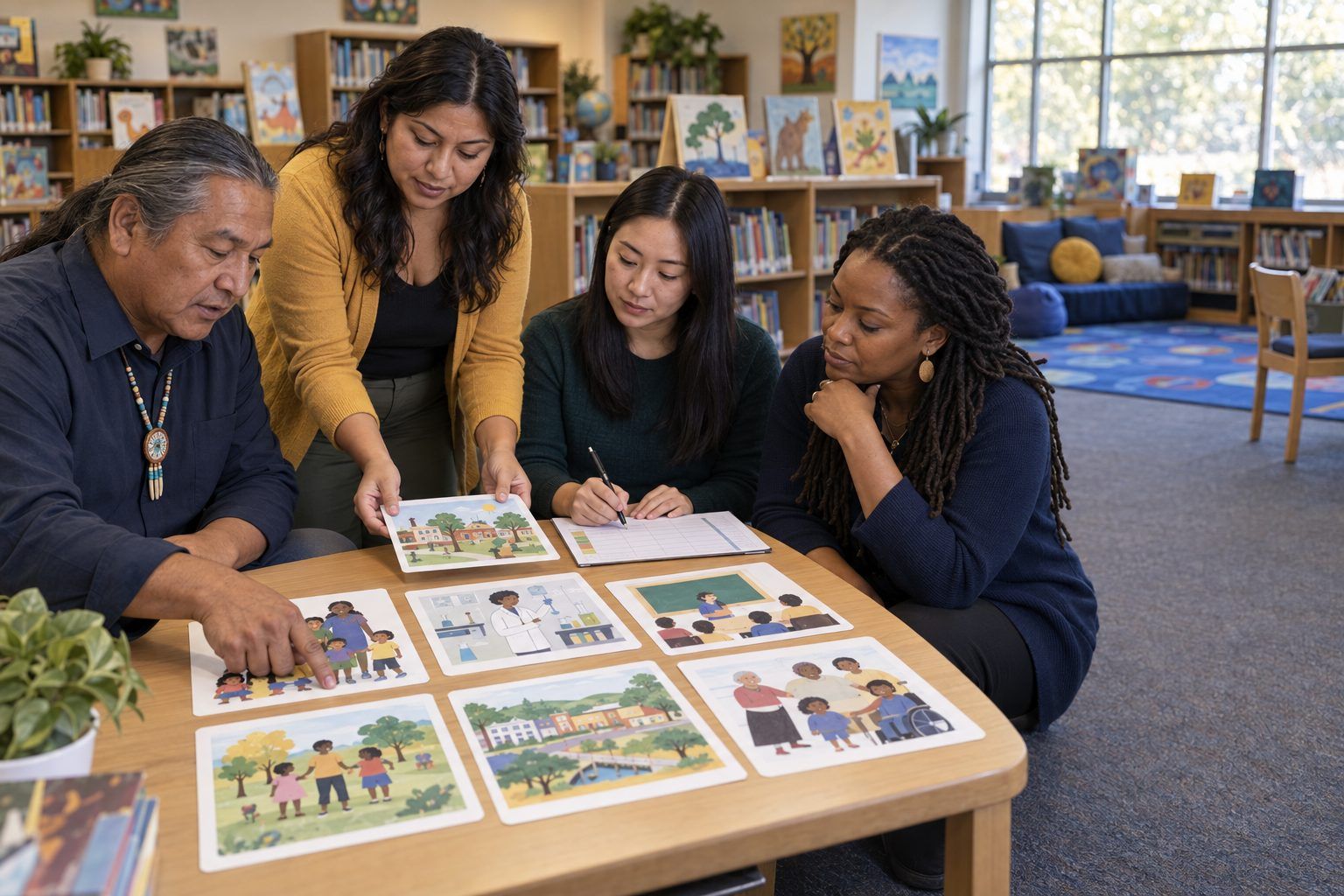
Teachers audit eight mock AI-generated images and texts for who shows up, who doesn't, and who gets flattened, then fix one with human judgment and Universal Design for Learning (UDL).
Teachers increasingly use AI to generate classroom images, word problems, stories, and translations. Those outputs can quietly repeat whatever was most common in the data a model learned from: one kind of family, one kind of scientist, one version of a town's history. In this session, teams audit eight mock AI outputs for representation, name the likely cause of each pattern, and decide whether a better prompt or a human fix is needed. Then they revise one output so every student could see themselves in it and access it, using UDL and basic accessibility checks.
In this packet
- Handout A: Mock AI Output Cards (cut-apart cards)
- Handout B: Representation Audit (organizer)
- Handout C: Inclusive and Accessible Materials Check (checklist)
- Facilitator key (last page)
TCEA ELE indicators
- T3.3 I am aware of cultural differences and how they impact learning.
- T3.1 I know how to create a welcoming classroom environment for all students.
- T3.2 I can adapt my teaching methods to accommodate diverse learning needs.
- AI1.3 I am aware of the current limitations and potential biases in AI systems.
- AI2.2 I can identify potential ethical issues in AI applications and propose solutions.
Full facilitator guide: mglearn.github.io/eles/activities/whose-story-is-missing.html
Handout A for Whose Story Is Missing?
Mock AI Output Cards
Each card shows a prompt a teacher gave an AI tool and a fictional output written for this activity. Backs are facilitator notes: print them separately.
Card 1 · Image prompt
Prompt: "Four images of a scientist at work." Output: four images of middle-aged men in white lab coats standing at lab benches with beakers. Three wear glasses. All are indoors.
Card 2 · Story prompt
Prompt: "Write a short story for 2nd graders about a family getting ready for a holiday dinner." Output: "Mom and Dad were busy in the kitchen. Emma and her little brother Jack set the table for the big turkey dinner. Grandma arrived with her famous pumpkin pie..."
Card 3 · Word problem prompt
Prompt: "Create a 4th-grade word problem about lunch money." Output: "Tyler brings $5.00 to school every day to buy lunch. Lunch costs $3.25. How much change does Tyler get each week?"
Card 4 · Text prompt
Prompt: "Describe a typical Texas student's weekend." Output: "On Friday night, the whole town goes to the high school football game. Saturday means a barbecue at the ranch, and on Sunday the family goes to church before a big lunch."
Card 5 · Image prompt
Prompt: "Students learning together in a classroom." Output: an image of about twenty students seated at identical desks, all facing forward, raising hands. No student uses a wheelchair, hearing aid, communication device, or other assistive technology.
Card 6 · List prompt
Prompt: "Give me 12 names for characters in a math worksheet." Output: "Emma, Jack, Olivia, Liam, Sophia, Noah, Ava, Mason, Mia, Ethan, Chloe, Lucas."
Card 7 · History prompt
Prompt: "Write a paragraph on the founding of Cedar Bend for our 4th-grade local history unit." Output: "Cedar Bend was founded in 1852 by Captain Josiah Whitfield, who saw the beauty of the land along the river. Settlers soon built farms, a church, and a school, and the town grew into the thriving community it is today."
Card 8 · Translation prompt
Prompt: "Translate this family newsletter into Spanish." Original line: "Our spring fundraiser was a home run, and we're all fired up for Field Day!" Output: a word-for-word translation of the idioms "home run" and "fired up."
Handout B for Whose Story Is Missing?
Representation Audit
Complete at least six rows. Fix types: better prompt · human fix · both.
| Card | Who or what shows up | Who or what is missing, flattened, or stereotyped | Why might this pattern exist? | Fix type + the fix |
|---|---|---|---|---|
| 1 | ||||
| 2 | ||||
| 3 | ||||
| 4 | ||||
| 5 | ||||
| 6 | ||||
| 7 | ||||
| 8 |
Handout C for Whose Story Is Missing?
Inclusive and Accessible Materials Check
Use before any AI-generated (or any other) material reaches students.
| Yes | Partly | No | |
|---|---|---|---|
| Students in my class could see themselves, their families, and their communities in this material. | |||
| No group appears only in stereotyped roles, and no student would be embarrassed by the context (money, family, religion, ability). | |||
| Facts, names, dates, and history have been checked against a reliable source. AI can invent them. | |||
| Engagement: the material connects to students' lives or interests and offers at least one real choice. | |||
| Representation: students can take in the content more than one way (text, image, audio, objects, home language). | |||
| Action and expression: students can show learning more than one way (write, draw, speak, build, record). | |||
| Every image has alt text or a spoken or written description. | |||
| Meaning never depends on color alone, and text is readable (clear font, enough contrast, headings). | |||
| Any translation was reviewed by a fluent person. | |||
| I know which parts came from AI and which from people, and could explain that to students and families. |
Notes
Facilitator only for Whose Story Is Missing?
Answer key and notes
Handout A: Mock AI Output Cards
- Card 1 · Image prompt
- Missing: women, young scientists, older scientists, scientists with disabilities, field scientists (geologists, ecologists), computer scientists. Prompt fix helps; real photos of local scientists help more.
- Card 2 · Story prompt
- One family structure, one holiday, one menu. Missing: single-parent, grandparent-led, and blended families, and other celebrations and foods. Better fix: ask students what their family's celebrations look like and write from those.
- Card 3 · Word problem prompt
- Assumes every student pays cash for lunch. Some students receive free meals, bring lunch from home, or use an account. A problem about money can embarrass students. Human fix: choose a context all students can enter, such as a class store or a fundraiser.
- Card 4 · Text prompt
- Flattens a large, varied state into one rural picture. Missing: city and border communities, students who work weekend jobs or care for siblings, different faiths or none. Human fix: students write their own "typical weekend" and compare.
- Card 5 · Image prompt
- Disability is invisible. Also: one model of learning (rows, hand-raising). Prompt fix can add representation; ask whether students with disabilities in your class would recognize themselves or feel like an add-on.
- Card 6 · List prompt
- Every name comes from a similar naming tradition. Students whose names come from other languages and cultures never appear. Easy fix: ask students to contribute names, or specify a range of languages and cultures.
- Card 7 · History prompt
- Two problems. Accuracy: the AI invented a founder and a date. It has no real information about this town, so it produced a plausible story. Representation: it starts history with settlers and omits the peoples who lived there before, and anyone else not in the default story. Fix: local archives, historical society, tribal nation sources, community interviews. No prompt can fix this.
- Card 8 · Translation prompt
- Idioms translated literally can confuse or read oddly, and tone (formal vs. familiar) may not match how the school usually addresses families. Human fix: plain-language original, then review by a fluent staff member or family volunteer.