Professional learning · Coaches, Teachers · 60 minutes
The Shallow Answers Coaching Cycle
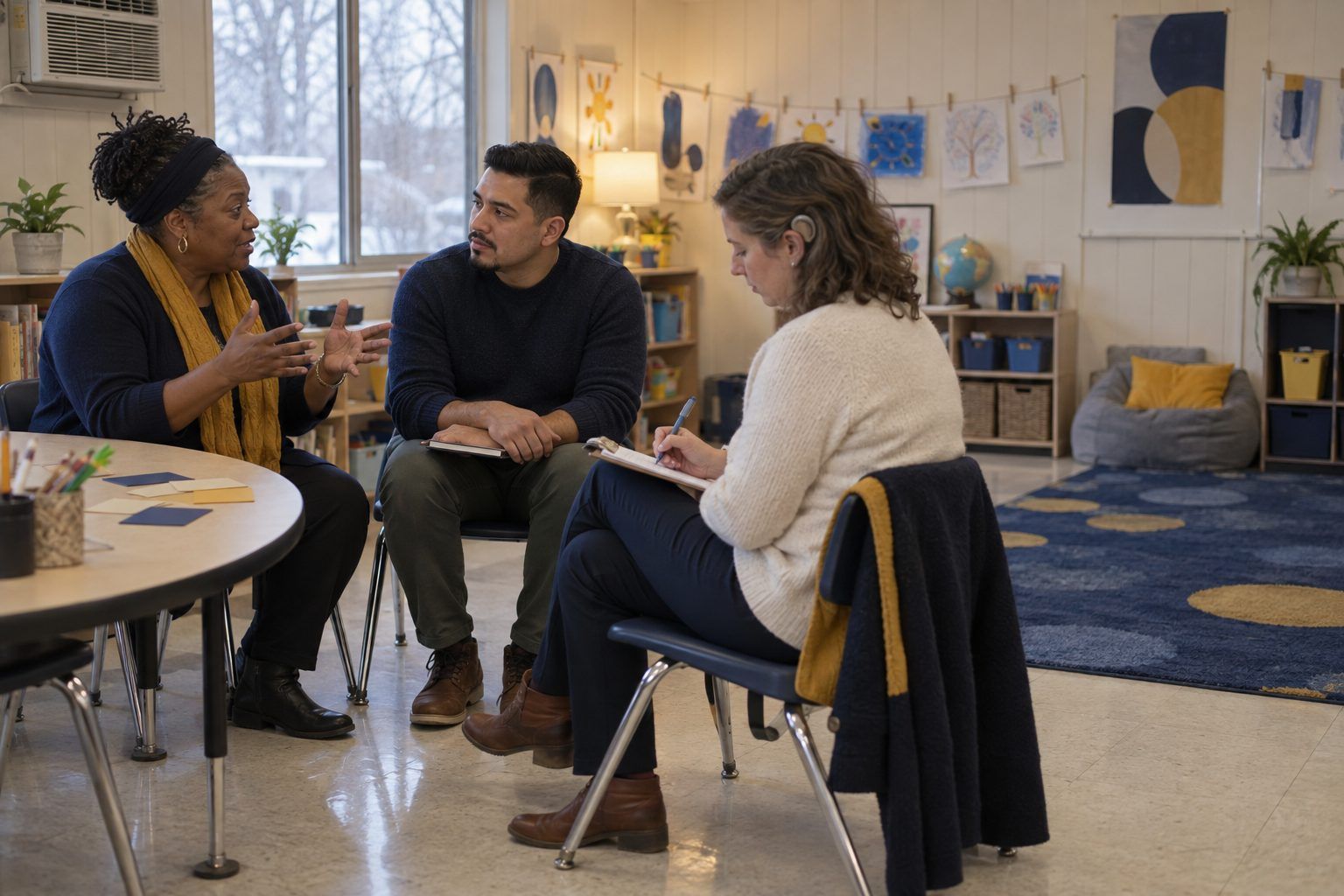
Coaches role-play a full listen, co-plan, model, measure, adjust cycle on one familiar problem: students finish the digital work but say very little.
A teacher tells you students are completing every digital activity but their answers are shallow, and some read as if a chatbot wrote them. This simulation walks coaches through a whole coaching cycle on that one case: listening before fixing, co-planning a lesson with fewer questions and more reasoning, modeling a move, and measuring the change in real student work. The cycle ends where the 2026 ELEs say coaching should: "What changed in teacher practice or student evidence?"
In this packet
- Handout A: Role-Play Cards (cut-apart cards)
- Handout B: Student Evidence Samples: Week 1 and Week 3 (reading)
- Handout C: Coaching Cycle Planner (organizer)
- Facilitator key (last page)
TCEA ELE indicators
- C1.1 I know how to mentor teachers in effective instructional practices.
- C1.2 I can provide constructive feedback to improve teaching strategies.
- C3.2 I can help teachers interpret and act on assessment results.
- AI4.1 I know how to promote critical thinking skills in relation to AI-generated information.
Full facilitator guide: mglearn.github.io/eles/activities/shallow-answers-coaching-cycle.html
Handout A for The Shallow Answers Coaching Cycle
Role-Play Cards
Cut apart. Each triad gets all four Teacher Persona cards and one of each Coach Move and Observer card. Backs are for the facilitator.
Sheet 1 of 2
Teacher Persona 1 · Grade 7 science
Opening line: "My kids finish every digital activity. The dashboard is all green. But when I read the answers, there's nothing there." Hidden detail (share only if asked a good question): you think a few students paste chatbot answers, but you're worried about accusing anyone.
Teacher Persona 2 · Grade 4 reading
Opening line: "We do the reading app every day and their levels are going up, but when I ask why a character did something, I get one word." Hidden detail: you would like to try discussion but are afraid of losing control of the room.
Teacher Persona 3 · Grade 10 history
Opening line: "They copy from the first website they find and their document analysis is two sentences." Hidden detail: your department requires 15 questions per packet, and you think it is too many.
Teacher Persona 4 · Higher Ed intro course
Opening line: "The discussion board posts all sound the same, polished and empty." Hidden detail: you suspect AI use but have no course policy about it yet.
Coach Move · Listen
For six minutes you may only use these stems: "Tell me more about…" · "What did you hope students would do?" · "What do you notice when you read their work?" · "What have you already tried?" · "What worries you most?" · "So what I'm hearing is… Did I get that right?" No suggestions.
Coach Move · Co-plan
Ask: "What should a strong answer contain?" Then cut the task: fewer questions, each needing a claim, evidence from the class's own work or text, and a "because." Ask: "Where, if anywhere, does AI belong in this lesson?" The teacher makes the final call.
Coach Move · Model
Model one move for two minutes as if the teacher's students were in front of you: a think-aloud of your own claim and evidence, a sentence frame, or a check of a chatbot's answer against the class's data. Then ask the teacher: "What would you keep? What would you change for your kids?"
Coach Move · Measure and Adjust
Lay the Week 1 and Week 3 tallies side by side. Ask: "What changed in the student evidence? Who didn't move? What's one thing we adjust for them?" Close with: "What changed in your practice?"
Handout A for The Shallow Answers Coaching Cycle
Role-Play Cards
Cut apart. Each triad gets all four Teacher Persona cards and one of each Coach Move and Observer card. Backs are for the facilitator.
Sheet 2 of 2
Observer
Tally every coach question and every coach suggestion. Write the teacher's goal in the teacher's words. Raise a hand if the coach suggests a fix in the Listen round. Report: "The teacher's goal was… The coach asked __ questions and made __ suggestions."
Handout B for The Shallow Answers Coaching Cycle
Student Evidence Samples: Week 1 and Week 3
Fictional samples from Ms. Okafor's 7th grade science class at Pecan Grove Middle School. Question: "Which light condition helped our bean plants grow most, and why?" Mark each sample: C = claim, D = class data, R = reasoning that links them.
1Week 1 (before the cycle). The digital activity had 12 short-answer questions. This was question 9.
2Sample 1: "The sun one."
3Sample 2: "Plants need sunlight to grow so the plant with more light grew more."
4Sample 3: "Group 3 plant was 14 cm."
5Sample 4: "Photosynthesis is the process by which plants convert light energy into chemical energy, which fuels growth. Therefore, plants exposed to greater light intensity typically exhibit increased growth rates, although excessive light can cause stress." (Ms. Okafor's note: "Sounds like a chatbot. Nothing about our plants.")
6Week 3 (after the co-planned revision). The activity had 3 questions, each needing a claim, our data, and a "because." Students could check their answer with the approved chatbot only after writing it, and had to mark what the chatbot got right or wrong about our experiment.
7Sample 2 (same student): "The windowsill plants grew most. Our windowsill plant grew 14 cm and the closet plant grew 3 cm, and it was yellow. I think that's because the windowsill plant got light to make food and the closet one didn't. The chatbot said too much light can hurt plants, but our windowsill plants were fine, so that part didn't match our data."
8Sample 3 (same student): "Windowsill. 14 cm, 12 cm, 13 cm for the three windowsill groups. Closet was 3 cm and 4 cm."
9Sample 5: "Plants exposed to greater light intensity exhibit increased growth, as our windowsill plant demonstrated. I checked the chatbot and it agreed." (Ms. Okafor's note: "Better, but the wording is still mostly the chatbot's, and 'it agreed' isn't a check.")
Handout C for The Shallow Answers Coaching Cycle
Coaching Cycle Planner
Fill in one row per phase for your persona's lesson. The last column is the one that matters most.
| Phase | Coach move | Teacher move | Evidence we will collect |
|---|---|---|---|
| Listen | The teacher's goal, in the teacher's words: | ||
| Co-plan | What a strong student answer will contain: | ||
| Model | What the teacher chose to keep or change: | ||
| Measure | Before-and-after tally (claim · data · reasoning): | ||
| Adjust | Which students, which next step, and what date we look again: |
Facilitator only for The Shallow Answers Coaching Cycle
Answer key and notes
Handout A: Role-Play Cards
- Teacher Persona 1 · Grade 7 science
- Stems that tend to surface the hidden detail: "What do you notice when you read the answers?" and "What worries you most about this?"
- Teacher Persona 2 · Grade 4 reading
- Good listening names the tension: the teacher trusts the app's level data more than her own read of their talk. Co-plan toward one short, structured discussion, not a new app.
- Teacher Persona 3 · Grade 10 history
- The constraint is structural. A good co-plan might pilot fewer questions in one unit and bring the student evidence to the department.
- Teacher Persona 4 · Higher Ed intro course
- Surfaces an AI transparency need. Co-plan a disclosure line on posts and a prompt that requires a course-specific example no chatbot would have.
- Coach Move · Listen
- Look-for: a paraphrase the teacher agrees with before any planning begins.
- Coach Move · Co-plan
- Look-for: the plan names what student work will look different, in writing.
- Coach Move · Model
- Look-for: the model is short and specific, and the teacher adapts it rather than copies it.
- Coach Move · Measure and Adjust
- Look-for: an adjustment aimed at specific students, plus a date to look at work again.
- Observer
- The observer role is the coach's future self-reflection habit. Encourage specific, kind reporting.