Student learning · Grades 6–8, Grades 9–12 · 110 minutes
Community Problem Pitch
Teams use the engineering design process to solve a real school or community problem, invite AI to critique their ideas, reject what doesn't hold up, and pitch a solution with a record of what changed.
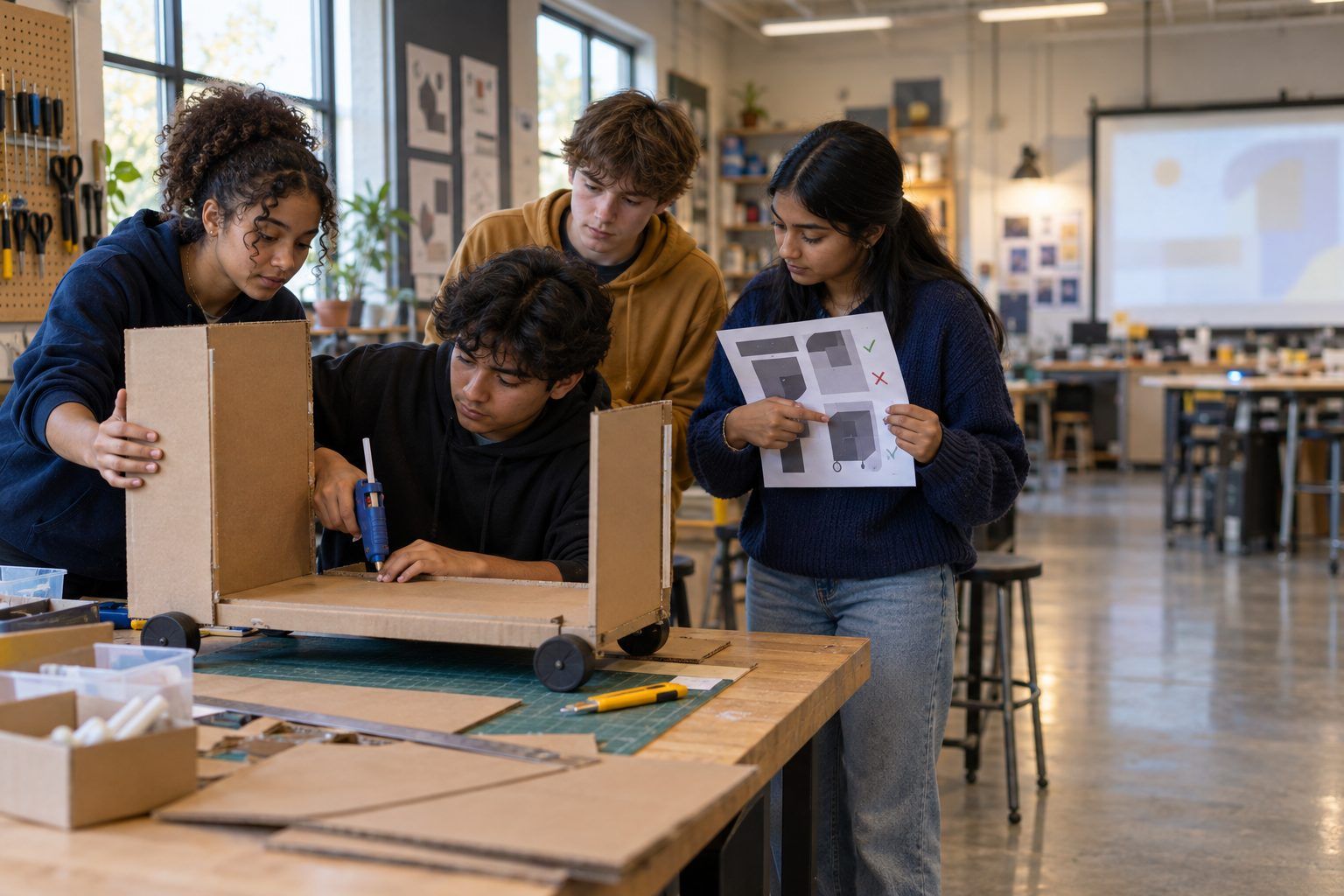
Students pick a real problem they can observe at school or in their community, gather evidence, and generate their own ideas before any AI is involved. Then AI joins as a brainstorm critic: the teacher projects a district-approved chatbot (or uses a printed mock critique) that suggests ideas and pokes holes in the team's plan. Some of its suggestions are useful, some are unrealistic, and some include claims no one can verify. Teams must decide what to keep, verify, or reject, build a simple prototype, and pitch it. The grade rests on their reasoning and their record of what changed, not on the AI's ideas.
In this packet
- Handout A: Sample AI Critic Response (reading)
- Handout B: Design Log (worksheet)
- Handout C: Pitch Rubric (rubric)
TCEA ELE indicators
- S5.1 I know how to approach complex problems systematically.
- S5.2 I can use creativity and logic to find innovative solutions.
- S3.1 I know how to work effectively in a team.
- S3.2 I can communicate my ideas clearly to others.
- AI5.3 I am aware of the potential of AI to augment human creativity and problem-solving.
Full facilitator guide: mglearn.github.io/eles/activities/community-problem-pitch.html
Handout A for Community Problem Pitch
Sample AI Critic Response
This mock AI response was written for this lesson. Ridgeview Middle School is fictional. For each suggestion or weakness, decide: Keep, Verify, or Reject, and say why.
1The team's prompt: "You are a friendly but tough critic for a middle school design team. Our problem: a lot of food gets thrown away at lunch at our school. We counted 23 full or half-full trays thrown away in five minutes. Our idea: make posters asking students not to waste food. Give us three suggestions and three weaknesses in our plan."
2AI response, part 1 (Suggestions): Great problem to tackle! Here are three ideas. 1. Start a share table. Students could place unopened items, like packaged snacks or whole fruit, on a table for others to take. Share tables are allowed in every school, so you can start right away. 2. Let students choose portion sizes. Some students may throw food away because they get more than they want. A "small or regular" choice at the serving line could help. 3. Start a composting program. Studies show that composting reduces cafeteria waste by 90%, so this is the most effective solution.
3AI response, part 2 (Bonus ideas): You could also ban packed lunches so every student eats the same food and the cafeteria can plan exact amounts. Or you could install AI cameras above the trash cans that scan every tray and send students a weekly report of how much they wasted.
4AI response, part 3 (Weaknesses in your plan): 1. Posters alone may not change what people do, because students might ignore them after the first few days. 2. You counted trays, but you don't know why the food was thrown away. Was it taste, time, or portion size? Interviewing students could help you find out. 3. You haven't planned how you'll know whether your solution worked. Consider counting the trays again after you try something and comparing the results.
Handout B for Community Problem Pitch
Design Log
Keep this log across all days. It's your evidence of how your team thought, decided, and changed.
DEFINE · Our problem as a question ("How might we…?"), who it affects, and the smaller parts we broke it into:
EVIDENCE · What we observed, counted, or heard in interviews (no names):
OUR IDEAS FIRST (before AI) · Our list, our top idea, and why we chose it:
AI CRITIC · For each suggestion or weakness write K (Keep), V (Verify), or R (Reject) and a reason:
VERIFY · One claim we checked, who or what we checked with, and what we found:
PROTOTYPE · Sketch or describe what we built:
WHAT CHANGED · Our first idea → what the critique and testing showed → our final idea:
PITCH PLAN · Our two-minute outline (problem + evidence, solution, one AI idea kept and one rejected, what changed):
Handout C for Community Problem Pitch
Pitch Rubric
Read this before you start. Self-score in the Reflect step; your teacher scores the pitch and Design Log.
| Criterion | Beginning | Developing | Proficient | Exemplary |
|---|---|---|---|---|
| Defining the problem with evidence | Problem is vague or too big; no evidence gathered. | Problem is named, with a little evidence or parts listed. | Problem is a clear question, broken into parts, with observed or interview evidence. | Problem is sharply defined, broken into parts, and supported by several kinds of evidence that shaped the solution. |
| Creative, logical solution | Solution doesn't connect to the problem. | Solution connects to the problem but isn't realistic or tested. | Solution is realistic, logical, and shown with a prototype. | Solution is original, realistic, tested with feedback, and improved from the first version. |
| Using AI as a critic, not a crutch | AI ideas were accepted without question, or the team's own ideas are missing. | Some AI suggestions were judged, with few reasons. | Every AI suggestion is marked Keep, Verify, or Reject with a reason; one claim was checked. | Decisions are well reasoned; the team rejected weak or unverifiable claims, verified with a real source, and explained what the AI couldn't know. |
| Teamwork | One or two members did most of the work. | Roles were assigned but not consistently used. | Roles were used and every member contributed to the log and pitch. | Roles were used well; members built on each other's ideas and can each explain the whole solution. |
| Pitch and communication | Pitch is unclear or missing key parts. | Pitch covers some parts; "what changed" is unclear. | Pitch clearly covers the problem, evidence, solution, AI decisions, and what changed. | Pitch is clear, persuasive, and within time, and answers audience questions with evidence. |