Professional learning · Teachers, Librarians · 90 minutes
The AI Critic Tank
Teams design a solution to a local community problem by hand, invite an AI chatbot to tear it apart (as critic, never author), decide which critiques to accept, disclose the AI's role, and pitch to a panel.
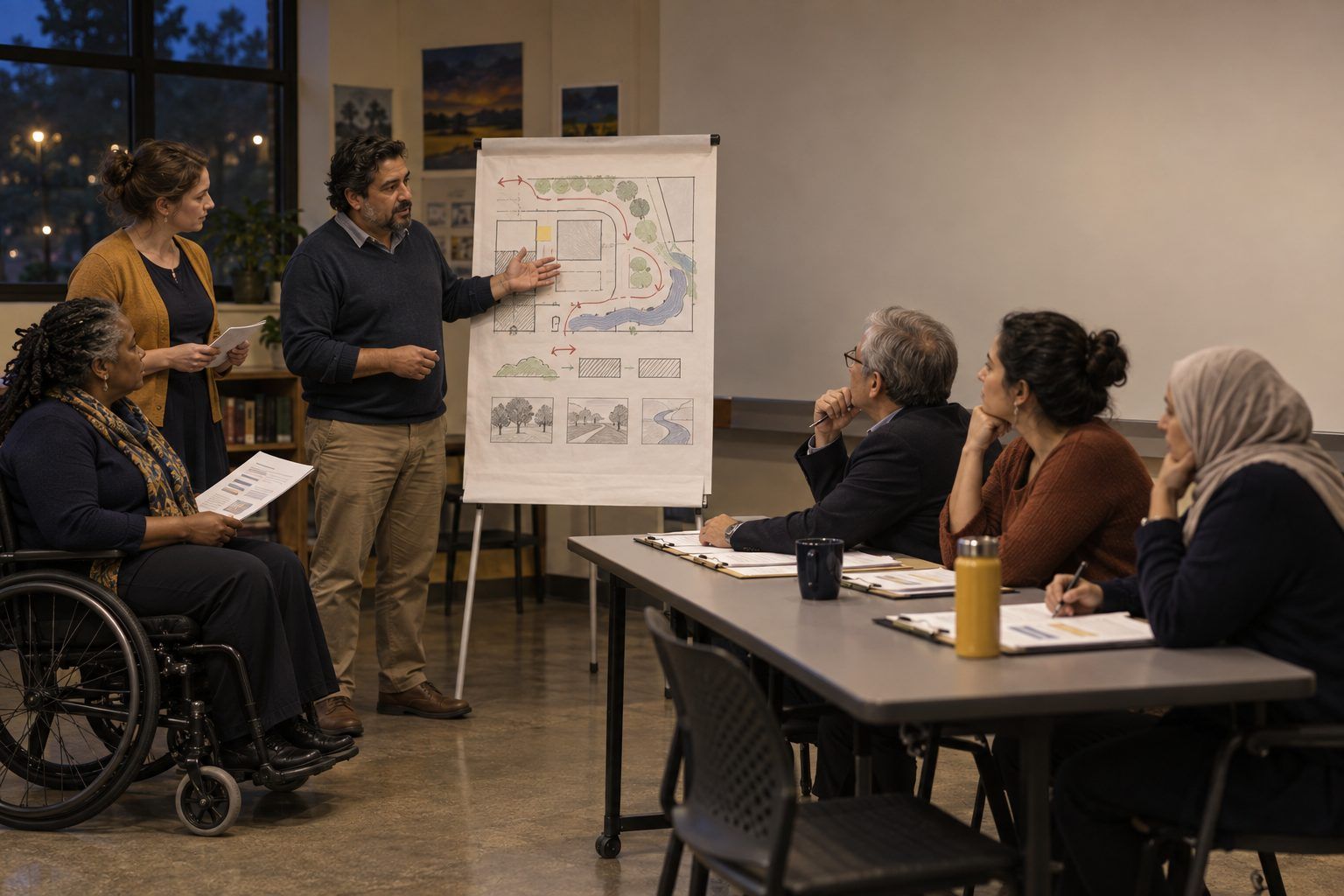
When students use AI on a project, it too often writes the idea and the student decorates it. This session flips the roles. Teams of teachers, working as students, choose a problem in the fictional town of Cedar Bend, understand it, and design a solution entirely on their own. Only then do they ask an approved chatbot to act as a skeptical critic. They log every critique, accept, reject, or modify each one with a reason, revise, write an honest disclosure of how AI was used, and pitch to a "Tank" panel. The debrief turns the structure into a problem-solving project teachers can run with students.
In this packet
- Handout A: Cedar Bend Problem Cards (cut-apart cards)
- Handout B: AI Critique Log (organizer)
- Handout C: Tank Panel Rubric (rubric)
- Facilitator key (last page)
TCEA ELE indicators
- T5.3 I am aware of strategies to develop students' problem-solving abilities.
- T5.1 I know how to design lessons that promote higher-order thinking skills.
- AI2.1 I know how to apply ethical principles when using or developing AI for education.
- AI5.1 I know how to foster collaboration between humans and AI systems.
- AI2.3 I am aware of the importance of transparency and accountability in AI systems.
Full facilitator guide: mglearn.github.io/eles/activities/ai-critic-tank.html
Handout A for The AI Critic Tank
Cedar Bend Problem Cards
Each team chooses one problem. Cedar Bend and everyone in it are fictional. Card backs are facilitator hints: print them separately.
Problem 1 · Transportation
Many Cedar Bend High students can't stay for after-school tutoring or clubs because the late bus was cut and their families work until 6 p.m.
Problem 2 · Food waste
The Cedar Bend Elementary cafeteria throws away large amounts of untouched fruit and milk each day, while the town food pantry runs low by midweek.
Problem 3 · Park safety
Families avoid Riverside Park after dark because the lights along the walking trail are broken, and the city says repairs are months away.
Problem 4 · Library access
The Cedar Bend Public Library closes at 5 p.m. on weekdays, and many students without home internet have nowhere to finish online assignments.
Problem 5 · Newcomer families
Newly arrived families say school messages are confusing, arrive in English only, and use terms like "STAAR" and "early release" without explanation.
Problem 6 · Heat
The Cedar Bend Middle School playground has almost no shade, and recess is regularly moved indoors during the hottest months.
Problem 7 · Online conflict
Arguments in a popular Cedar Bend students' group chat keep spilling into school, and many students say they don't know how to step away or get help.
Problem 8 · Senior isolation
Many older residents at the Maple Court apartments rarely leave home and say they feel lonely and unsure how to use video calls to reach family.
Handout B for The AI Critic Tank
AI Critique Log
Log every critique the AI (or peer critic) gives. Decide as a team: Accept · Reject · Modify. Write your AI disclosure statement at the bottom.
| Critique or question from the critic | Accept / Reject / Modify | Our reason | What we changed (if anything) |
|---|---|---|---|
Handout C for The AI Critic Tank
Tank Panel Rubric
Panelists: score each team, then ask at least one question about a critique they rejected.
| Criterion | Beginning | Developing | Proficient | Exemplary |
|---|---|---|---|---|
| Understanding the problem | Problem restated from the card; no stakeholders or causes named. | Some stakeholders or causes named; problem statement is vague. | Clear problem statement; several stakeholders and at least one root cause. | Sharp problem statement; includes an overlooked stakeholder and names what the team still needs to learn. |
| Solution reasoning | One idea presented with no alternatives or criteria. | Alternatives mentioned, but the choice isn't explained. | Solution chosen from alternatives using stated criteria. | Criteria are clearly tied to stakeholders' needs; team explains tradeoffs honestly. |
| Human judgment with the critic | Critiques ignored or accepted without discussion. | Some critiques addressed; reasons are thin. | Each critique accepted, rejected, or modified with a reason; revision is visible. | Team explains a thoughtful rejection and shows how critique made the solution better, not just longer. |
| Transparency and disclosure | AI use not mentioned. | AI use mentioned only in general ("we used AI"). | Disclosure states what the AI did and did not do. | Disclosure is specific and honest, including where the AI was unhelpful or had to be redirected. |
| Pitch | Hard to follow; runs over time. | Main idea clear; key parts missing. | Clear, on time, includes all required parts. | Compelling and clear; would persuade the people most affected by the problem. |
Facilitator only for The AI Critic Tank
Answer key and notes
Handout A: Cedar Bend Problem Cards
- Problem 1 · Transportation
- Often-missed stakeholders: students who care for younger siblings, bus drivers, club sponsors, students with part-time jobs.
- Problem 2 · Food waste
- Often-missed stakeholders: cafeteria staff, the health inspector, pantry volunteers, families who use the pantry and may not want to be identified.
- Problem 3 · Park safety
- Often-missed stakeholders: older adults who walk in the evening, people who work late shifts, neighbors near the trail, city maintenance staff.
- Problem 4 · Library access
- Often-missed stakeholders: library staff and budget, students without devices, teachers who assign online work, local businesses with Wi-Fi.
- Problem 5 · Newcomer families
- Often-missed stakeholders: students who translate for their parents, front-office staff, community interpreters, families who speak languages other than Spanish.
- Problem 6 · Heat
- Often-missed stakeholders: students with health conditions, PE teachers, custodial staff, the PTA, the district facilities department.
- Problem 7 · Online conflict
- Often-missed stakeholders: bystanders in the chat, students who are targeted, counselors, families, students who run the chat.
- Problem 8 · Senior isolation
- Often-missed stakeholders: apartment staff, residents' families, residents with hearing or vision loss, student volunteers and their schedules.