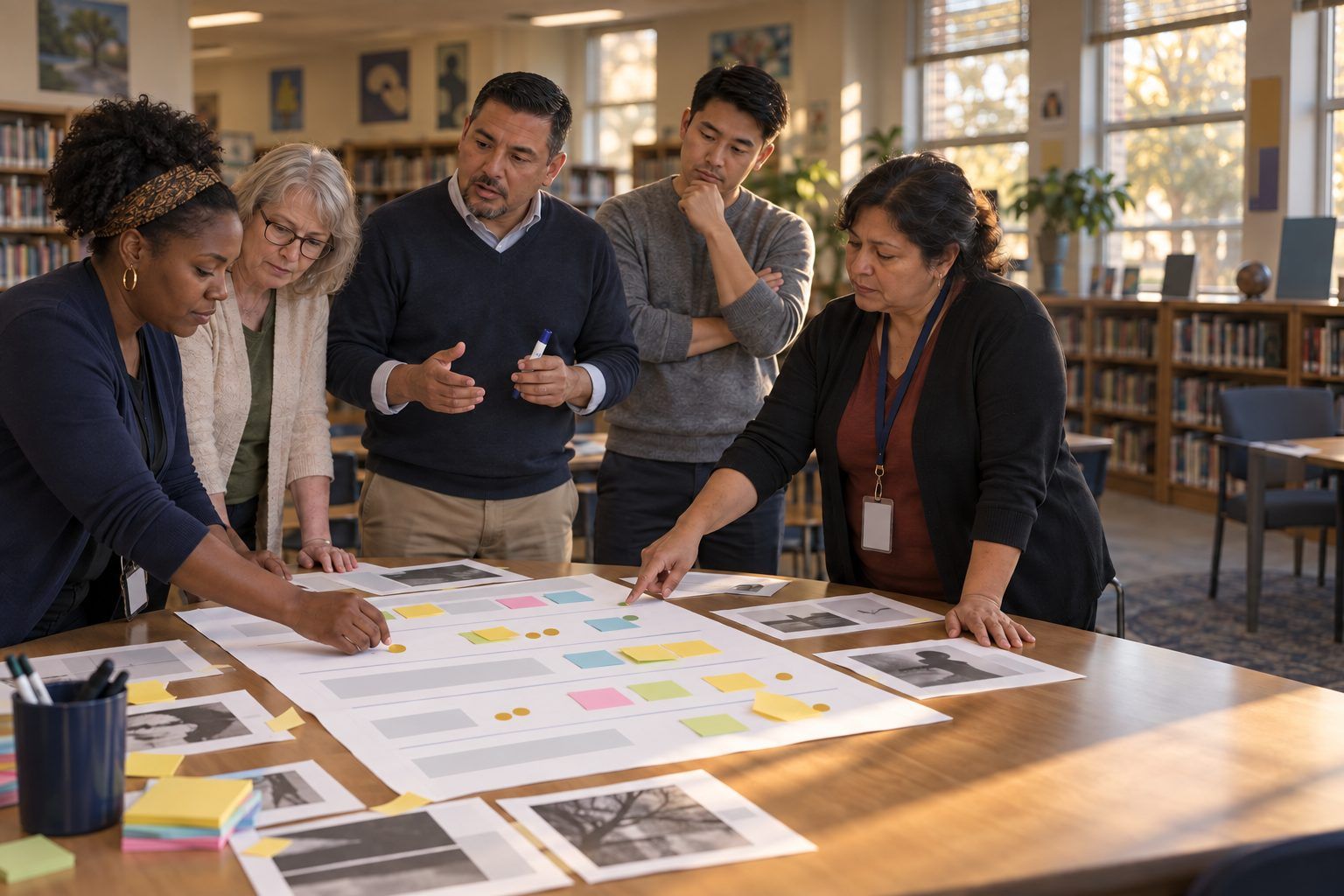
Professional learning · Coaches, Teachers, Leaders, Staff · 60 minutes
After the Rumor
A campus team digs past blame to the root causes of a fictional viral rumor and AI-edited image incident, then writes the trust and AI-use norms it will hold itself to next time.
When an online rumor tears through a campus, adults tend to respond on their own: some address it in class, some ignore it, someone forwards the image to ask "is this real?", and a well-meaning email makes things worse. This protocol uses a fictional incident, an AI-edited photo of a student and a rumor about who made it, to practice a structured, no-blame root-cause analysis. Teams trace the problem to causes they can act on, then write two sets of norms: how they'll respond together next time, and how they'll use AI inside their own PLC.
In this packet
- Handout A: Case File: "The Photo at Mesquite Hills" (reading)
- Handout B: Root-Cause Organizer (organizer)
- Handout C: Team Norms Drafting Sheet (worksheet)
TCEA ELE indicators
- C5.2 I can facilitate productive discussions and problem-solving sessions.
- C5.3 I am aware of strategies to build trust and promote teamwork.
- C5.1 I know how to foster a collaborative culture among educators.
- AI2.1 I know how to apply ethical principles when using or developing AI for education.
- T2.2 I know how to guide students in safe and responsible internet use.
Full facilitator guide: mglearn.github.io/eles/activities/after-the-rumor.html
Handout A for After the Rumor
Case File: "The Photo at Mesquite Hills"
Fictional. Mesquite Hills Middle School and everyone named here are invented. Mark each moment S (student decision), A (adult decision), or X (system or policy gap).
1Monday, 7:40 a.m. An anonymous account posts a photo that appears to show 8th grader Tomás asleep in the library with a humiliating caption. The image has been edited with an AI tool: the original photo was Tomás reading, taken from his public sports team page. The account's post tags a classmate, Rylee, implying she made it.
2By lunch. The photo has been shared well over a hundred times across several group chats. Students tell each other Rylee made it. Rylee, who did not, is confronted in the hallway. Tomás goes to the nurse and then home.
312:30 p.m. A 7th grade teacher, Mr. Pratt, receives the image from a student and forwards it to three colleagues asking, "Is this real? Did anyone else see this?" One colleague forwards it to her team chat. Another says nothing because she isn't sure whose job it is.
41:15 p.m. Two advisory teachers discuss the incident with their classes; one tells students, "Rylee needs to own this." Four other advisories don't mention it. No one tells students the image was edited, because no adult has checked.
53:30 p.m. The assistant principal, working fast, pastes the student report, including both students' full names, into a free chatbot to help draft a family email. The email that goes out that evening says "a student created an inappropriate image," which families take as confirming the rumor about Rylee.
6Tuesday. The counselor learns from Tomás's parent that the original photo came from the team page. The campus has no shared guidance on AI-edited images, no script for advisory, and no rule about adults forwarding student images. The PLC meets Thursday; the incident isn't on the agenda.
7Two weeks later. The account's creator turns out to be a student at a different school. Rylee's parent asks the campus why no adult corrected the rumor. Several teachers say privately that they didn't feel comfortable raising it with their team.
Handout B for After the Rumor
Root-Cause Organizer
For each row, start with what happened and ask "why?" until you reach something your team can change. Stop at causes within your control.
| Category | What happened (from the case) | Why? Why? Why? | Root cause we can act on | Who owns the fix |
|---|---|---|---|---|
| Student knowledge and skills | ||||
| Adult response and communication | ||||
| Systems and policies | ||||
| Culture and trust |
Handout C for After the Rumor
Team Norms Drafting Sheet
Every norm must be observable: someone could see or hear whether the team kept it.
Our top root cause (from the dot vote), in one sentence:
Incident response norms (3–4). When something goes viral, we will…
AI-use norms for our PLC (3–4). Consider disclosure, student data, recording and transcription, and who makes the final decision.
What will make it safe for any of us to say "wait" or raise a concern in the moment?
Review date, and the evidence we'll look at to see whether we kept the norms: