Student learning · Grades 9–12, Higher Ed · 60 minutes
Who Owns the Output?
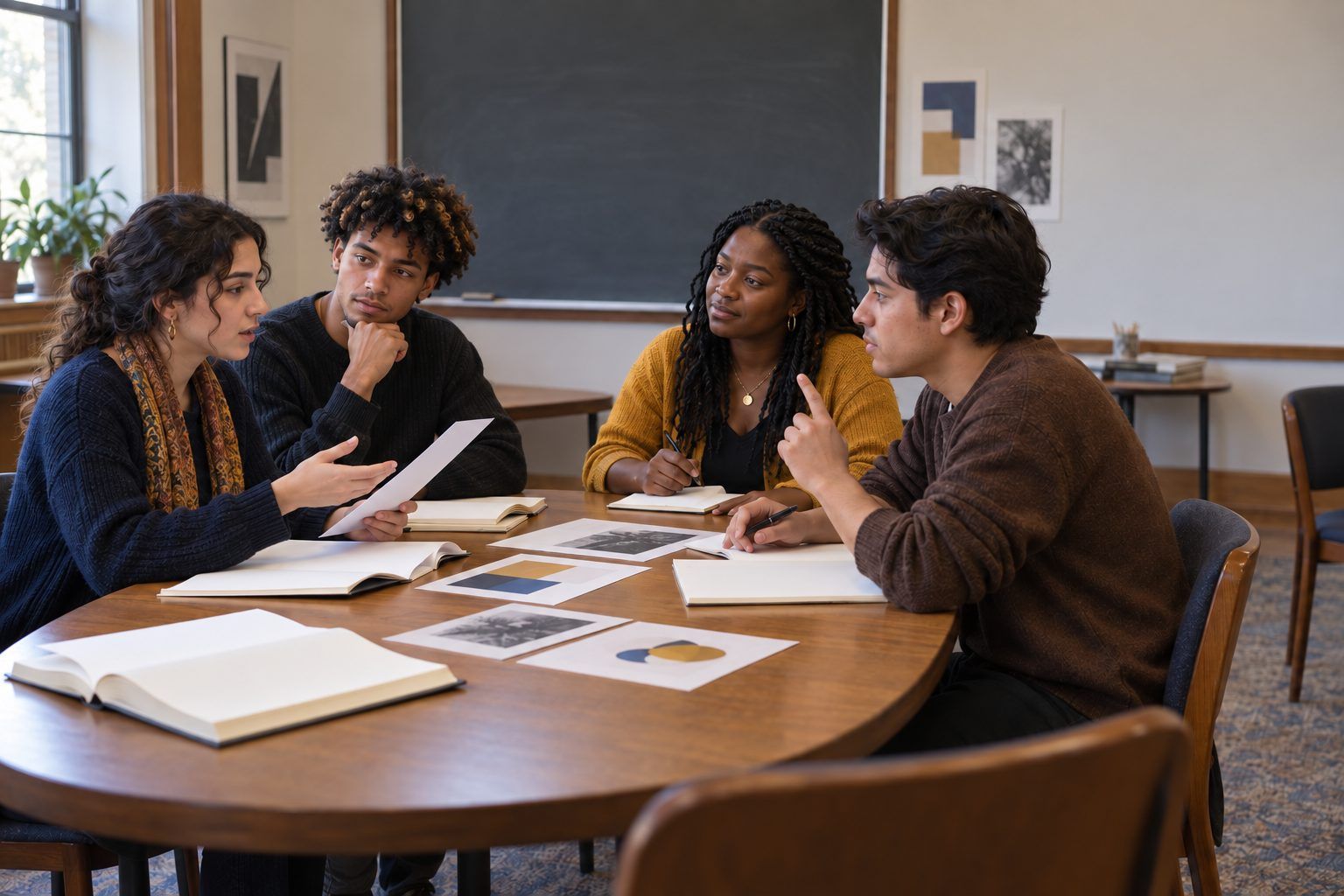
In a structured academic controversy, students argue both sides of an open question: is it fair for AI tools to learn from artists' work, and who gets credit for what they make?
Generative image, music, and writing tools learned their patterns from enormous collections of human-made work, often gathered without asking the creators. Whether that is fair, whether it is legal, and who owns what the tools produce are questions that courts, lawmakers, artists, and companies are still actively disputing, and the answers differ from country to country. Instead of a winner-take-all debate, students use a structured academic controversy: each pair argues one side, then switches and argues the other, then drops the sides and searches for the best shared recommendation. The goal is not a verdict on the law; it is the ability to reason carefully about an unsettled ethical question and act respectfully toward creators in the meantime.
In this packet
- Handout A: The Case of the Cedar Bluff Poster (reading)
- Handout B: Perspective Cards (cut-apart cards)
- Handout C: Controversy Organizer (worksheet)
- Facilitator key (last page)
TCEA ELE indicators
- AI2.2 I can identify potential ethical issues in AI applications and propose solutions.
- AI2.1 I know how to apply ethical principles when using or developing AI for education.
- S3.3 I am aware of the value of diverse perspectives in group work.
- S3.2 I can communicate my ideas clearly to others.
Full facilitator guide: mglearn.github.io/eles/activities/who-owns-the-output.html
Handout A for Who Owns the Output?
The Case of the Cedar Bluff Poster
Everyone and everything in this case is fictional. Read it twice: once for the story, once to underline the facts each side might use.
1Mara Kessling is an illustrator in the small town of Cedar Bluff. For fifteen years she has painted bright, patterned birds with thick outlines and gold-leaf backgrounds. She posts her work on her own website and on social media, where it has a loyal following. She sells prints and takes commissions, and that income pays her rent.
2Jordan, a junior at Cedar Bluff High, is designing a poster for the school's Spring Arts Night. Jordan types into an AI image tool: "a cardinal on a branch in the style of Mara Kessling, gold background, bold outlines." In seconds, the tool produces an image that Mara's fans would likely mistake for hers. Jordan tweaks the colors, adds the event text, and prints 200 copies.
3A parent recognizes the style and tags Mara in a post. Mara replies: "I never gave permission for my work to train this tool. I don't know if my paintings were used, but my name clearly works as a prompt. Would the school hire me for this poster next year, or just type my name again?"
4The company that makes the image tool, PixelHarbor, says its model learned from a very large collection of publicly available images and that it does not store or paste copies of any single artwork. Its terms of service say users may use generated images however they like. PixelHarbor does not say which images were in its training data.
5Jordan is upset: "I didn't copy anything. I didn't trace it. I typed a sentence. Artists learn by studying other artists' styles, too. Isn't that what the tool did?"
6The Arts Night committee must decide by Friday whether to keep the poster, and the school's art teacher wants a class rule for future projects.
7Core question: Is it fair for AI tools to learn from artists' publicly posted work without permission, and was it fair for Jordan to use the tool this way?
8Ownership question (advanced): Who, if anyone, should own the poster image: Jordan, PixelHarbor, Mara, or no one? Note that people with legal expertise disagree about questions like this, laws differ by country, and courts and lawmakers are still working through them.
Handout B for Who Owns the Output?
Perspective Cards
Each card is a viewpoint someone might reasonably hold. None is "the answer." Pairs choose the four strongest for their side, including at least one that challenges it.
Sheet 1 of 2
1 · Learning analogy
Human artists learn by looking at thousands of other artists' works. No one asks permission to be inspired. An AI learning patterns from images is doing something similar, just faster.
2 · Consent
Posting art online so people can enjoy it is not the same as agreeing to let a company use it to build a product. Consent should be asked for, not assumed.
3 · Livelihood
If anyone can generate an image in a working artist's style for free, fewer people may pay that artist. The tool competes with the very people it learned from.
4 · Style isn't ownable
No one owns a style: bold outlines, gold backgrounds, birds. Many artists paint in similar styles. Protecting style could limit everyone's creativity.
5 · Transparency
We can't judge fairness when the company won't say what's in its training data. At a minimum, companies should disclose what they trained on.
6 · Open access
Tools trained on huge public collections let people who can't afford to hire an artist, like a student club with no budget, make visual work they otherwise couldn't.
7 · Opt-out vs. opt-in
Some people argue artists should be able to opt out of training. Others argue they should have to opt in, because opt-out puts the burden on the artist to find and block every tool.
8 · Human author
Jordan made choices: the subject, the colors, the text, the layout. But the image itself came from the tool. How much human choice does it take for someone to be the author?
Handout B for Who Owns the Output?
Perspective Cards
Each card is a viewpoint someone might reasonably hold. None is "the answer." Pairs choose the four strongest for their side, including at least one that challenges it.
Sheet 2 of 2
9 · Credit
Even if it's legal, it's respectful to credit people whose work influenced yours. Jordan could label the poster "AI-generated image inspired by the style of Mara Kessling."
10 · School responsibility
A school shouldn't produce materials that might harm a local artist's income or reputation, even if a student meant no harm. Schools model what's acceptable.
11 · Different laws, different places
Countries and courts are approaching AI training and ownership in different ways, and the rules are still changing. What's allowed in one place may not be in another.
12 · Compensation
If companies earn money from tools trained on creators' work, some share should go back to those creators, the way musicians receive royalties when songs are played.
Handout C for Who Owns the Output?
Controversy Organizer
Complete with your partner. The last box is individual.
Our position (A or B) and our three strongest arguments, with card numbers:
The other pair's strongest argument, restated in words they agreed with:
After switching: one new argument for the side we first argued against:
Group recommendation: While the law is unsettled, our class should… (address consent, credit, and respect)
Individual: one thing I'll do differently the next time I use an AI creative tool, and why:
Facilitator only for Who Owns the Output?
Answer key and notes
Handout B: Perspective Cards
- 1 · Learning analogy
- Usually supports A. Counter: a human learner can't produce hundreds of works in someone's style in a minute, and scale may change the ethics.
- 2 · Consent
- Usually supports B. Counter: publicly posted work has long been viewed, indexed, and studied without individual permission.
- 3 · Livelihood
- Supports B. Counter: new tools have disrupted creative jobs before, and some artists use these tools to work faster.
- 4 · Style isn't ownable
- Supports A. Counter: prompting with a living artist's name targets one person's identity, not a general style.
- 5 · Transparency
- Can support either side; often becomes common ground in the consensus round.
- 6 · Open access
- Supports A. Counter: access for some shouldn't depend on unpaid labor from others.
- 7 · Opt-out vs. opt-in
- A middle-ground card. Useful in the consensus round.
- 8 · Human author
- Central to the ownership question. Traditionally, copyright has required a human author; how that applies to AI-assisted work is unsettled.
- 9 · Credit
- A consensus card. Counter: credit without permission or payment may feel empty to the artist.
- 10 · School responsibility
- Supports B. Counter: the school could use this as a teaching moment rather than a punishment.
- 11 · Different laws, different places
- Reminds both sides that legal status is unsettled; the ethics question can still be discussed.
- 12 · Compensation
- Often common ground. Counter: tracing which works influenced which outputs is very hard.