Student learning · Grades 6–8, Grades 9–12 · 45 minutes
Primary Source vs. AI Summary
Students read a clearly fictional 1911 letter, then catch an AI summary that changes dates, invents a quote, turns a rumor into a fact, and erases the neighbors who helped.
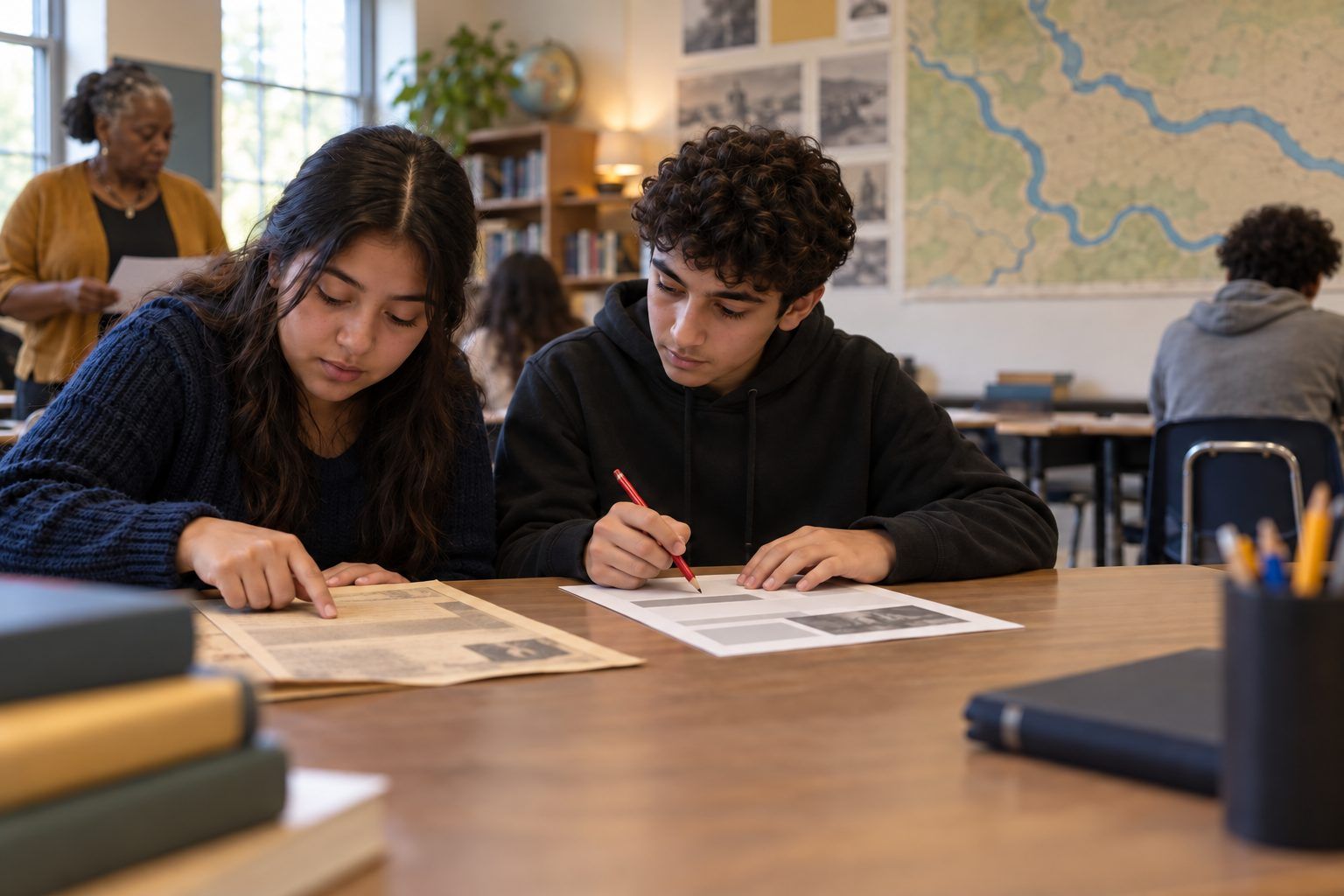
AI summaries are fast and fluent, which makes them easy to trust. But a summary is only useful if it is faithful to the source. Students read a primary-source-style letter (fictional and written for this lesson) from a 13-year-old describing a flood in her town, then compare it line by line with a mock AI summary. The summary sounds right but contains six distortions: a wrong date, an exaggeration, an invented quote, an uncertain rumor stated as fact, an added detail, and a family whose help disappears. Students learn a habit historians already use: go back to the source.
In this packet
- Handout A: The Letter (reading)
- Handout B: The AI Summary (reading)
- Handout C: Distortion Detector (organizer)
TCEA ELE indicators
- AI4.1 I know how to promote critical thinking skills in relation to AI-generated information.
- S2.2 I can identify trustworthy sources of information on the internet.
- AI1.3 I am aware of the current limitations and potential biases in AI systems.
- S3.2 I can communicate my ideas clearly to others.
- T5.1 I know how to design lessons that promote higher-order thinking skills.
Full facilitator guide: mglearn.github.io/eles/activities/primary-source-vs-ai-summary.html
Handout A for Primary Source vs. AI Summary
The Letter
This letter is fictional. It was written for this lesson in the style of a real letter from 1911. Willow Fork and everyone in it are made up. Read it before you read any summary.
1¶1 · Willow Fork, April 9, 1911. Dear Cousin Lorena, I am writing by lamplight because the creek has gone back down at last and Mama says I may have the whole evening for letters. You asked in your last one whether the rain reached us. It did, and more.
2¶2 · On Tuesday night the rain did not stop, and by morning Willow Fork Creek had come up over the lower road and into the mill yard. Papa and Mr. Peterson and some of the other men carried the sacks of grain up to the loft so they would stay dry. The water came onto the mill floor about as high as my boot tops. Several cellars on Front Street filled with water, ours included, and we lost most of the jars Mama put up last summer.
3¶3 · We could not stay in the house because of the cellar and the smell, so we went up the hill to the Castillo family. Mrs. Castillo gave us her front room for three nights and would not take a penny. Her son Tomás, who is fifteen, took his rowboat down to the schoolhouse with Miss Hale and they brought back every one of the school's books in flour sacks before the water got to the shelves. I think he is the bravest person in Willow Fork, though I would never tell him so.
4¶4 · School was closed for four days. Nobody was hurt, thank the Lord, but the Petersons lost two cows that got caught in the low pasture. Mrs. Peterson cried when she told Mama, and I cried too.
5¶5 · Some people at the store are saying the new dam the company built upstream last fall made the water come up faster. Mr. Olsen is sure of it and says he will write to the newspaper. But Papa says nobody knows yet, and that we had high water in 1899 too, before there was any dam. I do not know who is right.
6¶6 · I was frightened on Tuesday night, I will admit it. But mostly now I am tired of mopping. Please write back soon and tell me whether your Aunt Rose's garden made it through. Your loving cousin, Ada Whitfield (age 13)
Handout B for Primary Source vs. AI Summary
The AI Summary
This mock response was written for this lesson to show the kinds of mistakes AI summaries can make. Prompt: "Summarize this letter in one paragraph for a history project."
1In this letter, written in May 1912, a young farm girl named Ada Whitfield describes a devastating flood that destroyed the town of Willow Fork. The flood, caused by the new dam built upstream, forced families from their homes as the creek overflowed. Ada's father and other neighbors worked to save grain from the mill by carrying it to the loft.
2The school was closed for four days, and while no one was hurt, the Peterson family lost two cows. Ada writes that the experience was terrifying, saying, "We lost everything." The letter offers a vivid firsthand account of how a small community endured a natural disaster in the early twentieth century.
Handout C for Primary Source vs. AI Summary
Distortion Detector
Distortion types: Wrong detail · Exaggeration · Invented · Certainty added · Left out · Added detail. Cite the paragraph (¶) in the letter that proves it. The last rows are for your faithful summary and your summary rule.
| What the AI summary says | What the letter actually says (¶ #) | Distortion type | Why it matters |
|---|---|---|---|
| Our faithful 3-sentence summary: | |||
| I can trust an AI summary when… | I need to go back to the source when… |