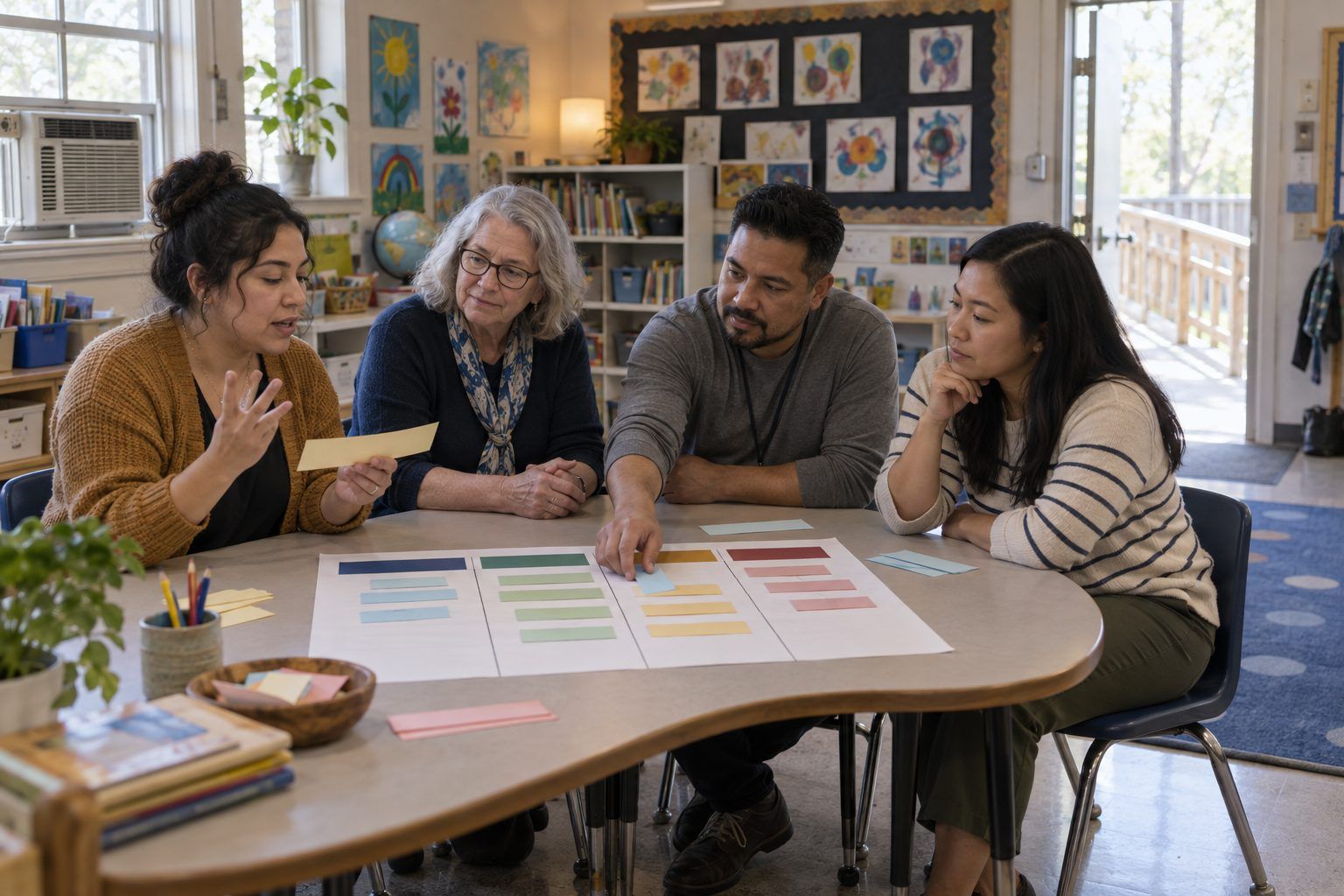
Professional learning · Teachers, Librarians · 20 minutes
Does This Need a Screen?
A fast, argument-starting card sort where teachers decide which classroom tasks are best unplugged, which earn their screen time, and where AI adds value, and have to say why.
The screen-time debate usually gets stuck at "more" or "less." This quick sort replaces that with a better question: for this task and these students, what does a screen add to the evidence of learning, and what does it cost in attention, connection, and wellbeing? Groups sort 14 real-feeling classroom tasks into four piles, argue the close calls, and leave with a five-question check they can use while planning tomorrow. It works well as a staff-meeting opener or the first 20 minutes of a longer session.
In this packet
- Handout A: Screen or No Screen? Sort (card sort)
- Handout B: Five-Question Screen Check (checklist)
- Facilitator key (last page)
TCEA ELE indicators
- T1.1 I know how to seamlessly integrate technology into my teaching practices.
- T4.3 I am aware of the importance of emotional support in academic success.
- T1.3 I am aware of emerging technologies and their potential applications in education.
Full facilitator guide: mglearn.github.io/eles/activities/does-this-need-a-screen.html
Handout A for Does This Need a Screen?
Screen or No Screen? Sort
Cut apart the strips. Before placing a strip, finish this sentence aloud: "The evidence of learning here is ___, and a screen helps / hurts / doesn't matter because ___."
Unplugged is best
Digital earns its place
AI adds value (with guardrails)
It depends: say on what
Handout A for Does This Need a Screen?
Screen or No Screen? Sort: cards to sort
Cut apart the strips. Sort each one onto the mat and be ready to explain why.
Sheet 1 of 2
Kindergartners practice forming the letters in their names.
A morning circle where students share how they're feeling today.
A 3rd-grade class plays a paper "guess the next word" game to learn how a chatbot writes answers.
High school students write the first draft of a personal narrative about a moment that changed them.
Two teams rehearse a formal debate before a class tournament.
4th graders compare a month of daily temperatures from two cities and explain the difference.
A middle school class interviews a partner class in another state about local landforms.
A student whose handwriting is slow and painful because of a motor disability writes a story.
8th graders practice solving two-step equations and need to know right away whether each answer is correct.
11th graders strengthen an argumentative essay by answering the strongest counterarguments to their claim.
A teacher needs a science article rewritten at two reading levels for newcomers learning English.
6th graders record a grandparent's memories for a family oral-history project.
Handout A for Does This Need a Screen?
Screen or No Screen? Sort: cards to sort
Cut apart the strips. Sort each one onto the mat and be ready to explain why.
Sheet 2 of 2
7th graders build a model of an animal cell.
Before a sensitive discussion, the teacher wants every student's honest opinion, anonymously.
Handout B for Does This Need a Screen?
Five-Question Screen Check
Run one task from this week's plans through these questions before deciding.
| Yes | Not sure | No | |
|---|---|---|---|
| I can name the evidence of learning this task should produce. | |||
| The screen (or AI tool) makes that evidence easier to produce, see, or give feedback on. | |||
| The same evidence would be weaker or slower to get without the screen. | |||
| I've considered what the screen costs here: attention, face-to-face talk, movement, or emotional connection. | |||
| If AI is involved, students must question, verify, or decide something about its output, not just accept it. | |||
| Students' personal information is protected in any tool this task uses. | |||
| I can explain my choice to students in one sentence. |
Notes
Facilitator only for Does This Need a Screen?
Answer key and notes
Handout A: Screen or No Screen? Sort
| Item | Sort | Why |
|---|---|---|
| Kindergartners practice forming the letters in their names. | Unplugged is best | Letter formation is a fine-motor skill; pencils, crayons, and tracing in sand build it better than tapping a screen. |
| A morning circle where students share how they're feeling today. | Unplugged is best | Eye contact, tone, and being heard in person are the point. A screen would thin out the connection. |
| A 3rd-grade class plays a paper "guess the next word" game to learn how a chatbot writes answers. | Unplugged is best | Handling the cards makes an invisible process visible; the concept, not the tool, is what's being learned. |
| High school students write the first draft of a personal narrative about a moment that changed them. | Unplugged is best | The drafting is the learning. An AI draft would do the remembering, choosing, and shaping for them. (Typing on a device is fine; AI generation is not.) |
| Two teams rehearse a formal debate before a class tournament. | Unplugged is best | Listening, rebuttal, and reading the room are live, face-to-face skills. |
| 4th graders compare a month of daily temperatures from two cities and explain the difference. | Digital earns its place | A spreadsheet graphs 60 numbers in seconds, so class time goes to interpreting the pattern instead of plotting points. |
| A middle school class interviews a partner class in another state about local landforms. | Digital earns its place | A video call is the only practical way to talk live with that class. The screen creates the learning opportunity. |
| A student whose handwriting is slow and painful because of a motor disability writes a story. | Digital earns its place | Typing or speech-to-text removes a barrier so the evidence shows the student's storytelling, not their handwriting. (Follow the student's plan.) |
| 8th graders practice solving two-step equations and need to know right away whether each answer is correct. | Digital earns its place | Immediate feedback on each problem helps students catch errors before they practice them 20 times. A worked-out answer key can also do this. |
| 11th graders strengthen an argumentative essay by answering the strongest counterarguments to their claim. | AI adds value (with guardrails) | An approved chatbot can act as a sparring partner that generates counterarguments. Students must verify and rebut them, and disclose the use. |
| A teacher needs a science article rewritten at two reading levels for newcomers learning English. | AI adds value (with guardrails) | AI can produce leveled drafts quickly. The teacher must check every fact and term against the original before students see it. |
| 6th graders record a grandparent's memories for a family oral-history project. | It depends: say on what | Depends on purpose and consent. Recording preserves the voice, but the interview itself is human; notes on paper may be enough. |
| 7th graders build a model of an animal cell. | It depends: say on what | Depends on the goal. A clay model shows structure you can hold; a simulation shows processes over time. |
| Before a sensitive discussion, the teacher wants every student's honest opinion, anonymously. | It depends: say on what | An anonymous digital poll or folded paper slips can both work. Choose based on class size, trust, and whether results need to be shown instantly. |