Student learning · Grades 9–12, Higher Ed · 55 minutes
Disclose It
Students sort real-feeling academic integrity dilemmas across courses, then write honest AI-use disclosures and process logs they would stand behind.
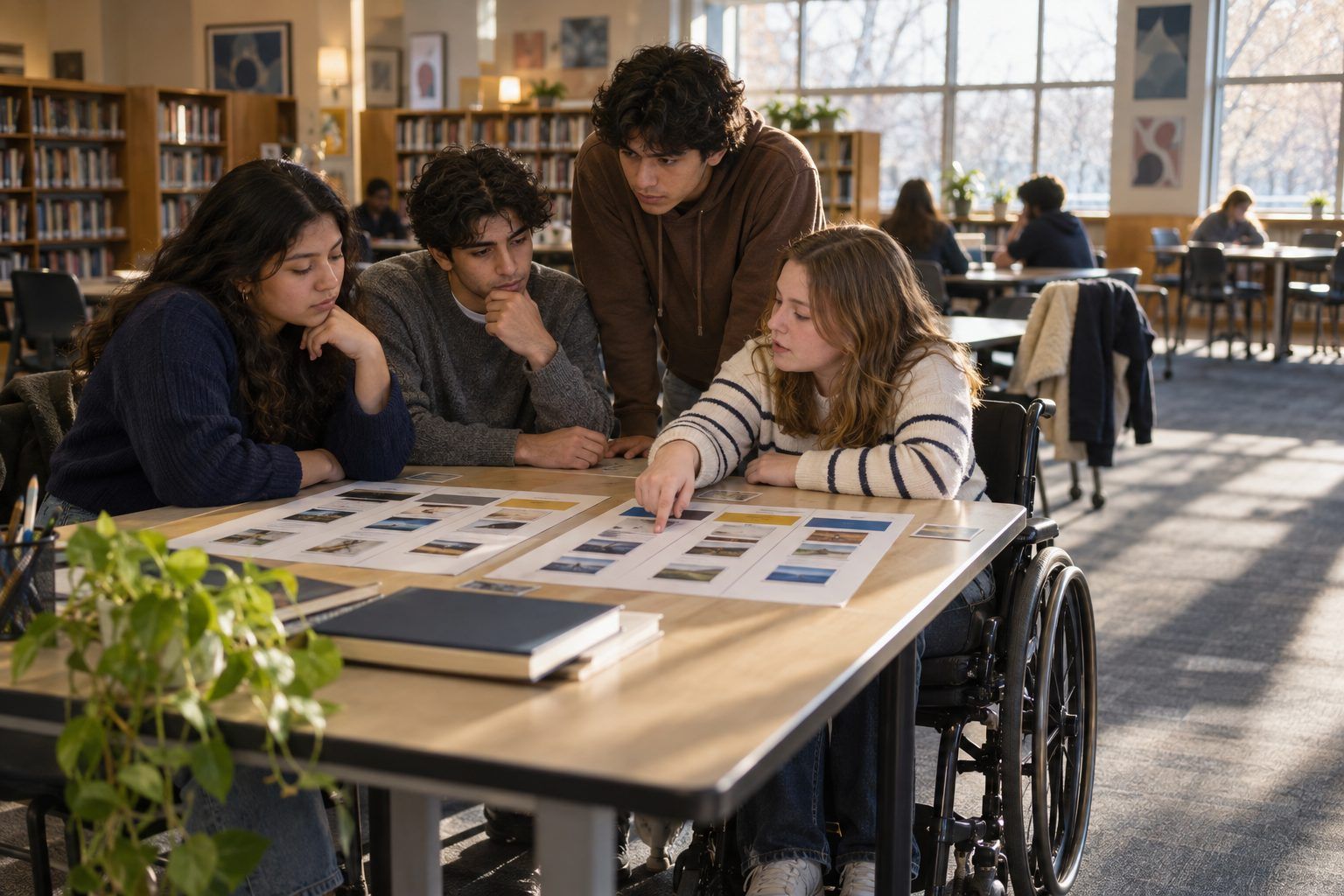
Students increasingly take several courses at once with several different AI rules: brainstorming allowed in one, banned in another, required with a log in a third. The skill that transfers across all of them is not memorizing rules; it is being transparent about what you did and taking ownership of your process. In this activity, students sort fourteen scenarios by what the posted course policy requires, argue the gray areas, and then write a disclosure statement and process log for a piece of their own work. No devices are needed, because the thinking is about judgment and honesty, not tools.
In this packet
- Handout A: Where Does It Land? (Scenario Sort) (card sort)
- Handout B: Disclosure Statement and Process Log (worksheet)
- Handout C: Disclosure Quality Check (checklist)
- Facilitator key (last page)
TCEA ELE indicators
- AI2.3 I am aware of the importance of transparency and accountability in AI systems.
- AI2.1 I know how to apply ethical principles when using or developing AI for education.
- S4.1 I know how to take responsibility for my own learning.
- AI2.2 I can identify potential ethical issues in AI applications and propose solutions.
Full facilitator guide: mglearn.github.io/eles/activities/disclose-it.html
Handout A for Disclose It
Where Does It Land? (Scenario Sort)
Decide using the course policy in parentheses, not your opinion of it. Say the reason aloud before placing each strip.
No disclosure needed
Disclose it
Ask first
Crosses the line
Handout A for Disclose It
Where Does It Land? (Scenario Sort): cards to sort
Cut apart the strips. Sort each one onto the mat and be ready to explain why.
Sheet 1 of 2
1. Anaya uses a chatbot to generate practice quiz questions to study for a chemistry test. Nothing is turned in. (Chemistry: "AI may be used for personal study.")
2. Marcus asks a chatbot for three possible essay topics, picks one, and writes the essay himself. (English: "AI brainstorming is allowed; disclose it.")
3. Priya pastes her whole lab report into a chatbot and asks it to "make it sound more scientific," then submits the result. (Biology: "AI may not be used to write or rewrite submitted work.")
4. Devin uses a chatbot to explain a statistics concept he missed while absent, then completes the problem set alone. (Statistics: "AI tutoring is encouraged; note it if it shaped your work.")
5. Lena asks a chatbot to summarize a novel instead of reading the assigned chapters, then writes her response from the summary. (English: "AI brainstorming is allowed; disclose it.")
6. Tomás uses an AI image tool to create the cover image for a history presentation. The policy doesn't mention images. (History: "AI may not be used for any writing task.")
7. Jada uses a search engine and the school library database to find sources for her research paper. (Government: "AI may not be used for this project.")
8. Kai asks a chatbot to check his computer code for bugs, and it rewrites two functions. He submits the rewritten code. (Computer Science: "AI debugging help is allowed; comment any AI-written lines.")
9. Rosa writes her Spanish essay in English and uses an AI translator to convert it to Spanish. (Spanish III: "Translation tools may not be used on graded writing.")
10. Omar uses a chatbot to generate interview questions for a family-history project, then revises them with his grandmother. (Social Studies: no AI policy posted.)
11. Bree runs her finished essay through the spell-and-grammar checker built into her word processor and accepts a few comma fixes. (English: "AI brainstorming is allowed; disclose it.")
12. Sam asks a chatbot to write his reflection paragraph about what he learned in a group project, then submits it as his own. (Any course: reflections are personal writing.)
Handout A for Disclose It
Where Does It Land? (Scenario Sort): cards to sort
Cut apart the strips. Sort each one onto the mat and be ready to explain why.
Sheet 2 of 2
13. Nia uses a chatbot to turn her class notes into a study guide, then shares the guide with her whole study group. (Psychology: "AI may be used for personal study.")
14. Eli uses an AI tool to generate data for a science fair project because his experiment failed, and presents it as his results. (Science Fair rules: "All data must come from your own experiment.")
Handout B for Disclose It
Disclosure Statement and Process Log
Use a real assignment. If you used no AI, complete the log anyway and write "No generative AI was used."
Assignment, course, and the course's AI policy in your own words:
Process log. For each stage (getting started, research, drafting, revising, final check), write the date, what you did, any tools you used (search, AI, grammar checker, calculator), and one decision you made.
Disclosure statement. Include: the type of tool (not a brand), the task you used it for, what you kept, what you changed, and what you checked.
Which part of this work is most clearly your thinking? How could a teacher see that?
If you're unsure whether your use fit the policy, write the question you would ask your teacher before submitting:
Handout C for Disclose It
Disclosure Quality Check
Review your partner's Handout B. Circle one item to strengthen, then write a question a teacher might ask about the work.
| Yes | Partly | No | |
|---|---|---|---|
| Names the type of tool used (or states that none was used) | |||
| Names the specific task the tool helped with | |||
| Says what was kept from the tool's output | |||
| Says what the student changed or rejected, and why | |||
| Says what the student checked or verified | |||
| Matches the course policy, or includes a question to ask first | |||
| Process log shows a decision at each stage | |||
| A teacher could tell which thinking belongs to the student | |||
| Written plainly enough that a family member would understand it |
Notes
Facilitator only for Disclose It
Answer key and notes
Handout A: Where Does It Land? (Scenario Sort)
| Item | Sort | Why |
|---|---|---|
| 1. Anaya uses a chatbot to generate practice quiz questions to study for a chemistry test. Nothing is turned in. (Chemistry: "AI may be used for personal study.") | No disclosure needed | Private study that produces no submitted work, and the policy explicitly allows it. |
| 2. Marcus asks a chatbot for three possible essay topics, picks one, and writes the essay himself. (English: "AI brainstorming is allowed; disclose it.") | Disclose it | Allowed use, and the policy asks for disclosure. |
| 3. Priya pastes her whole lab report into a chatbot and asks it to "make it sound more scientific," then submits the result. (Biology: "AI may not be used to write or rewrite submitted work.") | Crosses the line | Rewriting submitted work is exactly what the policy prohibits. |
| 4. Devin uses a chatbot to explain a statistics concept he missed while absent, then completes the problem set alone. (Statistics: "AI tutoring is encouraged; note it if it shaped your work.") | Disclose it | The explanation shaped how he worked the problems, so the policy asks for a note. |
| 5. Lena asks a chatbot to summarize a novel instead of reading the assigned chapters, then writes her response from the summary. (English: "AI brainstorming is allowed; disclose it.") | Crosses the line | Summarizing to skip the reading is not brainstorming, and it replaces the learning the assignment requires. |
| 6. Tomás uses an AI image tool to create the cover image for a history presentation. The policy doesn't mention images. (History: "AI may not be used for any writing task.") | Ask first | The policy is silent on images. Ask before, not after. |
| 7. Jada uses a search engine and the school library database to find sources for her research paper. (Government: "AI may not be used for this project.") | No disclosure needed | Ordinary research tools; cite the sources as usual. |
| 8. Kai asks a chatbot to check his computer code for bugs, and it rewrites two functions. He submits the rewritten code. (Computer Science: "AI debugging help is allowed; comment any AI-written lines.") | Disclose it | Allowed, but the AI-written lines must be marked in comments. |
| 9. Rosa writes her Spanish essay in English and uses an AI translator to convert it to Spanish. (Spanish III: "Translation tools may not be used on graded writing.") | Crosses the line | The policy names translation tools directly; the assignment measures her Spanish writing. |
| 10. Omar uses a chatbot to generate interview questions for a family-history project, then revises them with his grandmother. (Social Studies: no AI policy posted.) | Ask first | No policy means ask. It's likely fine, but the teacher decides, and a disclosure would still help. |
| 11. Bree runs her finished essay through the spell-and-grammar checker built into her word processor and accepts a few comma fixes. (English: "AI brainstorming is allowed; disclose it.") | No disclosure needed | Routine proofreading tools most courses already expect; if the tool starts rewriting sentences, that changes. |
| 12. Sam asks a chatbot to write his reflection paragraph about what he learned in a group project, then submits it as his own. (Any course: reflections are personal writing.) | Crosses the line | A reflection's whole purpose is the student's own thinking. Submitting generated reflection misrepresents authorship. |
| 13. Nia uses a chatbot to turn her class notes into a study guide, then shares the guide with her whole study group. (Psychology: "AI may be used for personal study.") | Ask first | Personal study is allowed, but sharing generated material with others may go beyond the policy; also check it for errors first. |
| 14. Eli uses an AI tool to generate data for a science fair project because his experiment failed, and presents it as his results. (Science Fair rules: "All data must come from your own experiment.") | Crosses the line | Fabricating data is a serious integrity violation with or without AI. |