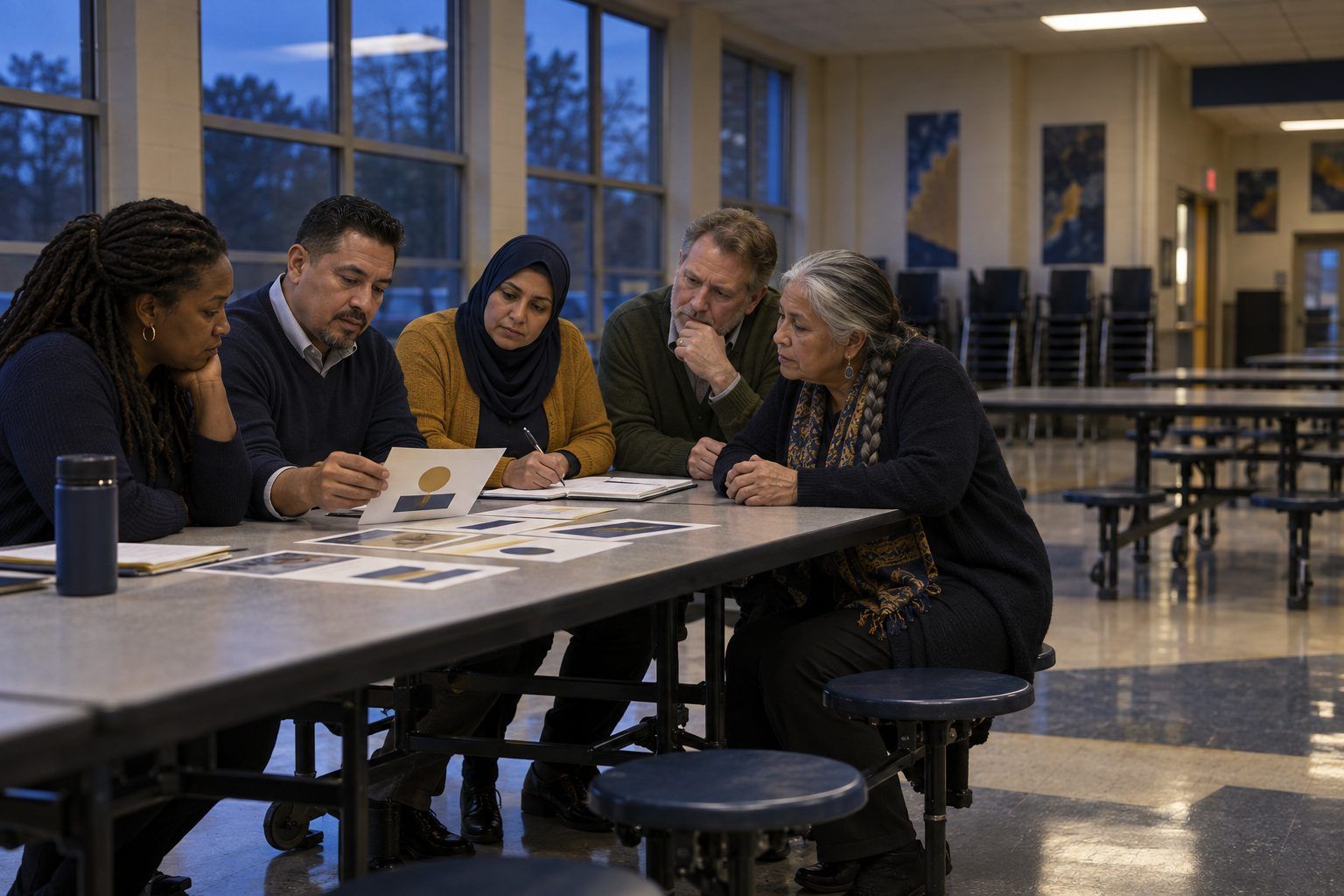
Professional learning · Leaders, Staff · 70 minutes
Is That Really Our Principal? A Synthetic Media Crisis Tabletop
A fake audio clip of the principal spreads through parent groups on a Friday night, and the leadership team has two hours of game time to verify, respond, and rebuild trust.
Voice-cloning and video tools make it possible to put convincing words in anyone's mouth, and school leaders are visible, recorded, and trusted, which makes them targets. In this tabletop, a crisis team works through a fictional Friday-night timeline in which a synthetic audio clip of the principal cancels a trip and insults a neighborhood. Teams must separate what they know from what they don't, verify without relying on a detector, communicate with families in the first hour, and plan how to help the whole community get better at spotting the next one. The deepest lesson is that verification is a practice you prepare before the crisis, not a tool you find during it.
In this packet
- Handout A: Incident Timeline Cards (cut-apart cards)
- Handout B: Verification and Response Log (organizer)
- Handout C: Synthetic Media Readiness Checklist (checklist)
- Facilitator key (last page)
TCEA ELE indicators
- L5.2 I can effectively use digital communication tools to share school goals and achievements with stakeholders.
- L4.1 I know how to create a positive and inclusive digital learning climate.
- AI4.2 I can teach others to question and verify AI outputs.
- AI1.2 I can explain AI concepts in simple terms to various stakeholders.
Full facilitator guide: mglearn.github.io/eles/activities/deepfake-principal-tabletop.html
Handout A for Is That Really Our Principal? A Synthetic Media Crisis Tabletop
Incident Timeline Cards
Fictional scenario. Keep cards face down in order and flip one at a time on the facilitator's signal. Backs are facilitator notes; print separately.
Card 1 · Fri 6:40 p.m.
The AP gets a text from a parent: "Is this real?? Everyone's sharing it." Attached is a 35-second audio clip posted in the Bluebonnet Springs Parents group. It sounds like Principal Dr. Renee Okafor saying Saturday's band trip to the regional competition is canceled due to "a security threat," followed by a disparaging comment about families from the Riverbend apartments.
Card 2 · Fri 6:52 p.m.
Dr. Okafor answers from the football stadium, where she has been since 5:30 p.m. with dozens of staff and families. "I never recorded that. I would never say that." The clip has now been shared in three parent groups and on a public social media account called @BSHSTruth, created four days ago.
Card 3 · Fri 7:05 p.m.
The band director calls: 40 families have messaged asking if the trip is off. Buses leave at 6:00 a.m. The PTA president says the Riverbend families' group chat is angry and hurt. Your team must draft a first family message within 30 minutes of game time.
Card 4 · Fri 7:30 p.m.
A staff member suggests uploading the clip to a free online "AI voice detector." It returns: "87% likely human." Some staff now wonder whether Dr. Okafor really said it and forgot.
Card 5 · Fri 7:50 p.m.
A local TV station's reporter emails the district: "We're aware of a recording of the Bluebonnet Springs principal. Can you comment by 9 p.m.?"
Card 6 · Fri 8:15 p.m.
A student messages the counselor: a classmate bragged in a group chat that he "made the principal say stuff" with a free app, "as a joke." The student is scared to be named.
Card 7 · Sat 5:30 a.m.
Buses are loading. Eleven band students haven't arrived, and three of their families live at Riverbend. A parent tells the band director, "We didn't think we were welcome."
Card 8 · Mon 7:30 a.m.
The rumor is debunked, but the clip is still circulating in some groups, and a few families still believe it. Staff are asking whether this could happen to them. Students are talking about it in every hallway.
Handout B for Is That Really Our Principal? A Synthetic Media Crisis Tabletop
Verification and Response Log
Update after every card. Keep verified facts separate from what you suspect.
| Game time | What we know (verified, and how) | What we don't know yet | Action + owner | Message sent (to whom, what channel) |
|---|---|---|---|---|
| Fri 6:40 p.m. | ||||
| Fri 6:52 p.m. | ||||
| Fri 7:05 p.m. | ||||
| Fri 7:30 p.m. | ||||
| Fri 7:50 p.m. | ||||
| Fri 8:15 p.m. | ||||
| Sat 5:30 a.m. | ||||
| Mon 7:30 a.m. |
Handout C for Is That Really Our Principal? A Synthetic Media Crisis Tabletop
Synthetic Media Readiness Checklist
Rate your own campus honestly. Circle the three items your team will act on first.
| Yes | Partly | No | |
|---|---|---|---|
| Families know our official channels for cancellations and emergencies, and we use them every time. | |||
| Our crisis communication plan names who verifies a rumor and who approves the first message. | |||
| We have a plain-language first-message template that works when we don't have all the facts. | |||
| We can send urgent messages in the languages our families speak, by text as well as email. | |||
| Staff know not to forward suspected fake media, even to report it, beyond the people who need it. | |||
| Our leaders know that AI detection tools are not reliable enough to decide what is real. | |||
| Our student code of conduct addresses creating or sharing synthetic media of students or staff. | |||
| Students learn to verify surprising audio and video by checking the source and context. | |||
| Families have been offered a session or resource on spotting manipulated and synthetic media. | |||
| We have a plan for repairing harm with any group targeted by a rumor, not only for correcting facts. | |||
| We have told our community in advance how we will always confirm real announcements (a pre-bunk). |
Notes
Facilitator only for Is That Really Our Principal? A Synthetic Media Crisis Tabletop
Answer key and notes
Handout A: Incident Timeline Cards
- Card 1 · Fri 6:40 p.m.
- First decision: who needs to know right now, and who owns verification? Strong teams reach the principal immediately and start a log. Note: nobody should forward the clip further, even internally, more than necessary.
- Card 2 · Fri 6:52 p.m.
- Two strong verification facts: a public alibi at the time of posting and a brand-new account as the first poster. Teams should log these as verified facts. They still don't know who made the clip.
- Card 3 · Fri 7:05 p.m.
- Time pressure. The message must go out before full certainty. Look for: the trip is on; the recording did not come from the principal or the school; do not share it; updates will appear on the official channel; a sentence addressing the harm to Riverbend families.
- Card 4 · Fri 7:30 p.m.
- The key teaching card. Detection tools are unreliable, and uploading the clip may spread it further. The alibi and provenance are stronger evidence than a detector score. Watch whether teams let one tool's number override verified context.
- Card 5 · Fri 7:50 p.m.
- Tests whether the team knows its district protocol: who speaks to media? Strong teams route this to the district communications office and prepare a brief statement consistent with the family message.
- Card 6 · Fri 8:15 p.m.
- Decisions: protect the reporting student, follow the student code of conduct and district policy on investigations, and involve district leadership. Teams should not publicly name a student. Some districts will involve law enforcement; follow your protocol.
- Card 7 · Sat 5:30 a.m.
- Harm persists after the facts are clear. Look for teams that planned direct, personal outreach to Riverbend families, not just a mass message.
- Card 8 · Mon 7:30 a.m.
- Recovery and prevention. Strong teams plan: a staff briefing, a student lesson on synthetic media, a follow-up with Riverbend families, and a community media literacy step. The incident becomes a teaching moment without spreading the clip again.