Academic, not devotional
The U.S. Supreme Court (Abington v. Schempp, 1963) has long held that public schools may teach about the Bible's literary and historical influence, so long as the approach analyzes texts rather than promotes belief. The TEA makes the same claim about its adopted materials. This suite is built entirely on that line.
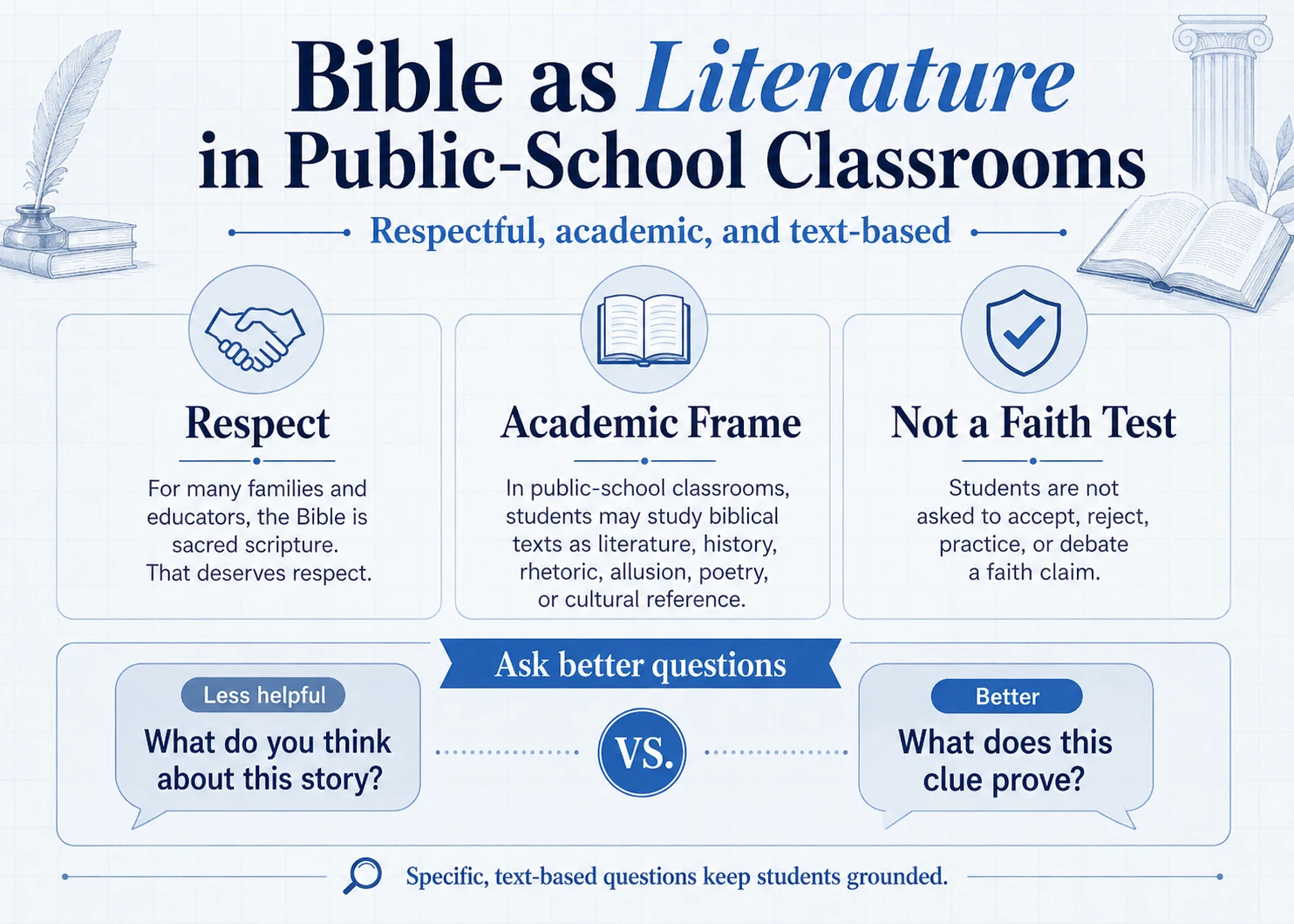
Study the text
Sequence, theme, genre, archetype, allusion, rhetoric. Students ask what the story says and how it's built — the same questions they'd bring to Aesop, Homer, or Shakespeare.
Never devotional
No prayer, no truth claims, no "what this means for your faith." Where the text and a common interpretation diverge — as with Esther and "religious freedom" — students are taught to notice the gap, not resolve it.
Every student included
Framing these as literature keeps the classroom open to students of every faith and none. The 9–12 breakout makes that constitutional reasoning an explicit object of study.
Two Kindergarten required-list titles — You Are Special (Max Lucado) and The Berenstain Bears and the Golden Rule — are modern children's books, not scripture. They are studied as literature that echoes a value the biblical texts also teach, and are clearly labeled as such.