
← Activities Get the packets
Classroom packet
Cases 01–05
CER or ACE response
Grades 5–8 core · K–16 adaptable

CER & ACECase Files

Observe. Test. Explain. Extend.
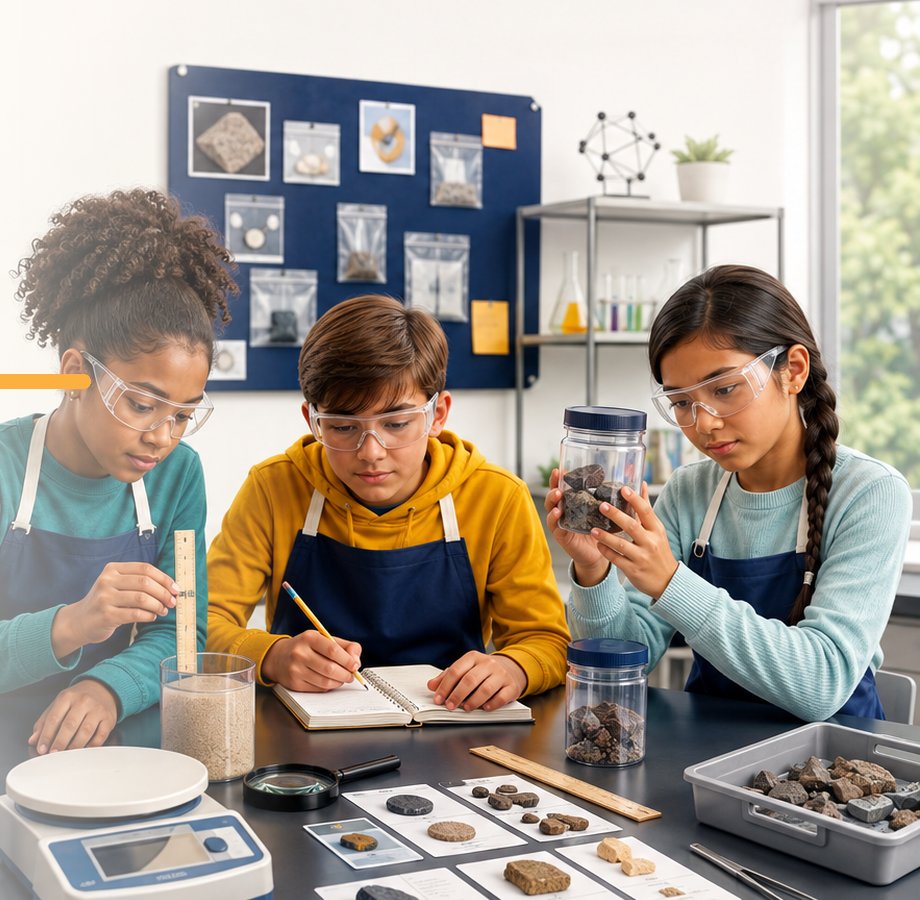
Three middle-school students in aprons and safety glasses examining rock and mineral samples at a lab bench

About these cases

Want to get students thinking of themselves as science detectives? Five hands-on cases, a teacher guide, and your choice of a Claim–Evidence–Reasoning or Articulate–Connect–Extend response page.

The CER & ACE Case Files packet applies one reasoning routine to five short, hands-on investigations. Each case is a Page 1 investigation plus your choice of a Page 2 response: CER or ACE.

The routine

Four moves, five cases

Every case uses the same routine, so students put their attention on the evidence instead of on learning a new worksheet.

  1. 01

    Observe

    Record what you notice before naming the object or explaining the result.

  2. 02

    Test

    Choose a property, tool, or measurement that can produce useful evidence.

  3. 03

    Explain

    Connect the result to a science idea. Tell why the evidence matters.

  4. 04

    Check

    Retest, consider another explanation, and state what still feels uncertain.

Evidence rule

A result is not automatically evidence. Explain what the result tells you and why it matters.

The five-pack

Exploring the cases

Each case is a Page 1 investigation and your choice of a Page 2 response.

Mystery Mixture materials laid out on a tray Case 01

Physical properties and separation

Separate a Mystery Mixture

Four mixtures are made from familiar solids. Choose a separation method for each sample, then use physical properties to explain why your method worked.

Students receive four teacher-prepared mixtures and a small set of tools: a magnet, sieve, water, filter, and magnifier. Their job is to choose a separation method based on an observable property.

The useful part comes after the separation. Students must explain why the method worked. “I used the magnet” is a procedure. “The magnet removed the iron because iron is magnetic and sand is not” shows the beginning of scientific reasoning.
Students figure out
Which method separates each mixture
Texas
Direct: 5.6B and 6.6B, mixture properties
NGSS
Practice: 5-PS1-3; add material identification for the full PE
Density Deception materials laid out on a tray Case 02

Mass, volume, and relative density

Unmask an Unknown with Density

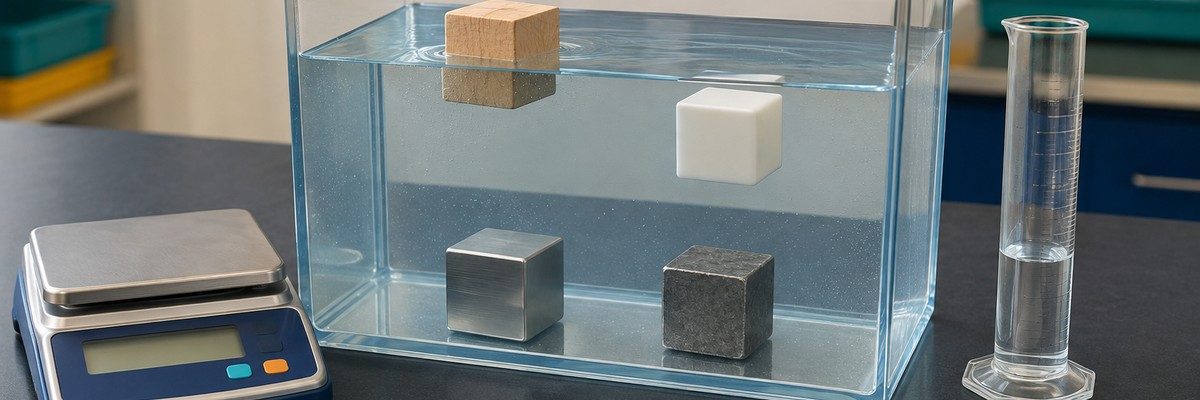
Four equal-size cubes look similar. Which cube is aluminum? Measure mass and volume, calculate density, and compare your results with the reference table.

Four cubes look similar, but their masses tell a different story. Students measure mass and volume, calculate density, and compare their results with a short reference table.

This case is built to expose a familiar misconception: heavy objects sink and light objects float. A large piece of wood may weigh more than a tiny metal cube and still float. Density, not weight alone, explains the result.

I would use the completed example before handing students the blank case. It models how to move from measurements to a claim without turning the response into a fill-in-the-blank exercise.

Students figure out
Which cube matches an unknown material
Texas
Direct: 6.6D; Grade 5 bridge: 5.6A
NGSS
DCI connection: MS-PS1.A; 5-PS1-3 excludes density
State Detectives materials laid out on a tray Case 03

Melting, condensation, and evaporation

Track a State Change

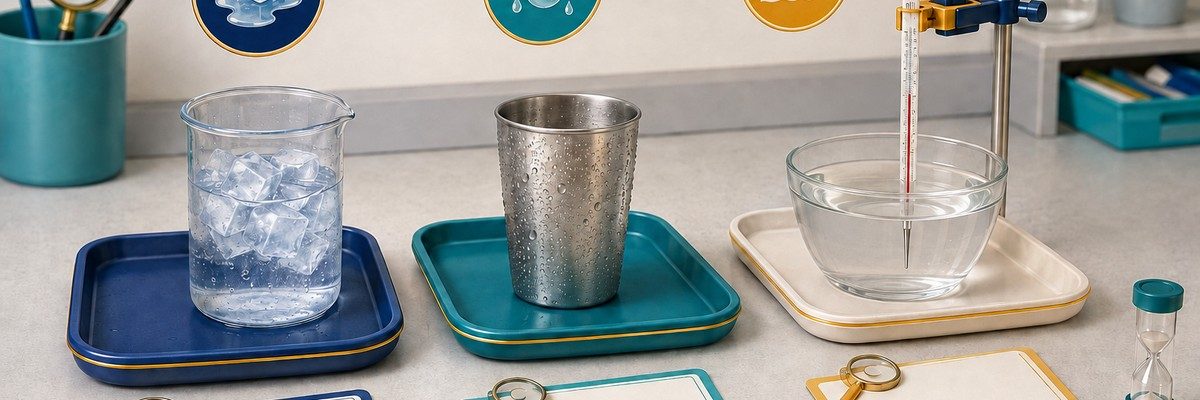
Water is changing at three stations. Identify melting, condensation, and evaporation, then explain whether the water undergoing each state change absorbs or releases energy.

This investigation uses three water stations: melting ice, condensation on a cold cup, and evaporation from warm water. There is no fizzing tablet pretending to be a state change. Fizzing is evidence that students should examine as a possible chemical change, which belongs in a different case.

Students record what they see, measure temperature when appropriate, and identify whether thermal energy enters or leaves the system. The Extend prompt asks them to predict what would change if the room were warmer, the cup were colder, or the surface area increased.

Students figure out
What changed and where energy moved
Texas
Content: 6.6A; add particle comparisons for the full SE
NGSS
Phenomenon: MS-PS1-4; add a particle model for the full PE
Magnet or Mimic? materials laid out on a tray Case 04

Magnetic properties

Catch the Magnet Mimics

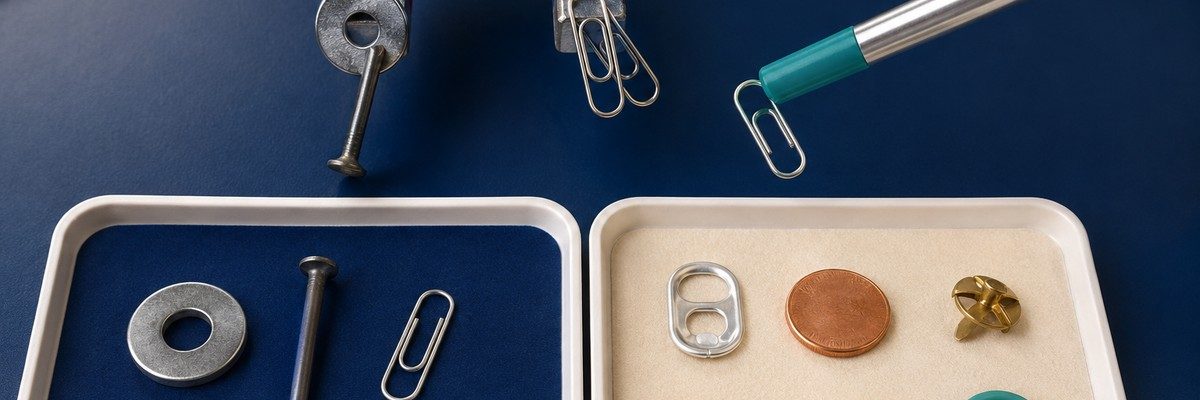
Several objects look metallic, but only some respond strongly to a magnet. Which objects are magnetic, and what second property could help you classify the mimics?

Metallic shine is a poor magnetism test, but students often treat it as proof. This case mixes steel, aluminum, copper, brass, wood, and plastic objects so appearance alone will not solve it.

After testing each object, students classify it and name a second property they could examine. That extra step keeps “metal” and “magnetic” from becoming accidental synonyms.

Students figure out
Which objects respond to a magnet and why
Texas
Direct: 5.6A, compare magnetism
NGSS
Direct property match: 5-PS1-3; 3-PS2-3 only with distance/orientation
Conductor Clues materials laid out on a tray Case 05

Electrical conductivity

Follow the Conductor Clues

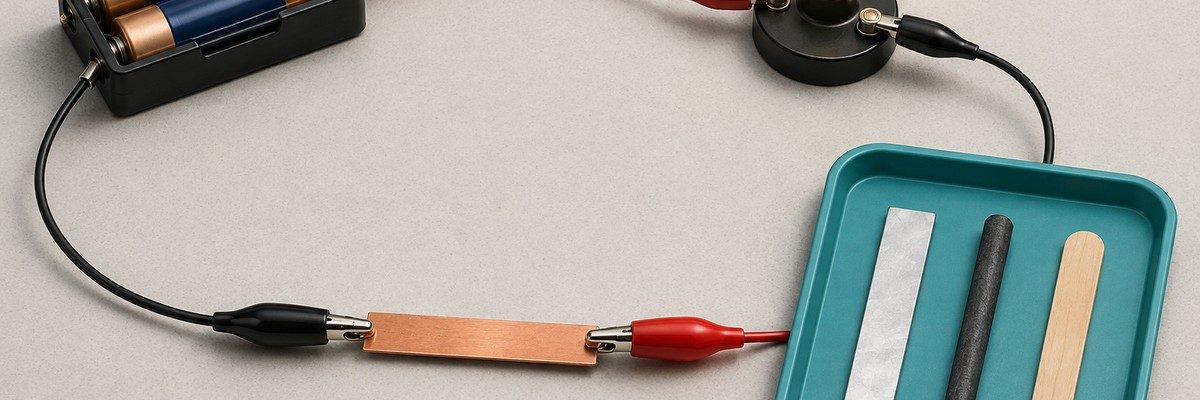
Which samples conduct electricity well enough to complete a low-voltage circuit? Test one sample at a time, then rule out loose clips or weak batteries before classifying an insulator.

Students place one sample at a time into the gap of a safe, low-voltage circuit. If the lamp turns on, the sample conducted electricity. If it stays off, students check the connections before classifying the material.

That check matters. A dark lamp may indicate an insulator, a loose clip, a dead battery, or a burned-out bulb. Science detectives do not confuse a failed setup with a finding.

Students figure out
Which materials complete a low-voltage circuit
Texas
Direct: 5.6A, conduct or insulate electric energy
NGSS
Direct property match: 5-PS1-3
Page 2

Choose CER or ACE

Both need Page 1 evidence. They ask for different thinking, so the packets ship as two separate files.

CER

Claim · Evidence · Reasoning

Use CER when students need a formal scientific argument. They state a claim, cite specific evidence, and connect that evidence to a science idea.

  1. 1 Claim
  2. 2 Evidence
  3. 3 Reasoning
  4. 4 Alternative explanation
  5. 5 Confidence check
ACE

Articulate · Connect · Extend

Use ACE when you want to hear more of the student's thinking. Students articulate what they learned, connect it to prior knowledge, and extend it with a prediction, application, or new test.

  1. A Articulate it
  2. C Connect it
  3. E Extend it
Download

Everything you need to run it

Free to print and share for classroom use. No login, no sign-up, nothing collected.

Quick start

Running it tomorrow

Run the completed density example before the first investigation. Students see what counts as an observation, data, and explanation. Then print Page 1 plus either CER or ACE for the case you want to use.

  1. 01

    Choose the response

    CER fits formal argument-from-evidence practice. ACE fits reflection, connection, and transfer. Both require Page 1 evidence.

  2. 02

    Prepare one evidence tray

    Keep sample amounts small. Test every setup before class. Put only the materials students need on the tray.

  3. 03

    Assign case roles

    Use evidence manager, recorder, skeptic, and reporter. Rotate roles across cases.

  4. 04

    Debrief the reasoning

    Ask which result changed a first idea, which explanation was ruled out, and what remains uncertain.

About the standards in the guideThis guide treats standards matches carefully: direct matches are separated from prior-grade bridges and extensions. Confirm local pacing, materials, accommodations, and laboratory safety rules before use.

Print one case, gather the materials, and let students work the evidence before you supply the explanation. Their first answer may be rough. Good. Now you know what they actually think.

Pair a hands-on case with a Science Critical Thinking Online Breakout for a digital follow-up.