
Forty-One Seconds
A fictional account, written for this session.
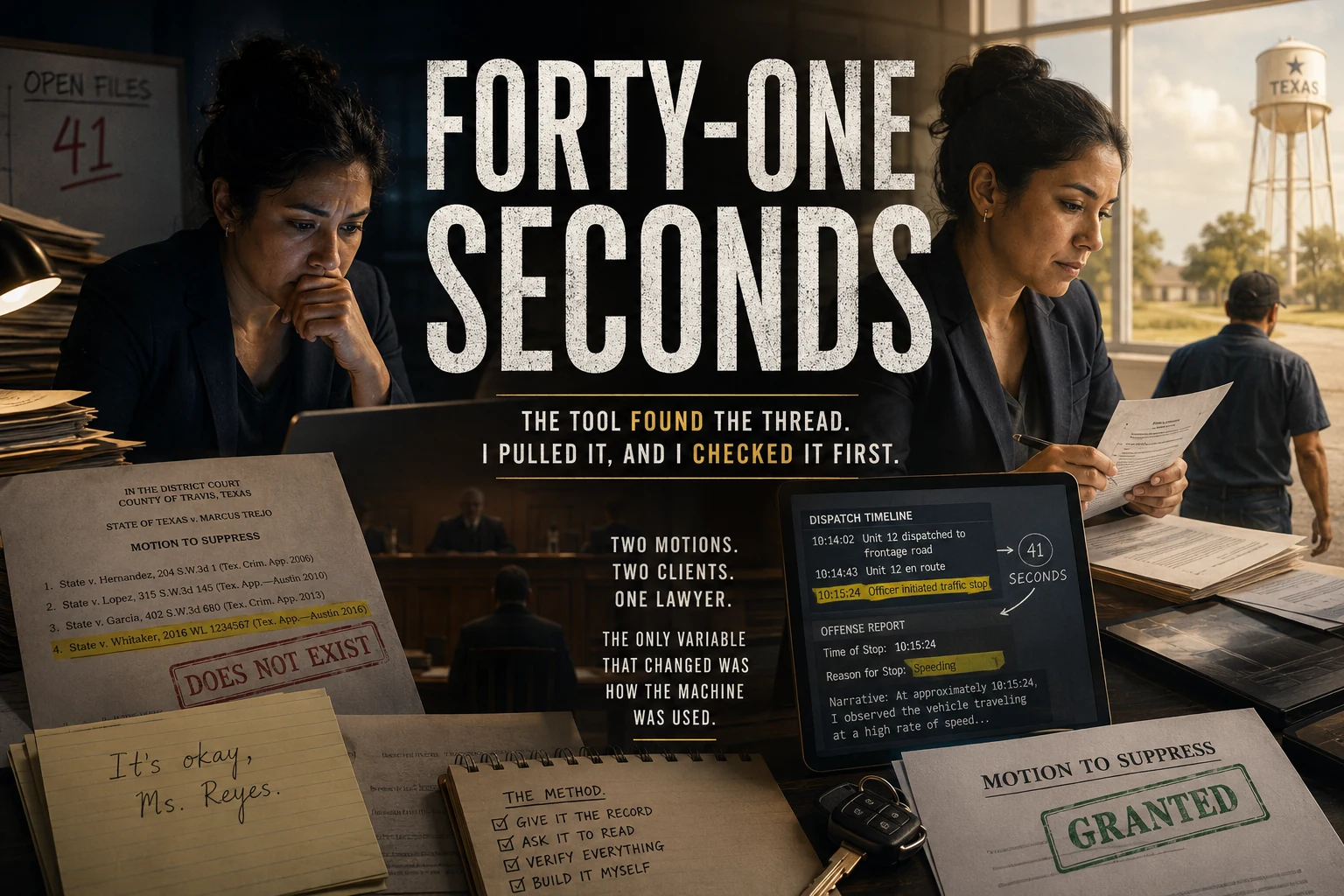
Dana Reyes practiced alone in a small Texas county, and in the spring she was carrying forty-one open files. She had become a defense lawyer because of an uncle nobody showed up for. Twenty years in, she still opened every file thinking about him.
One of those files belonged to Marcus Trejo, nineteen years old, charged with possession after a traffic stop. Marcus was raising his younger sister. He was eight weeks from finishing a nursing assistant program that a conviction would end. He called Dana every Friday to ask, politely, whether there was any news.
Two weeks before the suppression hearing, at eleven at night, Dana opened a chatbot and typed six words: write me a motion to suppress. What came back was clean, confident, and formatted like something she would have billed six hours for. It cited four Texas cases. Three of them were real.
The fourth, State v. Whitaker, did not exist. It had a plausible name, a plausible year, and a plausible holding. It looked exactly like the three real ones sitting beside it. Dana was tired. It looked right. She filed it.
At the hearing, the prosecutor stood up holding a legal pad and said she had been unable to locate one of the cases in the defense motion. The judge looked over his glasses and asked Dana to produce it. She could not. The room got very quiet, and then it moved on, and the motion was denied on its merits, but something else had been decided in that silence.
Marcus took a plea three weeks later. He lost his seat in the program. In the hallway afterward he looked at Dana, who could not look back, and said, It's okay, Ms. Reyes.
He comforted her. That was the part she could not put down.
Dana did not quit using AI. She decided the problem was not the machine but the way she had used it: she had asked it to remember instead of asking it to read.
So she changed two things. First, she stopped letting it work from memory and started handing it the record: the statute, the offense report, the dispatch log, her own prior briefs. Second, she added one question at the end of every session: For each claim you just made, quote the exact sentence in the material I gave you that supports it. If you cannot, mark it unsupported.
In the fall, Ruben Salas came to her. Thirty-four, a welder, two kids, charged after a stop on a frontage road. His file ran to just over three hundred pages: the offense report, the dispatch records, the dash-cam log, the inventory sheet.
Dana fed the model the record and nothing else, and asked it to build a timeline and flag anything that did not line up. It came back with a small, unglamorous note: the stop time written in the offense report and the time stamped in the dispatch log were forty-one seconds apart, and the reason the officer gave for the stop appeared in the record only after the later of the two timestamps.
Dana did not file that. She opened the dispatch records herself, found the line, read it three times, and confirmed it. Then she built the argument, in her own words, from the document she had now read. The court suppressed. Ruben drove himself home that afternoon.
The tool did not save my client. The tool found the thread. I pulled it, and I checked it first.
Two motions, two clients, one lawyer, and the only variable that changed was whether the machine was allowed to remember or required to read.