ACE is a simple way to move a lesson from heard to owned. For each idea below, you do three things in order. First you restate it in your own words, which proves you actually understood it. Then you connect it to something you already do, which is what makes it stick. Finally you extend it, putting it to work on a problem you have not seen before. That last step is where the learning lands.
Every scenario below is fictional and for reflection only. Nothing here is legal advice. Rule references follow the Texas Disciplinary Rules of Professional Conduct and may change, so verify the current text.
0 Opener · Taking your own measure
1.Know your own AI fluency before you build on it
Articulate. In one sentence, describe your current relationship with AI at work, and why you place yourself there.
- “I avoid it. I don’t trust it yet, and I haven’t tested where it helps.”
- “I dabble. I use it for quick drafts, but I check nothing systematically.”
- “I lean on it. It’s in my workflow, with rules for what I will and won’t feed it.”
Connect. Match where you are with AI today to where you once were on some tool you now use without thinking.
Extend. Name one AI habit you will build this year, and the first case type where you’ll test it.
- Draft one low-stakes item this week, like a client-update letter, and edit it hard.
- Adopt a single rule you follow every time, such as verifying every cite before it leaves your desk.
- Block twenty minutes to test one tool on a fictional fact pattern before any real matter.
1 Ethical foundations
2.Ethical responsibility cannot be delegated to software
Articulate. Restate why “the tool did it” is never a defense, and who owns the output.
- “My signature certifies the work. The tool has no license and no duty to the client.”
- “Responsibility can’t move to something that can’t be disciplined.”
- “I can delegate the drafting, but never the duty.”
Connect. Notice that AI changes nothing about a rule you already live by when other people draft your work.
Extend. A colleague says the AI “signed off” on a filing. Draft the two-sentence correction you’d give.
- Name the misconception: software certifies nothing, and only a licensed attorney can.
- Point back to the duty: the reviewing lawyer owns every word once it’s filed.
- Offer the fix: treat the output as a first draft to verify, not an approval.
3.Your existing duties already govern AI, so supervise it like a nonlawyer assistant
Articulate. In plain words, map each duty to AI use.
- Competence (1.01): know the tool’s failure modes before you rely on it.
- Confidentiality (1.05): what you paste can be retained, so protect client data.
- Supervision (5.01–5.03) and candor (3.03): check its work, and confirm what you file is true.
Connect. See the AI draft as arriving with the exact trust level of any first draft you review.
Extend. Pick one recurring task and write the supervision step you’d add before AI output leaves your desk.
- Add “verify every citation in a real database” to your pre-filing routine.
- Require a de-identification pass before any client facts touch a tool.
- Keep a one-line file note: the tool used, the task, and that you reviewed it.
4.Competence now includes the technology you choose to use
Articulate. Restate the expanded competence standard: what you must know about a tool before relying on it.
- Know what the tool keeps, trains on, and exposes.
- Know the tasks it’s bad at, like current case law and jurisdiction-specific rules.
- Know when the competent answer is “not this tool,” or “get help.”
Connect. Notice that declining a tool you don’t understand is a reflex you already trust.
Extend. Take an AI tool you’ve never used and list three questions to answer before using it on a real matter.
- Does it train on or retain what I type, and where does that data go?
- How does it handle citations, and does it flag when it’s unsure?
- What does it do badly, and is my task on that list?
5.Hallucinated case law is inherent to how models work
Articulate. Explain, without jargon, why a model invents citations that look and read right.
- It predicts likely-sounding text. It isn’t looking anything up.
- A fake cite in perfect format is exactly what “likely-sounding” produces.
- It has no built-in check that a case exists, and it states fiction as confidently as fact.
Connect. Tie the abstract risk to the concrete headlines you’ve already read.
Extend. Ask a free chatbot for three Texas suppression cases, then verify each one and sort it.
- Confirmed: you opened the real opinion and the holding matches.
- Unconfirmed: you can’t find it, so treat it as non-existent until proven.
- Invented: the cite or quote appears nowhere. Note how confidently it was offered.
6.Client data can leak the moment you paste it
Articulate. State where the confidentiality risk actually lives in a consumer chatbot.
- Inputs may be retained and logged, and sometimes reviewed by a human.
- Free tools may train on what you type.
- A name plus two facts can identify a matter instantly.
Connect. Feel the exposure by putting it where you already guard your words.
Extend. Take a real fact pattern and rewrite it as a de-identified stand-in you could safely paste.
- Replace names with initials or a fictional placeholder, like “client R.”
- Blur the specifics that pinpoint the matter: dates, locations, cause numbers.
- Keep only the legal shape of the problem, not the identifying facts.
7.AI output is never a substitute for legal judgment
Articulate. Draw the line between what the tool does and what only you do.
- The tool drafts, summarizes, and suggests options.
- You decide strategy, weigh risk, and choose what to file.
- You sign, and the signature is the judgment.
Connect. Recall a call from your own year that no tool could have made.
Extend. Given an AI-suggested defense strategy, find the one decision that must stay with you and the client.
- Spot the choice with client consequences: a plea, testimony, a waiver.
- Spot the choice that needs client consent, not just legal analysis.
- Spot the risk trade-off only you can weigh for this client.
2 Risk-reducing practices · TCDLAi
8.Start from the problem, not the tool
Articulate. Restate the difference between problem-first and tool-first, and why problem-first is measurable.
- Tool-first starts with a feature and hunts for a use.
- Problem-first starts with a pain point and asks whether AI solved it.
- Only problem-first leaves you with a yes-or-no test at the end.
Connect. Remember the last purchase that dazzled in the demo and then solved nothing.
Extend. Name one real pain point in your practice and define a “good result” before you touch a tool.
- Pick a task that eats hours or carries risk, like suppression research.
- Write, in one line, what “good” looks like before you prompt.
- Decide how you’ll judge whether AI actually got you there.
9.Structure reduces fabrication: role, context, task, format, and limits
Articulate. Explain why a vague prompt is an ethics problem, not just a quality one.
- The less you specify, the more the model invents to fill the gap.
- Invention is the exact failure, fabricated cites, that you’re trying to avoid.
- Structure shrinks the room to make things up. It’s a safeguard, not polish.
Connect. Picture handing the same vague instruction to a person and seeing what comes back.
Extend. Rebuild “write me a motion to suppress” into a four-part structured prompt for a fictional stop.
- Role: “Act as a Texas criminal defense attorney preparing a suppression hearing.”
- Context and task: paste fictional facts and jurisdiction, then ask for five angles with the legal basis.
- Format and limits: “Cite only sources I provide. Flag anything you’re unsure of.”
10.The TCDLAi framework, where the lowercase “i” is the point
Articulate. Say what each letter does, and why inspect is deliberately yours.
- T, C, D: Target the issue, Compile the facts, Define the law from your sources.
- L, A: List strategies tied to facts, Analyze them against the prosecution.
- i: inspect, which is the human review the other five letters set up.
Connect. Recognize the six moves as the sequence you already run to build a case.
Extend. Run one fictional fact pattern through all six letters, and stop to inspect what the model produced.
- Use one Scenario Lab pattern: DWI, possession, or assault.
- Paste the provided statute at the D step so the model stays grounded.
- At the i, open one cited source yourself and see what the model missed.
11.Grounding (RAG) holds the AI to sources you trust
Articulate. Restate the difference between answering from memory and answering from documents you provide.
- Ungrounded, it recalls a blurry average of everything, and fills the gaps.
- Grounded, it answers from the statute or opinion you handed it.
- A grounded answer is one you can check line by line against the source.
Connect. Hold the model to the standard you hold yourself to in front of a judge.
Extend. Paste a public statute excerpt, then ask a question it doesn’t cover and watch what happens.
- Ask something just outside the pasted text and see whether it admits the gap.
- Add “if the source doesn’t say, tell me” and compare the answer.
- Note the moment it invents a bridge. That’s the risk grounding still leaves.
12.Verification is the inspect habit
Articulate. Describe the four-step check in your own words.
- Get the draft, then pull each cited source yourself.
- Match the claim: confirm the quote, the holding, and the pinpoint are really there.
- Correct what fails, and note what you verified.
Connect. Treat the inspect prompt as a cross-examination of the model’s own work.
Extend. Run the inspect prompt on a grounded answer, then open a source yourself.
- Ask it to quote its supporting sentence for every claim.
- Flag any claim it can’t ground, and strike it.
- Then open one source yourself. The model’s self-check isn’t the last word.
3 Guardrails and takeaways
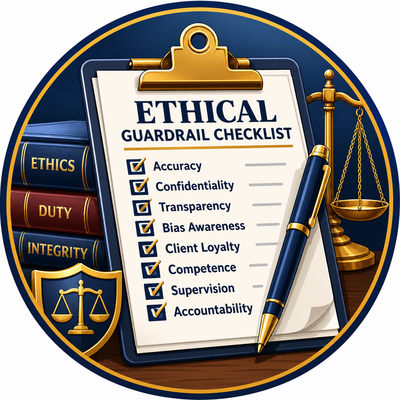
13.The eight-point ethical guardrail checklist
Articulate. From memory, name as many of the eight checks as you can.
- Data and tool: confidentiality, competence.
- Substance: grounding, verification, judgment.
- Court and record: candor, supervision, record.
Connect. Trust the list the way you already trust a checklist when the cost of forgetting is high.
Extend. Apply all eight to a piece of AI-assisted work you might produce next week, and find the weak box.
- Walk a real upcoming task through each of the eight checks.
- Circle the box most likely to be skipped under time pressure.
- Build one habit to catch that box. The others usually take care of themselves.
14.The do and do-not bright lines
Articulate. State one “do” and one “do not” you consider non-negotiable.
- Do: verify every citation in a real database before you cite it.
- Do not: paste privileged or client-identifying facts into a consumer tool.
- Do not: let the model make the client’s call or pick the strategy.
Connect. Trace each bright line back to the duty it protects.
Extend. Draft a two-line AI-use rule you could actually post in your office.
- Line one is what the office will always do: verify, and de-identify.
- Line two is what it will never do: file unread cites, or paste client data.
- Keep it short enough to post by the printer.
15.Document, review, and verify: the record that protects you
Articulate. Explain how a one-line file note answers a future question from a court or bar committee.
- Document: which tool, for which task, on what facts.
- Review: you read the full output as the responsible attorney.
- Verify: every authority confirmed against a real source.
Connect. See it as the same instinct behind the notes you already keep.
Extend. Write the single sentence you’d want in the file to show you supervised and verified an AI-assisted draft.
- Name the tool and the task in plain terms.
- State that the facts were de-identified before use.
- State that you reviewed the output and verified every authority.
16.The fit test: can you supervise and verify it?
Articulate. Restate the one question that decides whether AI belongs on a task.
- Ask yourself: can I supervise and verify this output?
- If yes, it may fit: first drafts, summaries, brainstorming.
- If no, it doesn’t: unchecked final authority, privileged facts, strategy.
Connect. Watch the test sort two real tasks from your own week.
Extend. Take a task you assumed AI couldn’t help with, and test whether de-identifying or grounding it changes the answer.
- Try de-identifying the facts. Does the confidentiality barrier drop?
- Try grounding it in a statute. Does the accuracy barrier drop?
- If both barriers fall and you can still verify, it may fit after all.
17.The closing habit: “Draft with the tool. Decide as the lawyer.”
Articulate. Say the one habit you’ll keep, and why “verify every citation” is the whole session in a sentence.
- “Draft with the tool, decide as the lawyer.”
- The tool proposes, and you dispose.
- One habit above all: open the source and verify the cite, every time.
Connect. Return to the habit you named at the start and test whether it held.
Extend. Commit to the first real, de-identified matter where you’ll run TCDLAi plus the checklist.
- Pick the matter and the task this week.
- De-identify the facts before anything touches a tool.
- Name the one thing you’ll verify first.