Inside: 10 sections of teacher guidance and reusable student forms, with Texas ELAR TEKS, local text approval, Reciprocal Teaching, optional Jigsaw, and an Aesop practice reading.
21-page PDF: cover + 10 instructional sections + two optional organizers. Use the kit section numbers in the footer to find handouts; a section may span more than one PDF page.
LITERATURE CIRCLES / TEACHER • QUICK START
Launch literature circles
Clear the reading → Form groups → Schedule meetings
Grades 5–12 · Small groups, shared reading, student-led meaning making.
Start tomorrow: Clear the practice text (p. 2), copy pp. 5–9, form groups of four, and run the 45-minute launch on p. 4. No devices or purchased books are required for the practice lesson.
What makes it a literature circle?
Students read a common text within their group, bring their own questions, and build interpretations together. Offer choices from locally approved readings when possible. Different groups may read different texts, or the same text. Roles support conversation; everyone reads and interprets the whole assigned section.
Before students arrive
Choose one reading goal and its TEKS (p. 3). Example: explain how choices reveal a theme, using two details.
Provide one text per reader, pencils, timer, group folder, and accessible versions. Copy all pages within teacher sections 1–4 and 10 once; sections 5 and 8 once per group; sections 6, 7, and 9 once per student.
Group 3–5 readers by interest and access needs. Avoid permanent ability labels. Seat groups so everyone can see one another; reserve a conference spot.
Set reading chunks at meaningful breaks, meeting dates, in-class reading time, and an absence plan. Check access before assigning home reading.
Model a short discussion, then collect each student's own response. Coach groups while students lead.
Your instructional toolkit
Teacher sections
Student and group copies
1 Launch checklist 2 Text selection and approval 3 TEKS planning map 4 Schedule and facilitation 10 Assessment, troubleshooting, sources
5 Group agreement and reading calendar 6 Individual reading preparation 7 Rotating roles and talk moves 8 Meeting agenda and record 9 Practice reading and independent response
Make learning visible
Learning intention: We are learning to build and revise interpretations together. Success criteria: I bring a question, explain relevant text evidence, respond to a peer, and identify how my thinking changed. Share these before every meeting; use p. 10 to give one specific next step.
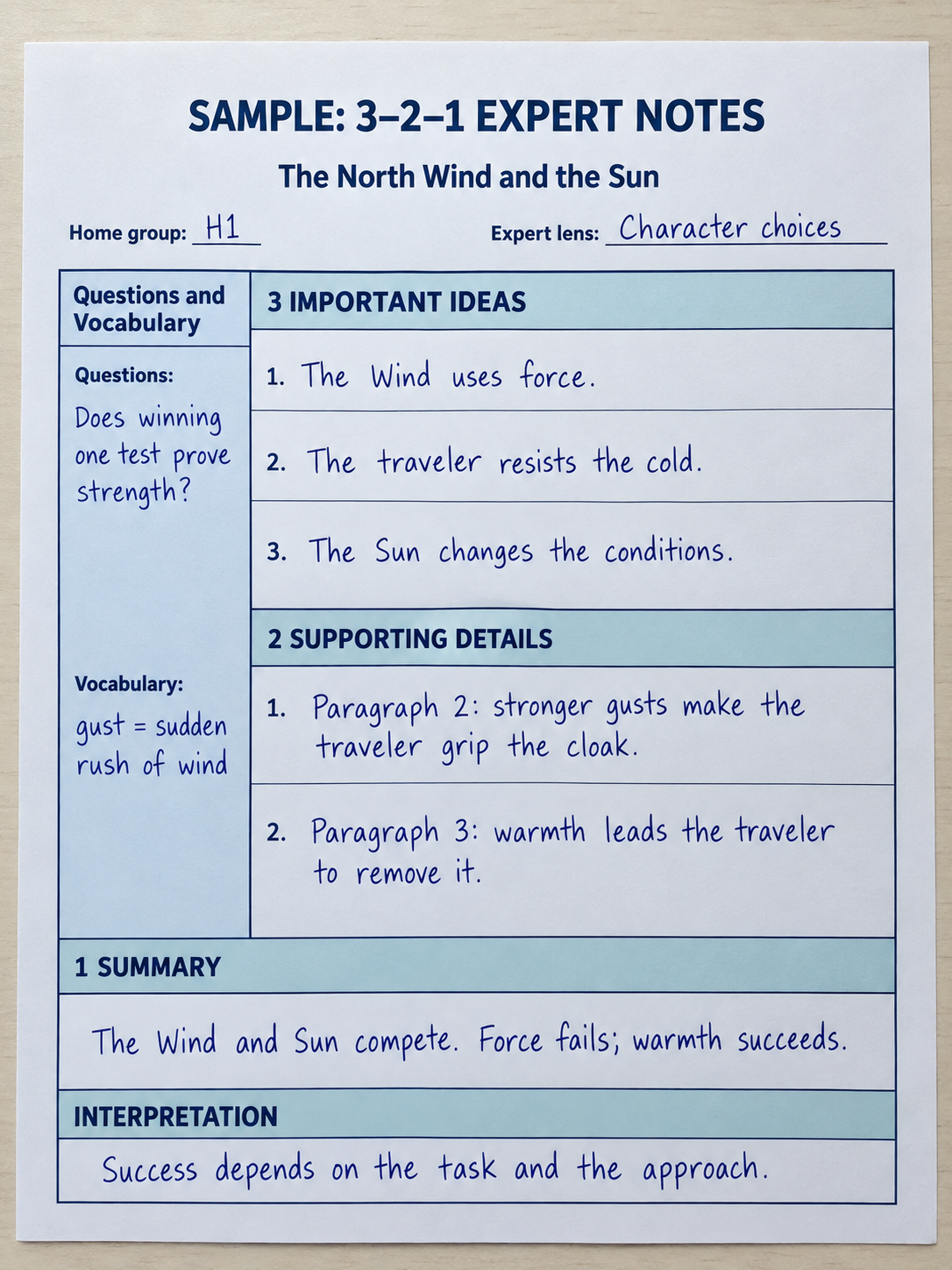
Completed sample: 3–2–1 expert notes on character choices in the Aesop fable.Read the sample notes
Text: The North Wind and the Sun. Lens: Character choices.
The Wind uses force.
The traveler resists the cold.
The Sun changes the conditions.
Two details: In paragraph 2, stronger gusts make the traveler grip the cloak. In paragraph 3, warmth leads the traveler to remove it.
Summary: The Wind and Sun compete. Force fails; warmth succeeds.
Interpretation: Success depends on the task and the approach.
Question: Does winning one test prove strength? Vocabulary: gust means a sudden rush of wind.
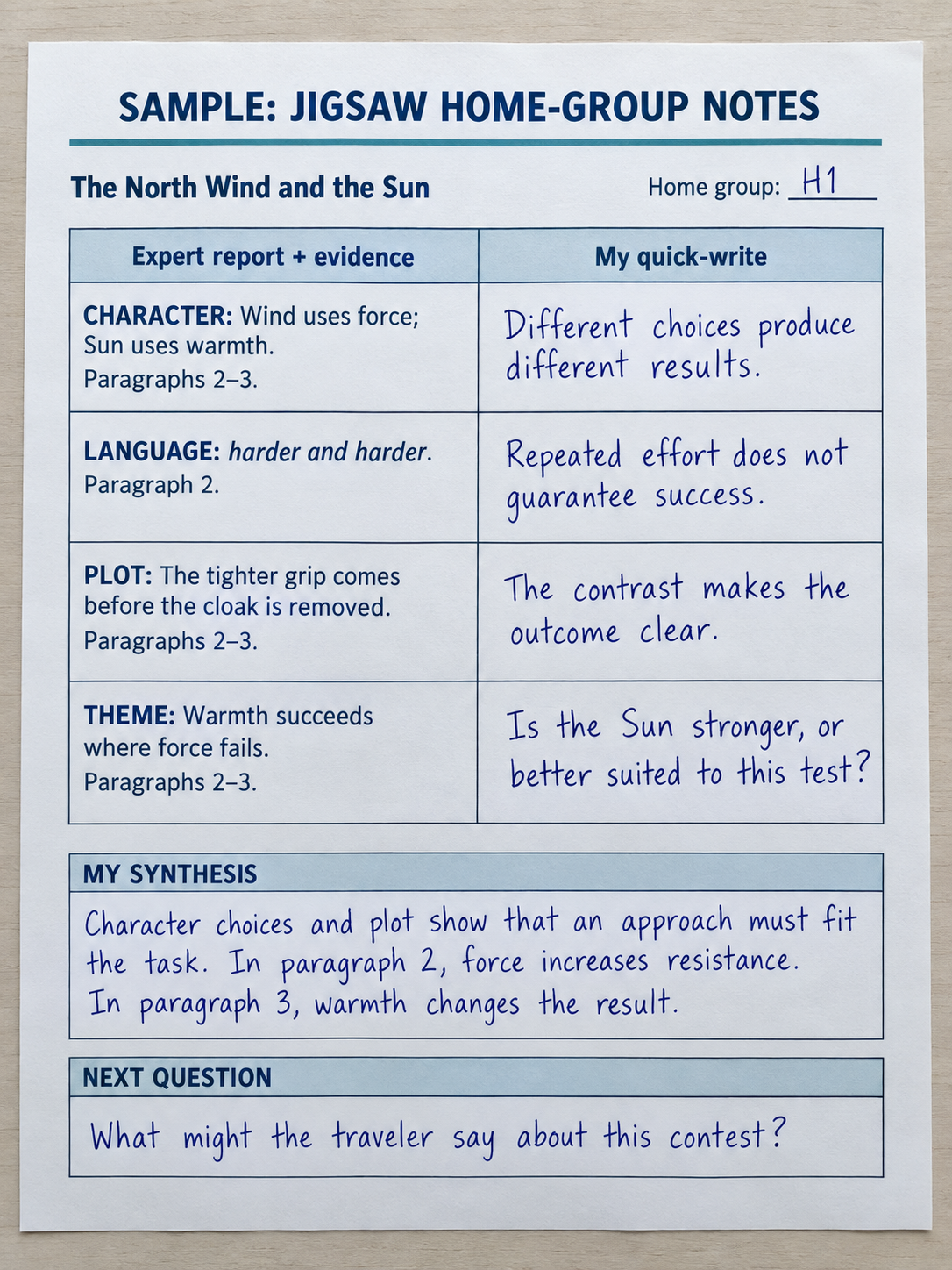
Completed sample: Home-group Jigsaw reports and synthesis for the Aesop fable.Read the sample notes
Character: Wind uses force; Sun uses warmth (paragraphs 2–3). Different choices produce different results.
Language: “harder and harder” (paragraph 2). Repeated effort does not guarantee success.
Plot: The tighter grip comes before the cloak is removed (paragraphs 2–3). The contrast makes the outcome clear.
Theme: Warmth succeeds where force fails (paragraphs 2–3). Is the Sun stronger, or better suited to this test?
Synthesis: Character choices and plot show that an approach must fit the task. In paragraph 2, force increases resistance. In paragraph 3, warmth changes the result.
Next question: What might the traveler say about this contest?
LITERATURE CIRCLES / TEACHER • TEXT APPROVAL
Choose and clear the reading
Preview the exact text → Confirm access and approval → Plan the calendar
Screen the exact edition or excerpt
Read the selection fully. Check developmental fit, complexity, cultural context, stereotypes or dated language, sensitive content, curriculum purpose, and discussion potential. Confirm legal copies and accessibility for every reader. Record any required approval and an equivalent alternate reading before offering choices. Consult your librarian or curriculum lead when status is uncertain.
Text / suggested band
Why consider it / preview first
Aesop, “The North Wind and the Sun” 5–12: launch practice
Short, low-barrier fable; choices, power, persuasion. Older readers critique the moral and whose viewpoint is missing. Retelling on p. 9.
Frances Hodgson Burnett, The Secret Garden (1911) 5–7: selected chapters or novel
Character change and belonging; preview colonial attitudes, racist language, disability portrayal, and death.
Louisa May Alcott, Little Women (1868–69) 7–9: selected chapters or novel
Family, ambition, conflict; preview gender expectations, religious references, illness, and death.
O. Henry, “The Gift of the Magi” (1905) 7–10: short story
Irony and sacrifice; preview dated vocabulary, poverty, and Christmas context.
Frederick Douglass, Narrative of the Life of Frederick Douglass (1845) 9–12: selected chapters
Literacy, voice, and freedom; plan context and support for accounts of enslavement, violence, and racist language.
Original publication dates are shown above. Obtain the selected edition and accessible copies before launch. A locally approved contemporary text or nonfiction reading may replace any candidate.
Our locally approved menu — complete before launch
Title / author / edition / section
Approval source, reviewer, date
Copies, access, alternate
Instructional purpose / family communication required and completed: _____________________ ____________________________________________________________________________
LITERATURE CIRCLES / TEACHER • TEXAS ELAR
Plan from the TEKS
Use the row for the enrolled grade/course, select a narrow target, and collect the evidence shown below. Codes refer to subsection (b) of the cited rule.
4(B,F,I); 5(C,D): interpretive commentary and summary
6(A): theme; cross-cultural comparison
English III · §110.38
1(D): purposeful ideas; evaluate teamwork
4(B,F,I); 5(C,D): analytic commentary and summary
6(A): relationships among literary elements
English IV · §110.39
1(D): purposeful ideas; evaluate teamwork
4(B,F,I); 5(C,D): evaluative commentary and summary
6(A): relationships among literary elements
Match the target to observable evidence
Collaboration: p. 5 responsibilities + p. 8 agenda; teacher records a student's response to a peer.
Comprehension: p. 6 question, supported inference, and repair strategy; predictions must be revisited.
Response: p. 9 individual claim, evidence, and explanation; p. 8 accurate group summary.
Literary analysis: extend p. 9 using the chosen grade/course focus. Add a second approved text for an across-text target; extend the lesson with additional readings as needed.
For nonfiction: retain collaboration/comprehension/response targets; replace the literary focus with your course's informational or argumentative-text expectation. High school alignment follows course enrollment, not grade number alone.
My target code: __________________ Learning intention: _____________________________ Evidence I will collect: __________________________________________________________
Verified September 16, 2026 against TEA Chapter 110, Subchapters A–C. Official links and research sources are on p. 10.
LITERATURE CIRCLES / TEACHER • FACILITATION
Run the launch and the cycle
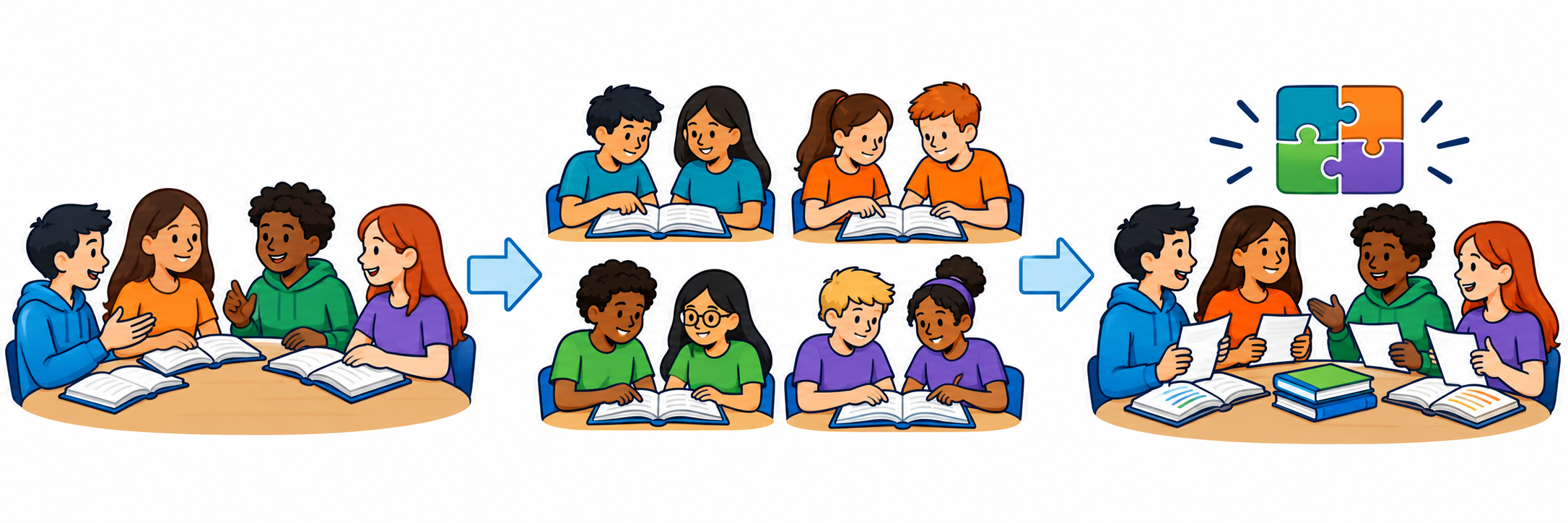
Home group → Expert groups → Return home and connect ideas
First meeting: 45 minutes with the p. 9 fable
Time
Teacher and student actions
0–5
State the goal and success criteria (p. 1). Explain norms and show a text-supported response.
5–12
Read p. 9; pause before paragraph 3 to predict. Students reread and begin p. 6.
12–18
Model question → clarification → evidence → summary. Think aloud about revising a prediction. Invite two students to respond.
18–23
Groups complete p. 5 and assign p. 7 roles. Each student prepares a question and evidence.
23–40
Students run p. 8's 17-minute agenda. Visit two groups; note evidence and coach one talk move.
40–45
Each student completes p. 9's exit response. Give a next step and set the next reading deadline.
Reusable two-week cycle: five 45-minute lessons
Model and practice; offer the approved reading menu and form groups.
Read chunk 1 in class (20 minutes), prepare (8 minutes), and meet (17 minutes).
Repeat for chunk 2; conference with different groups.
Repeat for chunk 3; use optional Jigsaw when it supports the reading goal.
Finish reading, meet, write an individual synthesis, and reflect.
For novels, repeat lessons 2–4 until the text is finished; enter actual dates and sections on p. 5.
Reciprocal Teaching: a comprehension scaffold
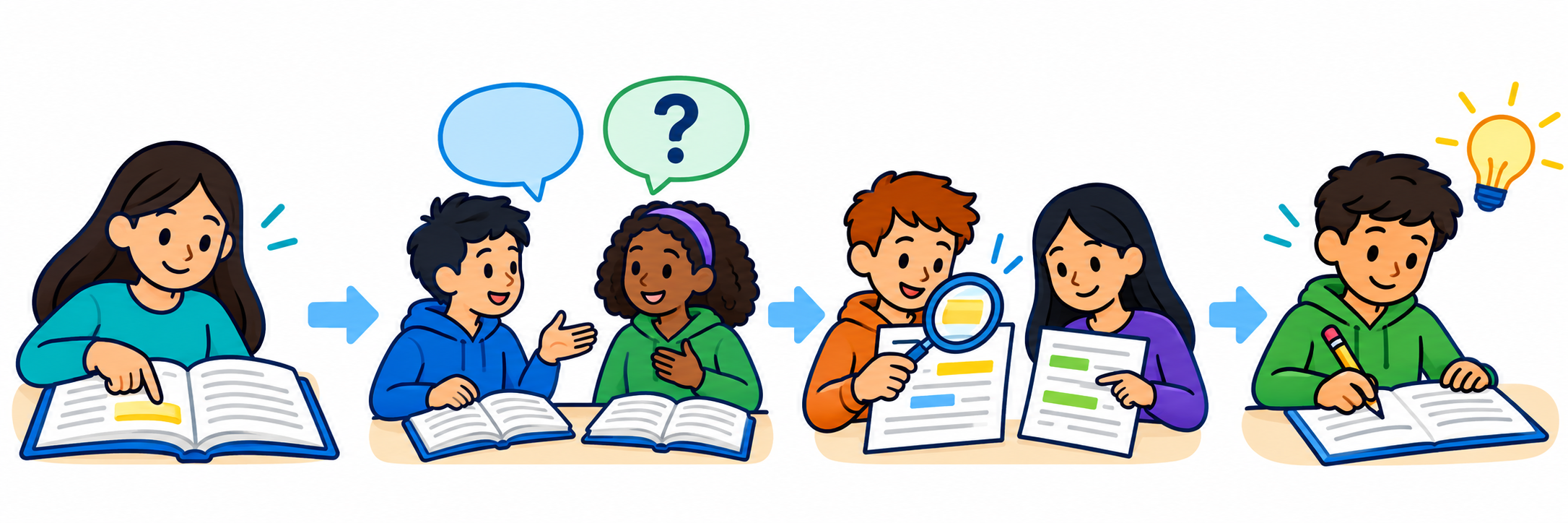
Explicitly model predicting, questioning, clarifying, and summarizing; guide practice, then transfer leadership. Rotate leadership at a section break or next meeting. Each student uses all four strategies on p. 6; p. 7 assigns who starts each move. Predict before reading the next section, then confirm or revise. Use clarification when meaning breaks down. Let students' questions drive interpretation after the comprehension check.
Optional Jigsaw: deepen, then return to the circle
Begin after everyone has read the selection and groups can talk productively.
Assign lenses: Give each home-group member character choices, language, plot, or theme.
Expert groups · 6 minutes: Meet with readers assigned the same lens. Use Appendix A to find two details and agree on an explanation. Check accuracy with the teacher.
Home groups · 8 minutes: Each expert teaches while peers question and record reports and quick-writes on Appendix B.
Individual synthesis · 3 minutes: Each student explains how two lenses connect.
Substitute this 17-minute block for one meeting. With three readers combine plot/theme; with five add point of view.
Jigsaw should enrich shared reading. Avoid dividing unread novel chapters among experts: every reader needs the story context. Fade role sheets as students independently use the strategies; keep preparation and individual evidence.
Completed sample: Home-group Jigsaw reports and synthesis for the Aesop fable.Read the sample notes
Character: Wind uses force; Sun uses warmth (paragraphs 2–3). Different choices produce different results.
Language: “harder and harder” (paragraph 2). Repeated effort does not guarantee success.
Plot: The tighter grip comes before the cloak is removed (paragraphs 2–3). The contrast makes the outcome clear.
Theme: Warmth succeeds where force fails (paragraphs 2–3). Is the Sun stronger, or better suited to this test?
Synthesis: Character choices and plot show that an approach must fit the task. In paragraph 2, force increases resistance. In paragraph 3, warmth changes the result.
Next question: What might the traveler say about this contest?
LITERATURE CIRCLES / GROUP HANDOUT • KEEP IN FOLDER
Our circle agreement and calendar
Group: __________________________ Class / period: __________ Date: ______________ Text / author / edition: __________________________________________________________ Our learning goal: _____________________________________________________________
Agree before you begin
Check each agreement together. Add one norm your group needs.
☐ We read the whole assigned section and bring p. 6, our text, and a pencil.
☐ We invite every member, allow thinking time, and listen without interrupting.
☐ We discuss the text and ideas respectfully. Nobody must share personal experiences.
☐ We give page/paragraph evidence and consider more than one interpretation.
☐ We stay within the assigned section to avoid spoilers and finish with a next step.
☐ We ask the teacher for help when our agreed repair steps do not work.
Reading and meeting calendar — confirm with teacher
Meeting date
Read through (chapter/pages/paragraphs)
In-class reading time / next leader
If someone is absent or behind
The folder stays at: ____________________ Our catch-up time is: ____________________ The teacher provides the reading and notes. A returning reader reviews p. 8 and prepares a question. A reader who is behind uses a short reread with support before joining; peers do not complete that reader's work. Reassign an absent member's job temporarily.
We agree (initials): __________________________ Teacher check: ____________________
LITERATURE CIRCLES / INDIVIDUAL HANDOUT • COPY EACH CYCLE
Everyone prepares. Read the entire assigned section. Write brief notes below; your job does not limit your thinking. Use chapter/page or paragraph numbers from your edition.
1 · Predict, then revisit
Before reading or at a stopping point: What might happen or develop? What clue supports it?
After reading: My prediction was confirmed / revised because…
2 · Ask an open question
Ask about a choice, conflict, idea, or author's craft. It should invite explanation and allow more than one reasonable interpretation. “Why might…?” or “How does…?”
3 · Clarify a difficulty
Confusing word, passage, or idea + location: _________________________________________ Repair used: ☐ reread ☐ context clues ☐ glossary/resource ☐ ask for help Now I understand… / I still need help with…
4 · Summarize the essentials
In 2–3 sentences, explain the key events or ideas accurately and in order. Keep your opinion separate.
5 · Bring two details and an interpretation
Location + short quotation or accurate paraphrase
What it suggests / why it matters
My first idea about the theme, central idea, or author's choice: __________________________ ____________________________________________________________________________
Ready check: ☐ Reading completed ☐ Question ready ☐ Evidence located ☐ Support requested if needed
LITERATURE CIRCLES / STUDENT HANDOUT • ROLE AND TALK GUIDE
Rotate leadership; share the thinking
Locate a passage → Ask and clarify → Compare evidence → Summarize
Assign who starts each move. Everyone may question, clarify, summarize, predict, and interpret. Rotate jobs one position each meeting. With three members combine Summarizer and Predictor; with five add an Evidence Tracker to note locations on p. 8.
Job
What to do
Try saying…
Questioner / facilitator
Open with the learning goal. Invite each reader's question; help select one worth exploring. Invite quieter voices and watch time.
“Which question will help us understand this section?” “Would you like to add, read your note, or pass for now?”
Clarifier
Invite difficulties. Lead a reread; use context or a resource. Check whether the explanation fits the passage.
“Where did meaning break down?” “Let's reread before and after that line.”
Summarizer / recorder
Give a brief accurate section summary. After discussion, record the group's interpretation, evidence, disagreement, and next step on p. 8.
“The essential events or ideas are…” “We agree on… but still differ about…”
Predictor / timekeeper
Revisit earlier predictions. Use a clue to predict the next section before reading it. Announce agenda transitions and confirm the deadline.
“Our earlier prediction changed because…” “This clue makes me expect…”
Talk moves that build an interpretation
Locate: “In paragraph/page ___, the text says/shows…”
Explain: “That matters because…”
Build: “Adding to your idea, another detail is…”
Test: “Does that explanation fit this other passage?”
Disagree respectfully: “I read it differently because…”
Revise: “I first thought… Now I think… because…”
When the conversation stalls
Pause for 30 seconds of writing. Reread one short passage. Invite a question from each reader. Choose one question and compare two possible answers using the text. If disagreement continues, record both supported views; you do not have to force consensus.
Roles are temporary scaffolds. When your group uses these moves without reminders, ask the teacher to use a shared agenda instead of assigned roles. Keep the same reading and evidence expectations.
My job this meeting: __________________ Next meeting: ____________________________ One talk move I will practice: ___________________________________________________
Completed sample: 3–2–1 expert notes on character choices in the Aesop fable.Read the sample notes
Text: The North Wind and the Sun. Lens: Character choices.
The Wind uses force.
The traveler resists the cold.
The Sun changes the conditions.
Two details: In paragraph 2, stronger gusts make the traveler grip the cloak. In paragraph 3, warmth leads the traveler to remove it.
Summary: The Wind and Sun compete. Force fails; warmth succeeds.
Interpretation: Success depends on the task and the approach.
Question: Does winning one test prove strength? Vocabulary: gust means a sudden rush of wind.
LITERATURE CIRCLES / GROUP HANDOUT • COPY EACH MEETING
Meeting agenda and group record
Bring evidence → Invite questions → Build an interpretation → Record next steps
Check materials and goal. Give the short summary; revisit an earlier prediction.
2–5
Invite every reader's question or difficulty. Clarify by rereading and select a focus question.
5–12
Explore that question. Each reader contributes evidence or responds to a peer; compare interpretations. Include anyone who passed earlier.
12–15
Record a supported interpretation and an unresolved question. Predict the next section if there is one; otherwise identify a new question.
15–17
Self-check; set reading deadline and rotate jobs. Return the folder; write the individual exit response as directed.
Our focus question
What we now think and what supports it
Interpretation / explanation
Two text locations and supporting details
A different supported view or unresolved question:
Participation and next steps
Members who contributed evidence or responded to an idea (initials): ___________________ How we invited others / support we need: __________________________________________ Next prediction + clue OR new question: ____________________________________________ Read through: __________________ Due: __________ Next job rotation: ________________
Group check: ☐ We used evidence ☐ We considered another view ☐ We know our next step One improvement for next time: __________________________________________________
This record supports reflection. The teacher assesses each student's understanding using individual work and observation.
LITERATURE CIRCLES / STUDENT HANDOUT • READING AND EXIT RESPONSE
Practice with a public-domain fable
Read closely → Test an interpretation → Explain evidence → Write your response
An original classroom retelling of Aesop's public-domain fable, based on The Aesop for Children (1919). Paragraph numbers support evidence citations.
1. The North Wind and the Sun argued about which of them was stronger. As they argued, a traveler appeared on the road, wrapped in a cloak. They agreed on a test: whoever could make the traveler remove the cloak would win.
2. The North Wind went first. He blew a cold blast toward the traveler. The traveler pulled the cloak tightly around his body. The Wind blew harder and harder, but each gust made the traveler hold on more firmly. At last the Wind stopped.
Pause: What might the Sun do? Write a prediction and clue on p. 6 before continuing.
3. The Sun began to shine gently. The traveler loosened the cloak as the air grew warmer. Then the Sun shone more brightly. Feeling hot, the traveler took off the cloak. The Sun had won the test.
Vocabulary: cloak = loose outer garment; gust = sudden strong rush of wind. Discussion invitation: What does this contest suggest about influence? Does winning this test prove who is stronger?
Choose the teacher-assigned challenge
Grades 5–6: Compare the characters' actions; propose two possible lessons supported by details.
7–8: Explain how the sequence of events develops a theme and test another interpretation.
9–10: Analyze characterization and contrast; question the contest's definition of strength.
11–12: Evaluate how viewpoint, plot, and characterization shape the message; consider the traveler's missing perspective. Transfer these skills to the class reading.
Independent exit response — after discussion
Make a claim answering your challenge. Use two paragraph references and explain how each detail supports your claim. Include an alternative interpretation or a limitation when appropriate.
My thinking changed / became clearer because… (identify a peer idea or passage)
Self-check: ☐ Clear claim ☐ Two details + locations ☐ Explanation ☐ Reflection My next step: __________________________________________________________________
LITERATURE CIRCLES / TEACHER • FEEDBACK AND SOURCES
Assess, adjust, and keep going
Use a brief individual evidence check
Use pp. 6 and 9 plus your observations. For each dimension mark 2 = independent and accurate; 1 = partial or needs prompting; 0 = not yet shown. Reassess after feedback. Adapt scoring to local policy; do not substitute a group score for individual understanding.
Dimension
Evidence for a 2
Preparation / comprehension
Accurate summary, meaningful question, and a useful clarification or prediction revision.
Interpretation / evidence
Defensible claim; two relevant details with locations; explanation connects details to the claim.
Collaboration
Builds on or tests a peer's idea respectfully; helps others participate using the agreed norms.
Reflection / transfer
Identifies what clarified or changed thinking and chooses a specific next step.
Feedback example: “You located two details. Next, explain why the traveler's tighter grip challenges the Wind's idea of strength.” Practice response: Gentle influence can work where force fails: in ¶2 stronger gusts make the traveler grip the cloak; in ¶3 warmth leads him to remove it. Another reading is that success depends on the task, not absolute strength. Accept different supported claims; do not require one moral.
Common problems → practical repairs
Unfinished reading: provide supported in-class catch-up and adjust chunk size.
One voice dominates: use a brief round, then open discussion.
Silence: silent notes, partner rehearsal, then reread.
Unsupported opinions: ask for a location and explanation.
Confusion: model one repair strategy and check again.
Off-task conflict: restate the norm; conference or regroup when needed.
Access: honor IEP/504 and language supports. Offer audio with text, larger print, vocabulary preview, bilingual notes, speech-to-text or an oral exit response. Keep the interpretive goal. Do not equate speech volume or speed with understanding. After two meetings, review student evidence and revise supports, pacing, or grouping.
Sources, scope, and reuse
Official TEKS: TEA Chapter 110 (tea.texas.gov → Laws and Rules → Chapter 110), Subchapter A, B, and C; verified Sept. 16, 2026. Fable source: Project Gutenberg #19994, The Aesop for Children (1919), public domain in the USA. Strategy references: Visible Learning MetaX, Reciprocal teaching and Jigsaw method (visiblelearningmetax.com → Influences).
Name: _________________________ Date: __________ Home group: _________________ Text / section: __________________________ Expert lens (if used): ____________________
Read the whole section first. Write or draw three important ideas, two supporting details with locations, and one summary in your own words. Record questions and vocabulary alongside your notes. Use this instead of p. 6 when your teacher assigns it, or to prepare for an expert group.
Questions
What needs clarification? What could the group explore?
3 · Important ideas
Character choices, conflicts, themes, or central ideas.
1.
2.
3.
Vocabulary
Word + location + meaning or clue. Mark anything still uncertain.
2 · Supporting details
Short quote or accurate paraphrase + page/paragraph + what it shows.
1.
2.
1 · Summary in my own words
State the key events or ideas accurately and in order. Keep interpretation separate.
Bring to the circle: Star one idea worth discussing and one detail that supports it. My interpretation: These details suggest __________________________________________ After discussion: My thinking changed / became clearer because ______________________
Completed sample: 3–2–1 expert notes on character choices in the Aesop fable.Read the sample notes
Text: The North Wind and the Sun. Lens: Character choices.
The Wind uses force.
The traveler resists the cold.
The Sun changes the conditions.
Two details: In paragraph 2, stronger gusts make the traveler grip the cloak. In paragraph 3, warmth leads the traveler to remove it.
Summary: The Wind and Sun compete. Force fails; warmth succeeds.
Interpretation: Success depends on the task and the approach.
Question: Does winning one test prove strength? Vocabulary: gust means a sudden rush of wind.
LITERATURE CIRCLES / STUDENT ORGANIZER B
Jigsaw notes and quick-write
Learn with experts → Teach your home group → Write your own synthesis
Name: _________________________ Date: __________ Home group: _________________ Text / section: __________________________ My expert lens: _________________________
Expert group: Prepare Organizer A for your assigned lens. Compare evidence and check your explanation with the teacher. Home group: Each expert teaches; everyone listens, asks a question, and records the rows below. Quick-write: After each report, write or sketch how that lens deepens your interpretation. Prioritize ideas over spelling.
Expert lens + notes from the report Include an idea and its text location.
My quick-write / question Connect the report to the text or another lens.
1 · Lens: __________________________
How does this help explain the reading?
2 · Lens: __________________________
What connects to or challenges an earlier idea?
3 · Lens: __________________________
What does this add to our interpretation?
4 · Lens: __________________________
What question or alternative view remains?
Four rows allow notes from your own lens and three others. With five readers, combine related lenses in a row or continue on the back. Use character choices, language, plot, theme, or point of view; for nonfiction use central idea, structure, evidence, and author's perspective.
Independent synthesis — connect at least two lenses
My interpretation is… Two lenses connect because… The supporting text locations are…
Check: ☐ I can explain another lens ☐ I used text evidence ☐ I wrote my own synthesis Next step / unresolved question: __________________________________________________
Completed sample: Home-group Jigsaw reports and synthesis for the Aesop fable.Read the sample notes
Character: Wind uses force; Sun uses warmth (paragraphs 2–3). Different choices produce different results.
Language: “harder and harder” (paragraph 2). Repeated effort does not guarantee success.
Plot: The tighter grip comes before the cloak is removed (paragraphs 2–3). The contrast makes the outcome clear.
Theme: Warmth succeeds where force fails (paragraphs 2–3). Is the Sun stronger, or better suited to this test?
Synthesis: Character choices and plot show that an approach must fit the task. In paragraph 2, force increases resistance. In paragraph 3, warmth changes the result.
Next question: What might the traveler say about this contest?