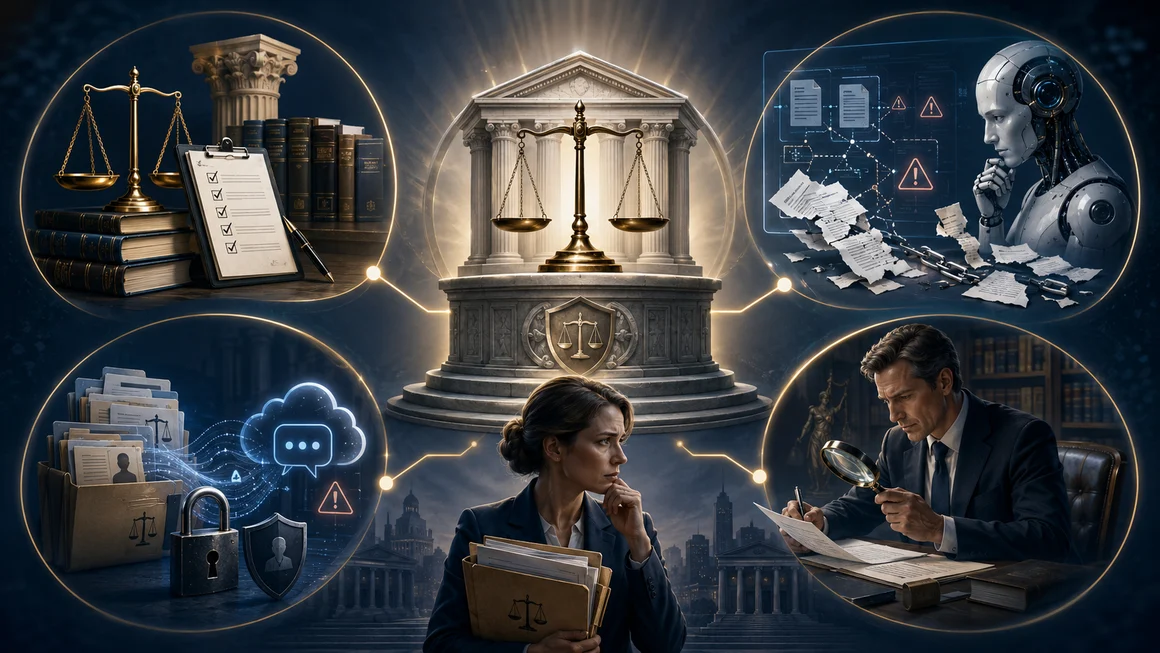
We start with ethics because everything else stands on it. Before a single prompt, the question is not what the tool can do. The question is what your duties require.
In the next twenty minutes we cover four things. The duties that already govern this, the way AI fabricates case law, the confidentiality trap in consumer tools, and why the output never replaces your judgment.
Keep your own hardest matter in the back of your mind as we go. You will see where each of these lands for real work.
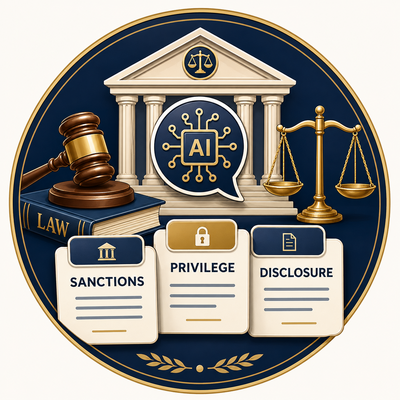
Courts have already sanctioned this
Both failures we just covered have played out in real courtrooms. Lawyers have been fined, referred to discipline, and publicly named for briefs built on citations an AI invented, and judges have begun ruling on how client data is handled in these tools.
⚖️Real sanctions
Fines and disciplinary referrals for fabricated case law that reached a filing.
🔒Privilege rulings
Decisions that turn on how confidential client data was exposed to a tool.
📰Ongoing coverage
A running list you can keep watching well after today.
See the cases. The AI in the Courts reference on the resources page collects the sanctions, rulings, and coverage behind everything in this segment.
Before we turn to judgment, look at why this matters so much. Nothing we just covered is theoretical. Around the country, lawyers have been sanctioned for filing briefs that rested on cases the AI invented, and courts have started ruling on how client data was handled inside these tools. The list is real, and it keeps growing.
I have gathered the sanctions, the privilege rulings, and the news coverage in one place, called AI in the Courts, on the resources page. When you have a few minutes after today, open it. It is the fastest way to see that the duties we just walked through are being enforced right now, not someday.
Hold that in mind as we turn to the one thing the tool can never do for you.

Draw an ethics dilemma and talk it through
Turn to two or three people near you. Pull one fictional AI-ethics dilemma from the Legal Ethics Scenario Randomizer, work it as a table, then we hear a few out loud.
Draw
One person opens the randomizer and taps Draw. Read the situation and the big question to your table.
Think, then discuss
A silent minute for a first reaction, then work the guiding questions together. Name the Texas rule in play.
Share
Land on one "We will" or "We will not" rule you would adopt, ready to report to the room.
Open it now. Legal Ethics Scenario Randomizer, on the resources page at go.mgpd.org/tcdla26.
Let us put this to work before we talk about judgment. Find two or three people near you, because this one is a conversation, not a solo task.
On the resources page there is a tool called the Legal Ethics Scenario Randomizer. One person at your table opens it and taps Draw. It hands you a short, fictional AI-ethics dilemma from defense practice, tied to a specific duty. Read the situation and the big question out loud.
Take a quiet minute first so everyone forms their own view, then talk through the guiding questions together and name the rule in play as you go. You have five to seven minutes. Before we come back, land your table on one sentence, a we will or a we will not that you would actually adopt, and I will ask two or three tables to share theirs. Go ahead and draw.

What holds true before any prompt
- Your existing duties already reach AI-assisted work
- Competence now includes the tools you choose to use
- Every AI citation is a lead to verify, not an authority
- Keep client data out of tools that may retain or train on it
- Responsibility stays with you and only you
If AI is this prone to error, why use it at all. Because with structure and grounding, you can cut the risk sharply. That is segment two.
Let us gather the segment. Five things hold true before you type a single prompt. Your duties already reach this work. Competence now includes the tools. Every citation is a lead, not an authority. Client data stays out of tools that may keep it. And responsibility is yours alone.
That might sound like a case for avoiding AI entirely. It is not. Here is the honest bridge. If the tool is this prone to error when used carelessly, the answer is to stop using it carelessly. With structure and with grounding in real sources, you can cut the risk sharply and still get real value.
That is exactly what we build next, starting with a framework made for this audience.