The moment a definition stops working
Ask a class what evaporation is and most hands go up. Ask what happens to a puddle on a cool, cloudy day instead of a hot one, and the room goes quiet. The vocabulary was never the problem. The thinking underneath it was.
That gap shows up in every elementary science classroom, and it is easy to miss during a unit, because recall is fast and looks like understanding. A student who has memorized a definition can answer a recall question in two seconds. The same student stalls the moment a question changes one condition, because a definition is a fixed sentence and the question is asking for a relationship.
The move that closes the gap is not more vocabulary practice. It is asking students to explain a relationship out loud, connect it to evidence they can point at, and then push it into a situation they have not seen. That takes a minute, not a unit, and it can happen inside the lesson you were already teaching.
Word for word, a definition is a place to start. It is a poor place to stop.
What the SST actually changes for elementary science
Beginning in 2027–2028, the Student Success Tool replaces STAAR. Grades three through eight take beginning-, middle-, and end-of-year assessments rather than a single spring test. The beginning- and middle-of-year checkpoints are adaptive; the end-of-year assessment is static, which is why its questions can be released. Results are expected back within two business days of the testing window closing.
For an elementary science teacher, three things in the draft blueprints matter more than the calendar:
- Four strands organize the questions — Matter and Energy; Force, Motion, and Energy; Earth and Space; and Organisms and Environments. These are the same strand families your curriculum already uses.
- Question formats widen — multiple choice, multiselect, multipart, and inline choice. A multipart item can ask for a claim and then, in the same question, the evidence behind it.
- Stimulus-based clusters appear — a diagram, a data table, or an investigation description, followed by questions that only make sense if the student reads it. This is the shift that rewards teaching reasoning over teaching recall.
None of that requires a new curriculum. It requires students who are used to explaining what they see. The faster results arrive, the more useful it is to already know what a given student can do — which is the point of a routine you run all year rather than a review packet you run in April.
The area page carries a full timeline and the four draft TEKS maps, one per subject: From STAAR to SST. The primary source is TEA’s House Bill 8 student assessment page, and the draft blueprints are published there.
Use ACE during instruction
ACE is three questions that fit almost any science investigation. It takes less than a minute to explain, and it works during a lab, after a demonstration, in a science notebook, or on the way out the door.
Articulate
What happened? Explain it in your own words.
Connect
How does the evidence connect to the science concept?
Extend
What would happen if one condition changed?
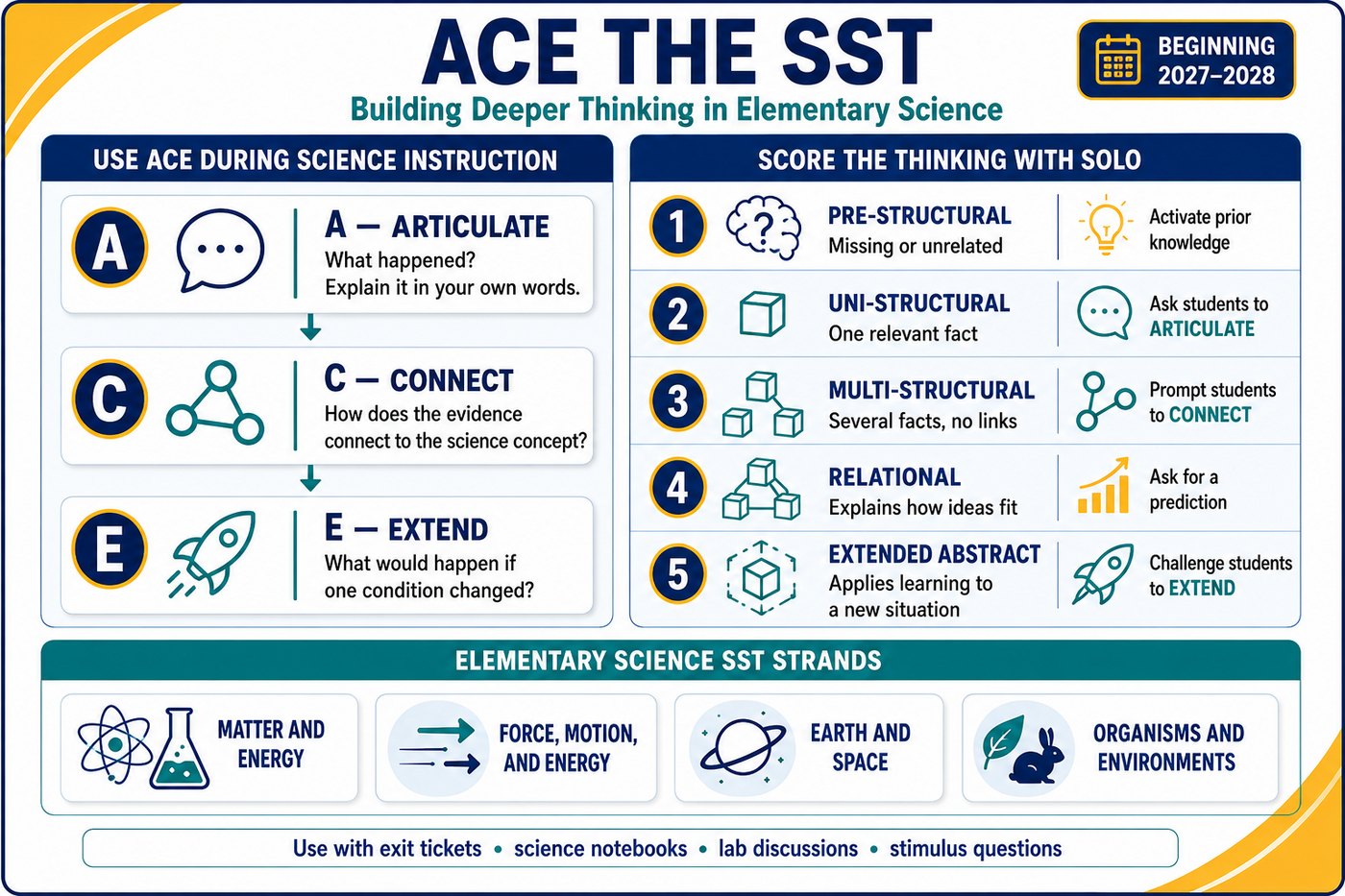
A — Articulate
Articulate asks for a plain-language account of what happened, before any technical term is required. The purpose is not to lower the bar. It is to find out whether the student has a mental picture at all, because a student who cannot describe the event will not be able to explain it either. Listen for sequence and for cause, and resist supplying the vocabulary too early — the word is more useful once there is something for it to name.
This is where multilingual learners often show far more understanding than a vocabulary check suggests. Home-language explanation, a drawing, or a gesture toward the setup all count as articulation. Ask for the science word after the idea is on the table, not before.
C — Connect
Connect is the step most often skipped, and it is the one the SST stimulus clusters ask for directly. The student has to tie what they observed to the underlying concept, and say what in the evidence supports it. The useful follow-up is always the same four words: how do you know? A student who says the water disappeared has described. A student who says the water evaporated because the Sun warmed it and the puddle shrank all morning has connected.
Connect is also where misconceptions surface in a form you can actually teach. “It went into the ground” is a claim with evidence behind it, and it is much easier to work with than silence.
E — Extend
Extend changes one condition and asks what follows. Cooler day. Deeper water. A lid on the container. Twice the distance. It is the cheapest way to find out whether a student holds a relationship or a sentence, and it is the closest thing on this page to what an end-of-year transfer item asks for.
Extend also protects against a quiet failure mode: a class that answers every question correctly all year and then meets an unfamiliar setup for the first time in May. If students have been extending since September, an unfamiliar setup is a normal Tuesday.
One ACE question in the right place beats three at the wrong moment. Early in a unit, Articulate alone is often the honest task. Late in a unit, go straight to Extend. The paired tickets are built this way on purpose: the entry ticket usually sits lower on the ladder than the exit ticket for the same phenomenon.
Score the thinking with SOLO
Once students are talking, the question becomes what to do next. A simple SOLO scoring guide turns a response into a decision. It describes the complexity of what a student showed you — not the student.
| Score | Evidence of learning | Next move |
|---|---|---|
| 1: Pre-structural | Response is missing or unrelated | Activate prior knowledge |
| 2: Uni-structural | Identifies one relevant fact | Ask the student to Articulate |
| 3: Multi-structural | Lists several facts without linking them | Prompt the student to Connect |
| 4: Relational | Explains how evidence and ideas fit together | Ask for a prediction |
| 5: Extended abstract | Applies the concept to a new situation | Challenge the student to Extend |
Two cautions worth keeping. First, the level describes the response, not the child — the same student can produce a level two answer on Monday and a level four on Thursday, and that is information about the task as much as about the learner. Second, a level three response is not a failure. Listing several facts is genuine progress from listing one; the next move is simply to ask how they fit together.
The column that matters most is the last one. A score with no next move is bookkeeping.
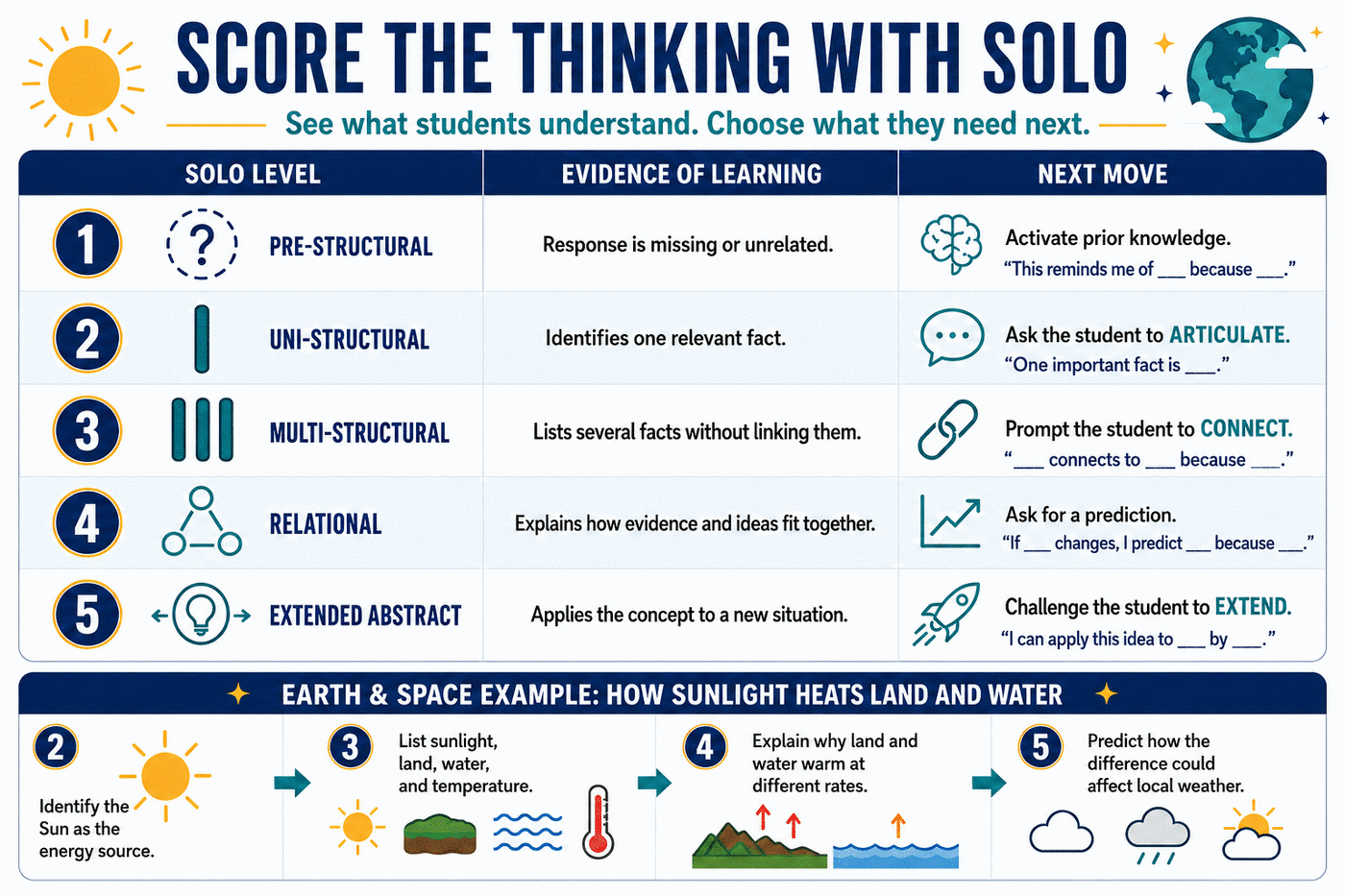
A worked example: sunlight, land, and water
Consider an Earth and Space question about how sunlight heats land and water. The same phenomenon produces recognizably different responses, and each one points at a different next move.
- 2“The Sun gives energy.”One relevant fact, correctly identified. The student has a piece. Ask them to describe what the Sun’s energy does to the land and to the water — that is Articulate.
- 3“There is sunlight, land, water, and temperature.”Several facts, sitting side by side without a relationship. Prompt for Connect: which one changes which, and how do you know from the data?
- 4“The land warms faster than the water because water takes more energy to heat up.”A relationship, explained. Now ask for a prediction: what would the graph look like after sunset?
- 5“Since the land cools faster at night, the air over the water stays warmer, so the breeze changes direction.”The concept applied to a situation nobody taught. Challenge them to Extend again — what happens on a cloudy day?
Notice that no response in that ladder is wrong. Each one is a different distance along the same path, and the guide tells you where to push next rather than what to mark.
Where the tickets fit in a week
SST preparation should not become a fresh stack of test-prep packets. The tickets are designed to disappear into instruction you already run. One rhythm that works:
Short stimulus questions belong in that rotation too. A data table on the board, one Connect question, and three minutes of talk does more for stimulus-cluster readiness than a worksheet of released items — and it costs less instructional time.
Two practical notes. Keep the entry and exit responses together so the comparison is possible at all; a notebook page folded in half is enough. And read a sample rather than the whole set. Ten responses sorted by level tell you what to do tomorrow, and they take five minutes.
How to use the ticket bank
The tool on this site holds 28 paired tickets across grades 3–5 and all four SST science strands, each written for a specific phenomenon rather than a vocabulary list.
- Filter by grade and by strand to find the ticket that matches tomorrow’s lesson, or press New ticket for a random one.
- Switch between entry and exit. Each ticket is a pair on the same phenomenon: the entry version asks what students bring, the exit version asks what they can now explain.
- Flip to the teacher view for the look-for — what a strong response contains — and the SOLO scoring buttons.
- Copy, download, or print. Copy pastes the ticket into a slide or a document; download saves a plain text file; print produces a clean sheet with the interface stripped out.
- Seven languages. The picker at the top translates the interface and the tickets themselves, so a Spanish-speaking or Vietnamese-speaking student reads the same prompt as everyone else.
Nothing is stored. There is no login, no student name field, and no server: responses live on paper or in the conversation, which is where they are most useful anyway.
What this is, and what it is not
This is an independent classroom resource, written by a teacher for teachers, and aligned to the draft SST elementary science blueprint and the currently assessed curriculum.
- It is not an official or approved SST assessment, and it does not reproduce SST items. Every phenomenon here was written for these tickets.
- The BOY / MOY / EOY framing is a local instructional approach for readiness. It is not a TEA requirement.
- TEKS codes shown on the tickets indicate the content each phenomenon belongs to. Confirm against your district curriculum before you plan from them.
- Scoring a response is formative. A SOLO level is a teaching decision, not a grade, and it does not belong in a gradebook.
Try a single ACE science exit ticket, sort the responses into the five levels, and use what you find to plan tomorrow’s first five minutes. That is the whole method. Everything else on this site is scaffolding for that one habit.