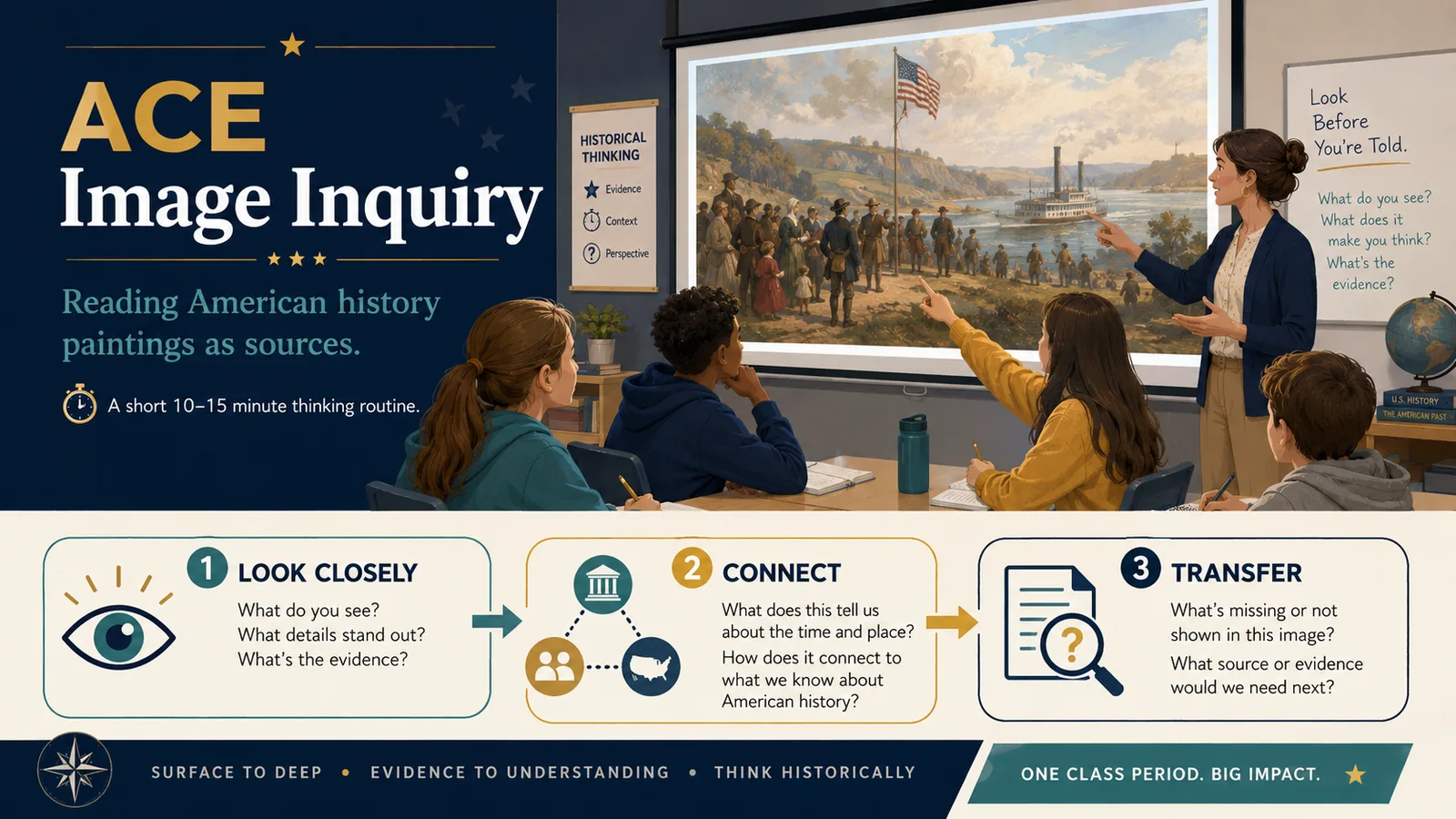
ACE Image Inquiry — reading American history paintings as sources
A short (10–15 minute) thinking routine that turns a single painting into a piece of historical evidence. Students look before they are told, connect what they see to context, and then transfer — naming what the image leaves out and what source they would need next. It is the same surface → deep → transfer spine as the PBL units, run in one class period.
ACE = Articulate → Connect → Extend
ACE maps directly onto surface → deep → transfer. Students articulate what is visible before any lecture (surface), connect that visual evidence to historical context once the title and date are revealed (deep), then extend to a new source or question (transfer). Do the steps in order — naming the missing source only means something after students have looked closely and connected carefully.
Look before you're told
Describe only what is visible — no backstory yet. "List eight things you notice. What is happening here?"
Tie evidence to context
Reveal title, artist, date. "What event, era, or issue does this connect to? What visual evidence supports that? Whose point of view is this?"
Think like a historian
"What does this painting leave out? What source would you need next to understand the event more fairly?"
The routine, step by step
① Articulate It — 8 observations (3–4 min)
Project the image with no title and no backstory. Ask students to silently list eight things they notice — objects, people, colors, where the eye goes first. Then share out. Accept only what is visible; push back gently on interpretation ("How do you know?").
Student stems: "I notice…" · "The first thing my eye goes to is…" · "The artist makes ___ look important by…"
② Connect It — evidence to context (4–5 min)
Now reveal the title, artist, and date. Ask what event, era, issue, or course topic the painting connects to — and to point at the visual evidence for each claim. Name the point of view: who made this, when, and why might they have shown it this way?
Student stems: "This connects to ___ because…" · "One detail that supports this is…" · "The artist's point of view may be…"
③ Extend It — the historian's move (3–4 min)
Ask what the painting leaves out and what source they would need next. This is the transfer move — a painting is a made thing, with a maker and a purpose, and understanding the event fairly means going past it. Watch this line most closely on the exit ticket.
Student stems: "A source I would need next is…" · "This painting leaves out…" · "A question this raises is…"
The exit ticket (3 lines)
Quick rubric
| Level | What it looks like |
|---|---|
| Surface | Lists details from the image but does not say why they matter. |
| Developing | Connects details to a historical topic with some evidence. |
| Strong | Makes a claim, supports it with visual evidence, and names what the image leaves out or what source is needed next. |
Run it tomorrow
Open with Norman Rockwell's The Problem We All Live With — no backstory. Students list eight observations. Reveal the title, the artist, and that the child is Ruby Bridges walking into a newly desegregated New Orleans school in 1960. Connect it to civil rights, Brown v. Board, and school desegregation. Then ask: "What source would you need next to understand this event more fairly?" — and looking at a painting becomes building an investigation.
Teacher supports: UDL · ELPS · PBL facilitation guide (7 languages)
Aligned to (not reproduced from) 19 TAC Ch.113 §113.41 & §113.44; effect sizes from Visible Learning MetaX. The ACE routine (Articulate → Connect → Extend) mirrors the ACE Powered Jigsaw Organizer and the slow-looking tradition. Images are linked to their hosting museum or collection — none are reproduced here.